Department of Pathophysiology, Ivano-Frankivsk National Medical University, Ivano-Frankivs'k, Ukraine.
Department of Rheumatology, Immunology and Internal Medicine, University Hospital in Kraków, Kraków, Poland.
J Korean Med Sci. 2024 Oct 14;39(39):e299. doi: 10.3346/jkms.2024.39.e299.
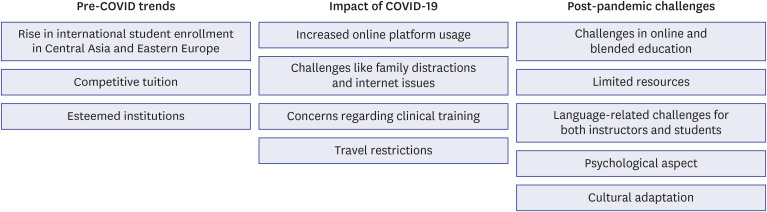
Prior to the coronavirus disease 2019 (COVID-19) pandemic, Central Asia and Eastern Europe saw a significant rise in international medical student enrollment, driven by competitive tuition fees, prestigious institutions, and culturally diverse environments. The pandemic forced a rapid shift to online learning, disrupting student mobility and compromising clinical training quality. Online education for international medical students during the COVID-19 pandemic has proven beneficial, though low- and middle-income countries struggled with access to information infrastructure and resources. While 64% of students preferred online learning, challenges like limited internet access and lack of in-person interaction persisted, making a blended approach of online and traditional methods most effective. Despite a rebound in post-pandemic enrollment, persistent challenges such as linguistic obstacles, psychological stress, and cultural adaptation issues remain. Active research engagement during undergraduate studies is essential for skill development. Integrating research into education curricula and fostering motivation are crucial for enhancing academic outcomes. Critical thinking and cultural competence are vital, necessitating explicit instruction and collaborative learning strategies. Addressing language barriers through comprehensive support systems for both instructors and students is imperative. Tailored strategies and robust institutional support are essential to enhancing the educational experiences and success of international medical students.
在 2019 年冠状病毒病(COVID-19)大流行之前,中亚和东欧地区国际医学生入学人数显著增加,这得益于有竞争力的学费、享有声望的院校和文化多元的环境。大流行迫使人们迅速转向在线学习,扰乱了学生的流动性并降低了临床培训质量。在 COVID-19 大流行期间,国际医学生的在线教育已被证明是有益的,尽管中低收入国家在信息基础设施和资源方面存在困难。尽管 64%的学生更喜欢在线学习,但仍存在一些挑战,如网络访问受限和缺乏面对面互动,因此,混合使用在线和传统方法效果最佳。尽管大流行后入学人数有所反弹,但仍存在语言障碍、心理压力和文化适应问题等持续挑战。在本科阶段积极参与研究对于培养技能至关重要。将研究纳入教育课程并激发学习动机对于提高学业成绩至关重要。批判性思维和文化能力至关重要,需要进行明确的指导和协作学习策略。通过为教师和学生提供全面的支持系统来解决语言障碍至关重要。制定有针对性的策略和提供强有力的机构支持对于增强国际医学生的教育体验和成功至关重要。