Wei Yinling, Wen Hongyan, Yang Lian, Zhang Bodou, Li Xiaoyu, Li Sheng, Dong Jing, Liang Zhenzhen, Zhang Yu
State Key Laboratory of Phytochemistry and Plant Resources in West China, Kunming Institute of Botany, Chinese Academy of Sciences, Kunming, 650201, China.
University of Chinese Academy of Sciences, Beijing, 100049, China.
Nat Prod Bioprospect. 2024 Oct 15;14(1):57. doi: 10.1007/s13659-024-00479-3.
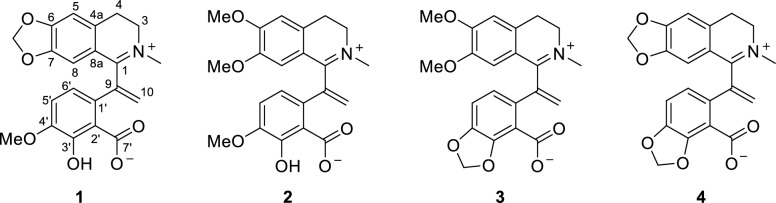
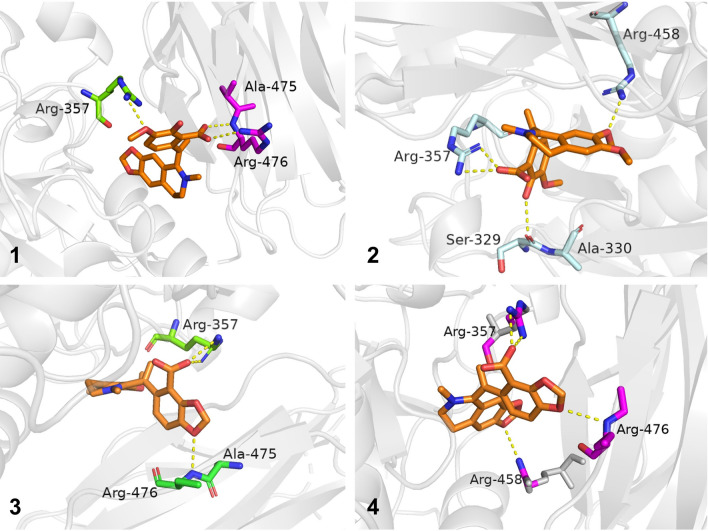
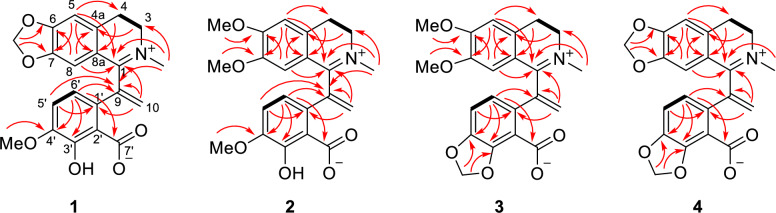
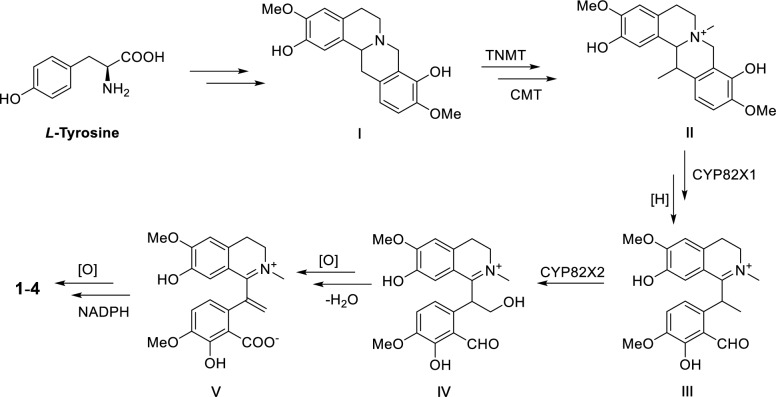
Four new isoquinoline alkaloids, hypecotumines A-D (1-4), were isolated and identified from the whole herbs of Hypecoum erectum L. Their structures were determined by a combination of HRESIMS, NMR, and X-ray diffraction analysis methods. Compounds 1-4 were characterized by a terminal double bond at C-9 and their plausible biosynthetic pathway was hypothesized. Since PCSK9 plays a key role in the development of cardiovascular disease (CVD), exploration of PCSK inhibitors from natural products are beneficial for drug discovery of CVD treatment. SPR and Western blot assays showed compound 4 had PCSK9 inhibition activity with K value of 59.9 µM and thus elevated the LDLR level. Further molecular docking studies demonstrated that 4 and PCSK9 could form stable interactions via key hydrogen bonds.
从直立黄堇全草中分离并鉴定出四种新的异喹啉生物碱,即紫堇曲胺A-D(1-4)。通过高分辨电喷雾电离质谱(HRESIMS)、核磁共振(NMR)和X射线衍射分析方法相结合确定了它们的结构。化合物1-4的特征在于C-9位有一个末端双键,并推测了其可能的生物合成途径。由于前蛋白转化酶枯草溶菌素9(PCSK9)在心血管疾病(CVD)的发展中起关键作用,从天然产物中探索PCSK抑制剂有利于CVD治疗药物的发现。表面等离子体共振(SPR)和蛋白质免疫印迹分析表明化合物4具有PCSK9抑制活性,K值为59.9 μM,因此提高了低密度脂蛋白受体(LDLR)水平。进一步的分子对接研究表明,化合物4和PCSK9可以通过关键氢键形成稳定的相互作用。