Cognitive Architecture for Collaborative Technologies Unit, Italian Institute of Technology, Genoa, Italy.
Department of Medicine and Surgery, University of Parma, Parma, Italy.
Sci Rep. 2024 Oct 15;14(1):24164. doi: 10.1038/s41598-024-74232-8.
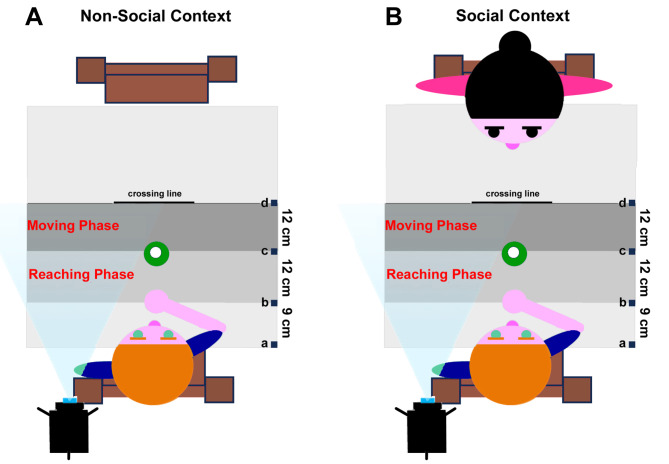
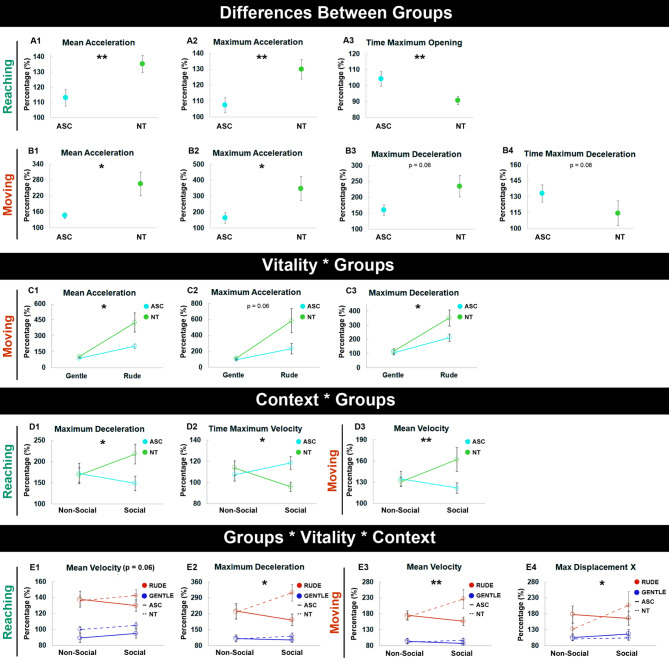
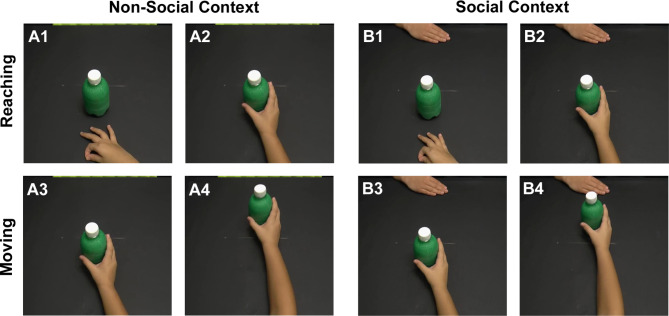
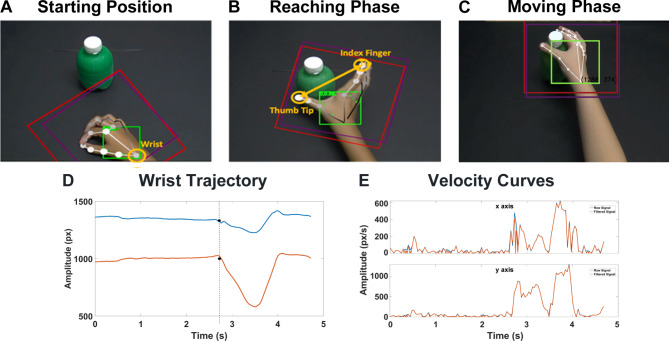
Vitality Forms (VFs) constitute the dynamic essence of human actions, providing insights into how individuals engage in activities. The ability to perceive and express VFs during interpersonal interactions is pivotal for understanding others' intentions, behaviors, and fostering effective social communication. Despite their ubiquity in all actions, research exploring the role of VFs in neurodivergent conditions related to social and communicative skills, particularly in autism, remains limited. This study aims to investigate the expression of different VFs during the execution of both social and non-social actions in children with an Autism Spectrum Condition (ASC) in comparison to neurotypical children (NT). ASC children and NT children were asked to move a small bottle either towards a target point (non-social context) or moving it towards a receiver (social context) with different VFs specifically neutral, gentle, or rude. Videotaped tasks were subsequently analyzed to study kinematic parameters characterizing VFs. Our results highlighted three main findings: (1) overall, ASC children are able to tune the motor profile of their actions, effectively conveying both gentle and rude VFs; (2) distinct kinematic parameters in the execution of VFs are able to distinguish autistic children from NT children; (3) the social context significantly influences the child's ability to express positive and negative VFs in autism. Taken together, these findings provide new insights to understand how VFs contribute to the complex dynamics of social communication in neurodivergent autistic children, providing a valuable contribution for future interventions and support strategies.
生命力形式(Vitality Forms,VFs)构成了人类行为的动态本质,深入了解了个体如何参与活动。在人际互动中感知和表达 VFs 的能力对于理解他人的意图、行为以及促进有效的社会交流至关重要。尽管 VFs 存在于所有行为中,但对于神经多样性条件下 VFs 的作用的研究,特别是在自闭症方面,仍然有限。本研究旨在探讨自闭症谱系障碍(Autism Spectrum Condition,ASC)儿童与神经典型儿童(Neurotypical children,NT)在执行社会和非社会动作时不同 VFs 的表达情况。要求 ASC 儿童和 NT 儿童将一个小瓶子分别向目标点移动(非社会情境)或向接收者移动(社会情境),并以不同的 VFs(中性、温和或粗鲁)进行移动。随后对视频记录的任务进行分析,以研究特征化 VFs 的运动学参数。我们的研究结果有三个主要发现:(1)总体而言,ASC 儿童能够调整其动作的运动特征,有效地传达温和和粗鲁的 VFs;(2)执行 VFs 时的独特运动学参数能够区分自闭症儿童和 NT 儿童;(3)社会情境显著影响自闭症儿童表达积极和消极 VFs 的能力。总之,这些发现为理解 VFs 如何为神经多样性自闭症儿童的复杂社会交流动态做出贡献提供了新的见解,为未来的干预和支持策略提供了有价值的贡献。