Department of Urology, Lausanne University Hospital, Lausanne, Switzerland.
Department of Urology, University Hospital of Bern, Inselspital, University of Bern, Bern, Switzerland.
Trials. 2024 Oct 15;25(1):682. doi: 10.1186/s13063-024-08526-7.
Urinary tract catheters, including Double-J or ureteral stents, are prone to bacterial colonization forming biofilms and leading to asymptomatic bacteriuria. In the context of asymptomatic bacteriuria, endourological procedures causing mucosa-inducing lesions can lead to severe infections. Antibiotic prophylaxis is warranted, yet its efficacy is limited by biofilm formation on stents. Biofilms promote antibiotic tolerance, the capacity of genetically susceptible bacteria to survive a normally lethal dose of antimicrobial therapy. The UROPOT study evaluates the effectiveness of a first-in-type metabolism-based aminoglycoside potentiation for (i) preventing infectious complications of asymptomatic bacteriuria during mucosa lesion-inducing endourological procedures and (ii) assessing its anti-tolerance efficacy.
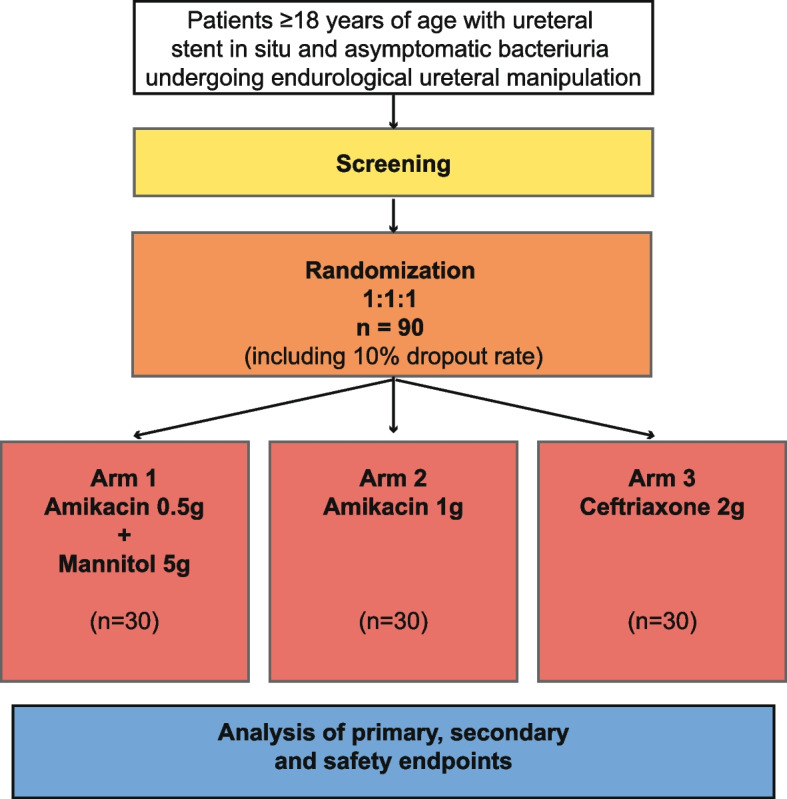
The UROPOT trial is a phase I/II single-center (Lausanne University Hospital (CHUV), Switzerland) randomized double-blinded trial. Over 2 years, patients with asymptomatic Escherichia coli and/or Klebsiella pneumoniae bacteriuria, undergoing endourological procedures, will be randomly allocated to one of three treatment arms (1:1:1 randomization ratio, 30 patients per group) to evaluate the efficacy of mannitol-potentiated low-dose amikacin compared to established standard treatments (ceftriaxone or amikacin standard dose). Patients will be recruited at the CHUV Urology Outpatient Clinic. The primary outcome is the comparative incidence of postoperative urinary tract infections (assessed at 48 h) between the investigational amikacin/mannitol therapy and standard (ceftriaxone or amikacin) antibiotic prophylaxis, defined by specific systemic symptoms and/or positive blood and/or urine culture. Secondary outcomes include assessing microbiological eradication through anti-biofilm activity, sustained microbiological eradication, and mannitol and antibiotics pharmacokinetics in blood and urine. Safety outcomes will evaluate the incidence of adverse events following amikacin/mannitol therapy and postoperative surgical complications at postoperative day 14.
UROPOT tests a novel antimicrobial strategy based on "metabolic potentiation" for prophylaxis enabling aminoglycoside dose reduction and targeting biofilm activity. The anti-biofilm effect may prove beneficial, particularly in patients who have a permanent stent in situ needing recurrent endourological manipulations strategies in preventing infections and achieving sustained microbiological eradication in pre-stented patients.
The protocol is approved by the local ethics committee (CER-VD, 2023-01369, protocole 2.0) and the Swiss Agency for Therapeutic Products (Swissmedic, 701,676) and is registered on the NIH's ClinicalTrials.gov (trial registration number: NCT05761405). Registered on March 07, 2023.
尿路导管,包括双 J 管或输尿管支架,容易发生细菌定植形成生物膜,并导致无症状菌尿。在无症状菌尿的情况下,引起黏膜诱导损伤的内镜下操作可能导致严重感染。需要进行抗生素预防,但由于支架上形成生物膜,其效果受到限制。生物膜促进抗生素耐药性,即具有遗传易感性的细菌在通常致命剂量的抗菌治疗下存活的能力。UROPOT 研究评估了一种首创的基于代谢的氨基糖苷类药物增效剂用于(i)预防黏膜损伤诱导的内镜下操作期间无症状菌尿的感染并发症,以及(ii)评估其抗耐药性效果。
UROPOT 试验是一项 I/II 期单中心(瑞士洛桑大学医院 (CHUV))随机双盲试验。在 2 年期间,接受内镜下操作的无症状大肠埃希菌和/或肺炎克雷伯菌菌尿症患者将被随机分配到三个治疗组之一(1:1:1 随机分组,每组 30 例患者),以评估甘露糖醇增强的低剂量阿米卡星与现有标准治疗(头孢曲松或阿米卡星标准剂量)的疗效。患者将在 CHUV 泌尿科门诊招募。主要结局是研究性阿米卡星/甘露糖醇治疗与标准(头孢曲松或阿米卡星)抗生素预防之间术后尿路感染(术后 48 小时评估)的发生率比较,通过特定的全身症状和/或阳性血和/或尿培养来定义。次要结局包括通过抗生物膜活性评估微生物学清除率、持续微生物学清除率以及甘露糖醇和抗生素在血液和尿液中的药代动力学。安全性结局将评估术后第 14 天接受阿米卡星/甘露糖醇治疗后的不良事件发生率和术后手术并发症。
UROPOT 测试了一种基于“代谢增强”的新型抗菌策略,用于预防,使氨基糖苷类药物剂量减少并针对生物膜活性。抗生物膜作用可能有益,特别是对于需要反复内镜下操作的原位永久性支架患者,有助于预防感染和实现预支架患者的持续微生物学清除。
该方案已获得当地伦理委员会(CER-VD,2023-01369,方案 2.0)和瑞士治疗产品管理局(Swissmedic,701,676)的批准,并在 NIH 的 ClinicalTrials.gov 上注册(试验注册编号:NCT05761405)。于 2023 年 3 月 7 日注册。