Catic Armin, Weinzierl Andrea, Heimer Jakob, Pompei Barbara, Harder Yves
Department of Plastic, Reconstructive and Aesthetic Surgery, Ospedale Regionale di Lugano, Ente Ospedaliero Cantonale (EOC), CH-6900 Lugano, Switzerland.
Faculty of Biomedical Sciences, Università della Svizzera Italiana (USI), CH-6900 Lugano, Switzerland.
J Clin Med. 2024 Sep 28;13(19):5803. doi: 10.3390/jcm13195803.
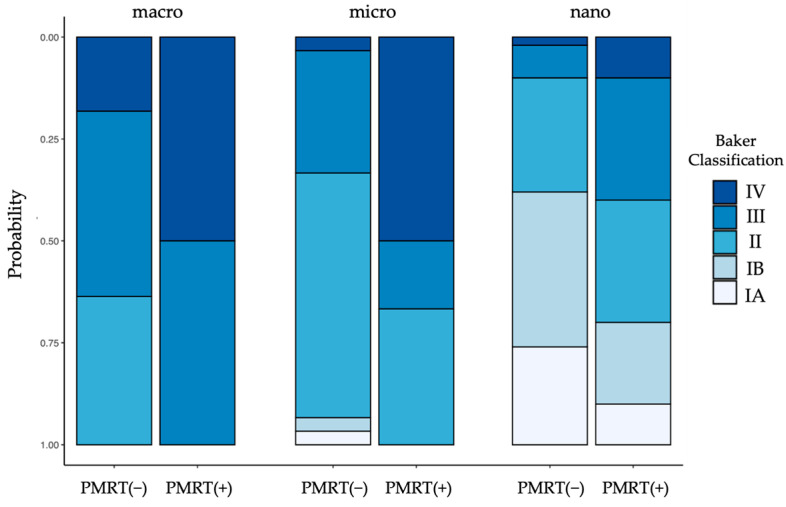
Continuous research on breast implant-associated anaplastic large cell lymphoma (BIA-ALCL) has introduced a focus on surface texturizations and a shift towards smooth breast devices, yet outcomes comparing the complication profiles of differently textured tissue expanders (TEs) remain conflicting. The study aim was to compare the complication profile of a new nanotextured and MRI-compatible TE to micro- and macrotextured TEs and to identify possible predictors for complications. A retrospective analysis of women undergoing expander-based breast reconstruction after mastectomy between January 2016 and March 2022 was conducted. The primary endpoint was the development of capsular contracture. Possible predictors were analyzed in a mixed-effects model using the least absolute shrinkage and selection operator (LASSO). Moreover, a comparison of complications and an evaluation of predictors were carried out. A total of 147 breasts, encompassing 82 nanotextured, 43 microtextured and 22 macrotextured TEs, were analyzed. Breasts with nanotextured TEs were less likely to develop capsular contracture overall (OR, 0.12; 95%CI 0.05-0.28, < 0.001). Post-mastectomy radiotherapy (PMRT) was identified as a predictor for capsular contracture (OR, 4.67; 95%CI 1.86-11.71, < 0.001). Breasts with nanotextured TEs showed a higher rate of seroma, but lower rates of malposition and pain. Predictors for developing postoperative complications included higher mastectomy weight ( = 0.008). Breasts with nanotextured TEs exhibited the lowest rate of capsular contracture compared to micro- and macrotextured TEs. Together with its MRI-compatibility and improved oncologic follow-up, the nanotextured TE seems to be a favorable device for expander-based breast reconstruction.
对乳房植入物相关间变性大细胞淋巴瘤(BIA-ALCL)的持续研究使人们将重点放在了表面纹理化上,并促使乳房植入设备朝着光滑型转变,然而,比较不同纹理组织扩张器(TEs)并发症情况的研究结果仍存在矛盾。本研究的目的是比较一种新型纳米纹理且兼容MRI的TE与微纹理和宏纹理TE的并发症情况,并确定并发症的可能预测因素。对2016年1月至2022年3月间接受乳房切除术后基于扩张器的乳房重建的女性进行了回顾性分析。主要终点是包膜挛缩的发生情况。使用最小绝对收缩和选择算子(LASSO)在混合效应模型中分析可能的预测因素。此外,还对并发症进行了比较并对预测因素进行了评估。共分析了147个乳房,其中包括82个纳米纹理TE、43个微纹理TE和22个宏纹理TE。总体而言,使用纳米纹理TE的乳房发生包膜挛缩的可能性较小(OR,0.12;95%CI 0.05 - 0.28,<0.001)。乳房切除术后放疗(PMRT)被确定为包膜挛缩的一个预测因素(OR,4.67;95%CI 1.86 - 11.71,<0.001)。使用纳米纹理TE的乳房血清肿发生率较高,但位置异常和疼痛发生率较低。术后并发症发生的预测因素包括乳房切除重量较大(P = 0.008)。与微纹理和宏纹理TE相比,使用纳米纹理TE的乳房包膜挛缩发生率最低。连同其MRI兼容性和改善的肿瘤学随访情况,纳米纹理TE似乎是基于扩张器的乳房重建的一种理想设备。