
COVID-19 期间细胞因子趋势的前瞻性变化:从发病到结局的递进方法。
Prospective Variation of Cytokine Trends during COVID-19: A Progressive Approach from Disease Onset until Outcome.
机构信息
Programa de Pós-Graduação em Ciências da Saúde (PPGCS), Escola de Medicina, Pontifícia Universidade Católica do Paraná (PUCPR), Curitiba 80215-901, PR, Brazil.
出版信息
Int J Mol Sci. 2024 Oct 1;25(19):10578. doi: 10.3390/ijms251910578.
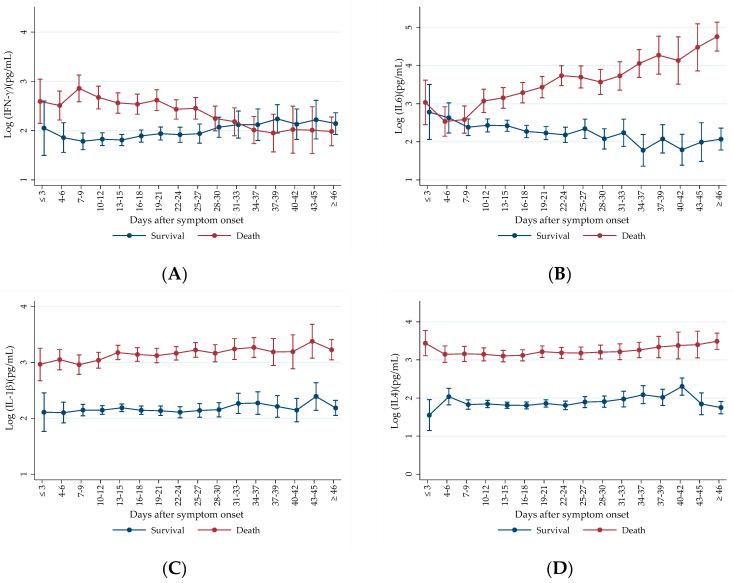
COVID-19 is characterized by pronounced hypercytokinemia. The cytokine switch, marked by an imbalance between pro-inflammatory and anti-inflammatory cytokines, emerged as a focal point of investigation throughout the COVID-19 pandemic. However, the kinetics and temporal dynamics of cytokine release remain contradictory, making the development of new therapeutics difficult, especially in severe cases. This study collected serum samples from SARS-CoV-2 infected patients at 72 h intervals and monitored them for various cytokines at each timepoint until hospital discharge or death. Cytokine levels were analyzed based on time since symptom onset and patient outcomes. All cytokines studied prospectively were strong predictors of mortality, particularly IL-4 (AUC = 0.98) and IL-1β (AUC = 0.96). First-timepoint evaluations showed elevated cytokine levels in the mortality group ( < 0.001). Interestingly, IFN-γ levels decreased over time in the death group but increased in the survival group. Patients who died exhibited sustained levels of IL-1β and IL-4 and increased IL-6 levels over time. These findings suggest cytokine elevation is crucial in predicting COVID-19 mortality. The dynamic interplay between IFN-γ and IL-4 highlights the balance between Th1/Th2 immune responses and underscores IFN-γ as a powerful indicator of immune dysregulation throughout the infection.
COVID-19 的特征是明显的细胞因子血症。细胞因子转换,以促炎细胞因子和抗炎细胞因子之间的失衡为标志,成为整个 COVID-19 大流行期间的研究焦点。然而,细胞因子释放的动力学和时间动态仍然存在矛盾,使得新疗法的开发变得困难,尤其是在严重的情况下。本研究在 72 小时的间隔内从 SARS-CoV-2 感染患者收集血清样本,并在每个时间点监测各种细胞因子,直到患者出院或死亡。根据症状出现后的时间和患者的结果分析细胞因子水平。所有前瞻性研究的细胞因子都是死亡率的强预测因子,尤其是 IL-4(AUC = 0.98)和 IL-1β(AUC = 0.96)。首次评估显示,死亡组的细胞因子水平升高(<0.001)。有趣的是,死亡组的 IFN-γ水平随时间降低,但存活组的 IFN-γ水平增加。死亡患者的 IL-1β和 IL-4 水平持续升高,IL-6 水平随时间升高。这些发现表明细胞因子升高是预测 COVID-19 死亡率的关键。IFN-γ 和 IL-4 之间的动态相互作用突出了 Th1/Th2 免疫反应之间的平衡,并强调 IFN-γ 是整个感染过程中免疫失调的有力指标。


 Zotero 插件