Department of Food Science and Biotechnology, College of BioNano Technology, Gachon University, Seongnam-si 13120, Republic of Korea.
Magicbullettherapeutics Inc., 150 Yeongdeungpo-ro, Yeongdeungpo-gu, Seoul 07292, Republic of Korea.
Int J Mol Sci. 2024 Oct 3;25(19):10642. doi: 10.3390/ijms251910642.
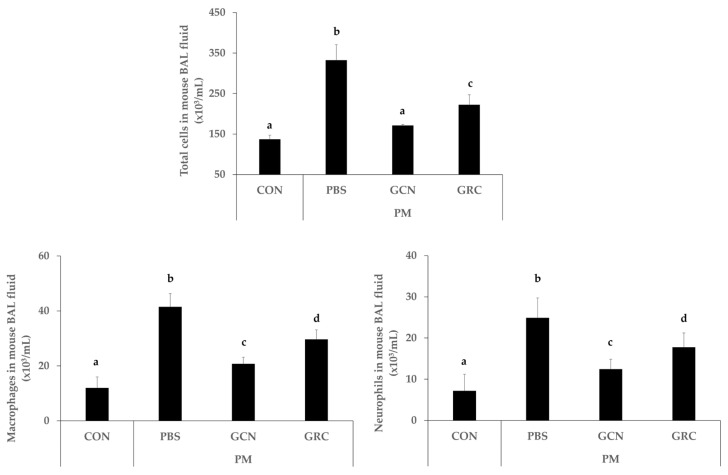
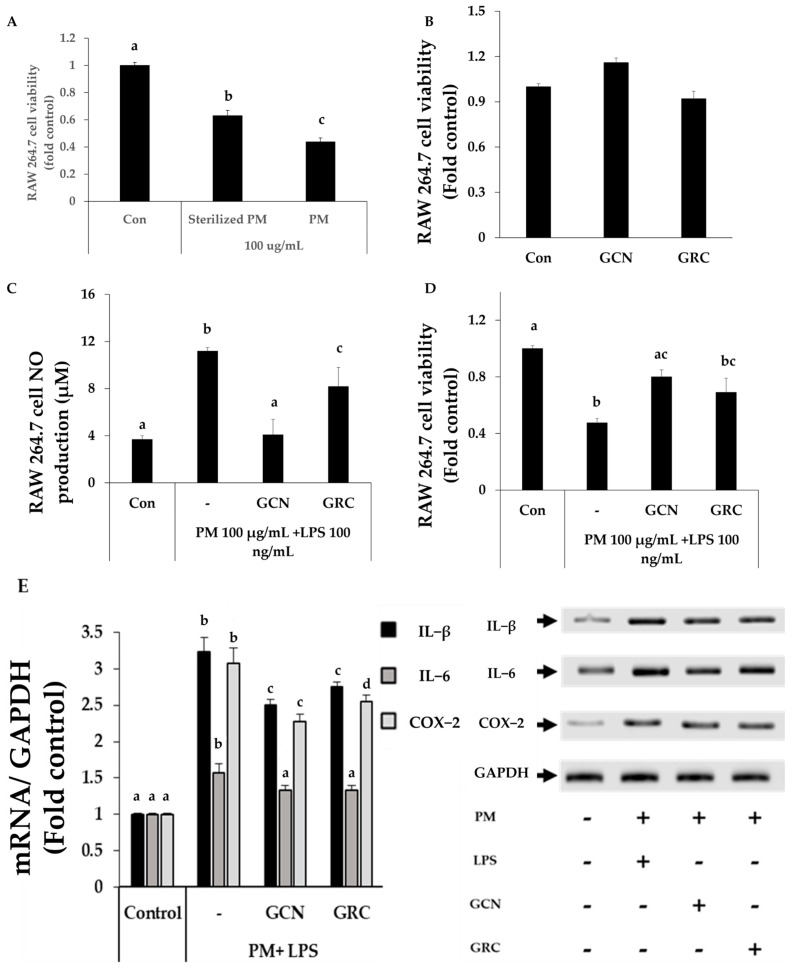
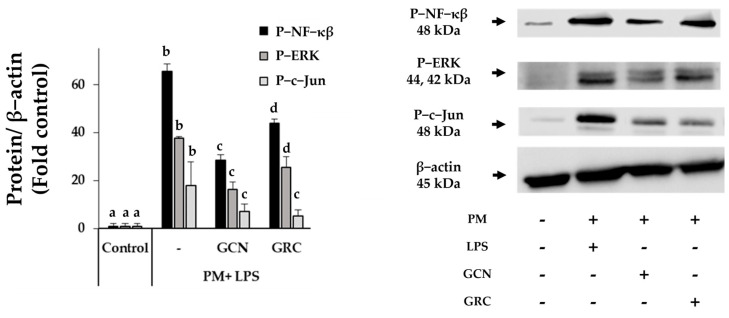
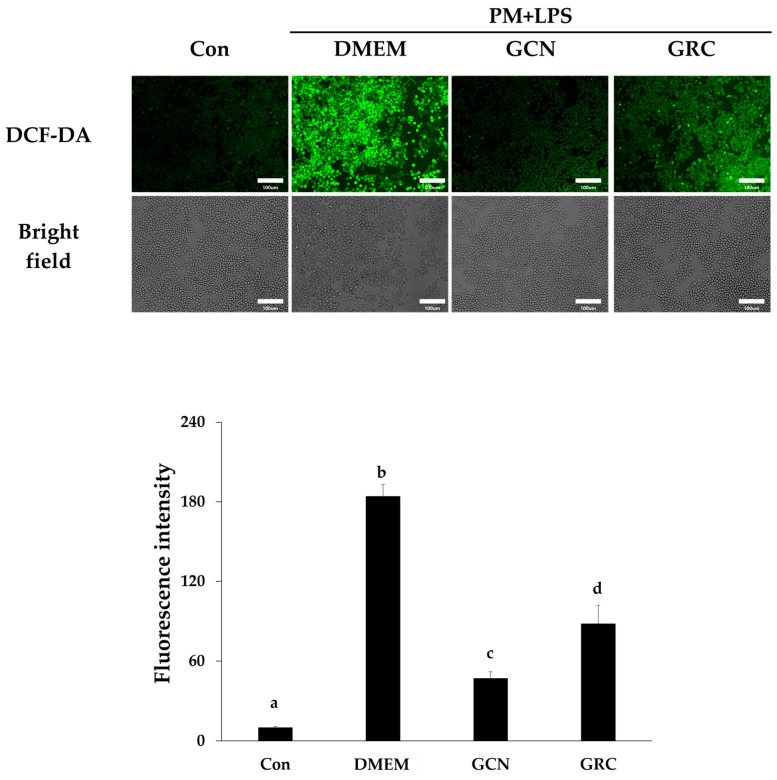
grown on germinated (GRC) exerts various biological effects, including anti-allergic, anti-inflammatory, and immune-regulatory effects. In this study, we investigated the anti-inflammatory effects of GRC encapsulated in chitosan nanoparticles (CN) against particulate matter (PM)-induced lung inflammation. Optimal CN (CN6) (CHI: TPP ratio of 4:1; TPP pH 2) exhibited a zeta potential of +22.77 mV, suitable for GRC encapsulation. At different GRC concentrations, higher levels (60 and 120 mg/mL) led to increased negative zeta potential, enhancing stability. The optimal GRC concentration for maximum entrapment (31.4 ± 1.35%) and loading efficiency (7.6 ± 0.33%) of GRC encapsulated in CN (GCN) was 8 mg/mL with a diameter of 146.1 ± 54 nm and zeta potential of +30.68. In vivo studies revealed that administering 300 mg/kg of GCN significantly decreased the infiltration of macrophages and T cells in the lung tissues of PM-treated mice, as shown by immunohistochemical analysis of CD4 and F4/80 markers. Additionally, GCN ameliorated PM-induced lung tissue damage, inflammatory cell infiltration, and alveolar septal hypertrophy. GCN also decreased total cells and neutrophils, showing notable anti-inflammatory effects in the bronchoalveolar lavage fluid (BALF) from PM-exposed mice, compared to GRC. Next the anti-inflammatory properties of GCN were further explored in PM- and LPS-exposed RAW264.7 cells; it significantly reduced PM- and LPS-induced cell death, NO production, and levels of inflammatory cytokine mRNAs (IL-1β, IL-6, and COX-2). GCN also suppressed NF-κB/MAPK signaling pathways by reducing levels of p-NF-κB, p-ERK, and p-c-Jun proteins, indicating its potential in managing PM-related inflammatory lung disease. Furthermore, GCN significantly reduced PM- and LPS-induced ROS production. The enhanced bioavailability of GRC components was demonstrated by an increase in fluorescence intensity in the intestinal absorption study using FITC-GCN. Our data indicated that GCN exhibited enhanced bioavailability and potent anti-inflammatory and antioxidant effects in cells and in vivo, making it a promising candidate for mitigating PM-induced lung inflammation and oxidative stress.
发芽的(GRC)产生各种生物效应,包括抗过敏、抗炎和免疫调节作用。在这项研究中,我们研究了壳聚糖纳米粒子(CN)包封的 GRC 对颗粒物质(PM)诱导的肺炎症的抗炎作用。最佳的 CN(CN6)(CHI:TPP 比例为 4:1;TPP pH 为 2)表现出+22.77 mV 的 ζ 电位,适合 GRC 包封。在不同的 GRC 浓度下,较高的浓度(60 和 120 mg/mL)导致负 ζ 电位增加,从而提高了稳定性。最佳的 GRC 浓度为 8 mg/mL,用于最大包封(31.4±1.35%)和包封的 GRC 的载药量效率(7.6±0.33%)(GCN)的直径为 146.1±54nm,ζ 电位为+30.68。体内研究表明,给予 300mg/kg 的 GCN 可显著减少 PM 处理小鼠肺组织中巨噬细胞和 T 细胞的浸润,这通过 CD4 和 F4/80 标志物的免疫组织化学分析得到证实。此外,GCN 改善了 PM 诱导的肺组织损伤、炎症细胞浸润和肺泡隔肥大。GCN 还减少了总细胞和中性粒细胞,与 GRC 相比,在 PM 暴露的小鼠的支气管肺泡灌洗液(BALF)中表现出明显的抗炎作用。接下来,在 PM 和 LPS 暴露的 RAW264.7 细胞中进一步探索了 GCN 的抗炎特性;它显著降低了 PM 和 LPS 诱导的细胞死亡、NO 产生和炎症细胞因子 mRNA(IL-1β、IL-6 和 COX-2)水平。GCN 还通过降低 p-NF-κB、p-ERK 和 p-c-Jun 蛋白的水平抑制 NF-κB/MAPK 信号通路,表明其在管理 PM 相关炎症性肺病方面具有潜力。此外,GCN 显著降低了 PM 和 LPS 诱导的 ROS 产生。通过使用 FITC-GCN 进行肠道吸收研究,增加了荧光强度,证明了 GRC 成分的生物利用度增强。我们的数据表明,GCN 在细胞和体内表现出增强的生物利用度和强大的抗炎和抗氧化作用,使其成为减轻 PM 诱导的肺炎症和氧化应激的有前途的候选药物。