Vladov Serhii, Banasik Arkadiusz, Sachenko Anatoliy, Kempa Wojciech M, Sokurenko Valerii, Muzychuk Oleksandr, Pikiewicz Piotr, Molga Agnieszka, Vysotska Victoria
Department of Scientific Work Organization and Gender Issues, Kremenchuk Flight College of Kharkiv National University of Internal Affairs, 17/6, Peremohy Street, 39605 Kremenchuk, Ukraine.
Department of Mathematical Methods in Technics and Informatics, Silesian University of Technology, 44-100 Gliwice, Poland.
Sensors (Basel). 2024 Oct 9;24(19):6488. doi: 10.3390/s24196488.
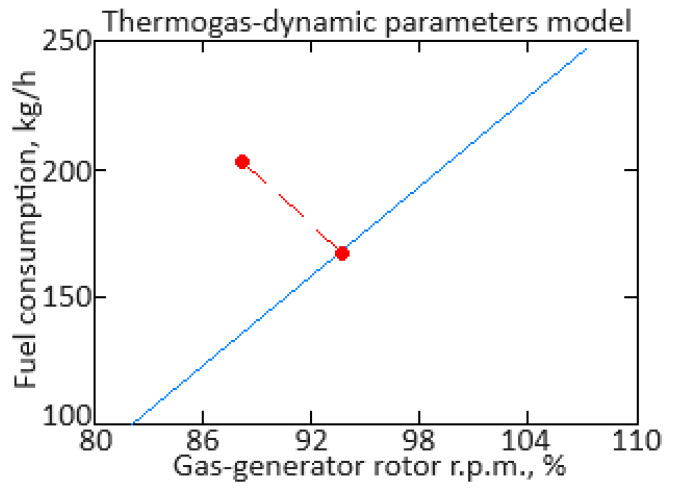
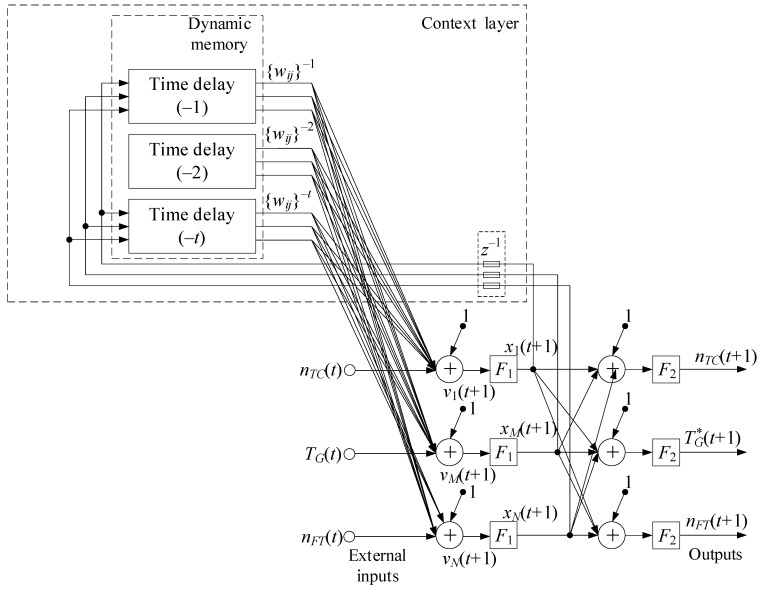
This research focused on the helicopter turboshaft engine dynamic model, identifying task solving in unsteady and transient modes (engine starting and acceleration) based on sensor data. It is known that about 85% of helicopter turboshaft engines operate in steady-state modes, while only around 15% operate in unsteady and transient modes. Therefore, developing dynamic multi-mode models that account for engine behavior during these modes is a critical scientific and practical task. The dynamic model for starting and acceleration modes has been further developed using on-board parameters recorded by sensors (gas-generator rotor r.p.m., free turbine rotor speed, gas temperature in front of the compressor turbine, fuel consumption) to achieve a 99.88% accuracy in identifying the dynamics of these parameters. An improved Elman recurrent neural network with dynamic stack memory was introduced, enhancing the robustness and increasing the performance by 2.7 times compared to traditional Elman networks. A theorem was proposed and proven, demonstrating that the total execution time for Push and Pop operations in the dynamic stack memory does not exceed a certain value (). The training algorithm for the Elman network was improved using time delay considerations and Butterworth filter preprocessing, reducing the loss function from 2.5 to 0.12% over 120 epochs. The gradient diagram showed a decrease over time, indicating the model's approach to the minimum loss function, with optimal settings ensuring the stable training.
本研究聚焦于直升机涡轮轴发动机动态模型,基于传感器数据识别非稳态和瞬态模式(发动机启动和加速)下的任务求解。众所周知,约85%的直升机涡轮轴发动机在稳态模式下运行,而只有约15%在非稳态和瞬态模式下运行。因此,开发考虑这些模式下发动机行为的动态多模式模型是一项关键的科学和实际任务。利用传感器记录的机载参数(燃气发生器转子转速、自由涡轮转子速度、压气机涡轮前的燃气温度、燃油消耗)进一步开发了启动和加速模式的动态模型,以在识别这些参数的动态特性时达到99.88%的准确率。引入了具有动态堆栈存储器的改进型埃尔曼递归神经网络,与传统埃尔曼网络相比,增强了鲁棒性并使性能提高了2.7倍。提出并证明了一个定理,表明动态堆栈存储器中Push和Pop操作的总执行时间不超过某个值()。利用时延考虑和巴特沃斯滤波器预处理改进了埃尔曼网络的训练算法,在120个训练周期内将损失函数从2.5%降低到0.12%。梯度图显示随着时间下降,表明模型接近最小损失函数,最优设置确保了稳定训练。