Li Hongqiang, Xi Bin, Lin Shuqin, Tang Defu, Gao Yaqin, Zhao Xiangmin, Liang Jing, Yang Wanyun, Li Jinlu
College of Animal Science and Technology, Gansu Agricultural University, Lanzhou 730070, China.
Laboratory of Quality & Safety Risk Assessment for Livestock Products of Ministry of Agriculture, Lanzhou Institute of Husbandry and Pharmaceutical Sciences, Chinese Academy of Agricultural Sciences, Lanzhou 730050, China.
Foods. 2024 Sep 30;13(19):3130. doi: 10.3390/foods13193130.
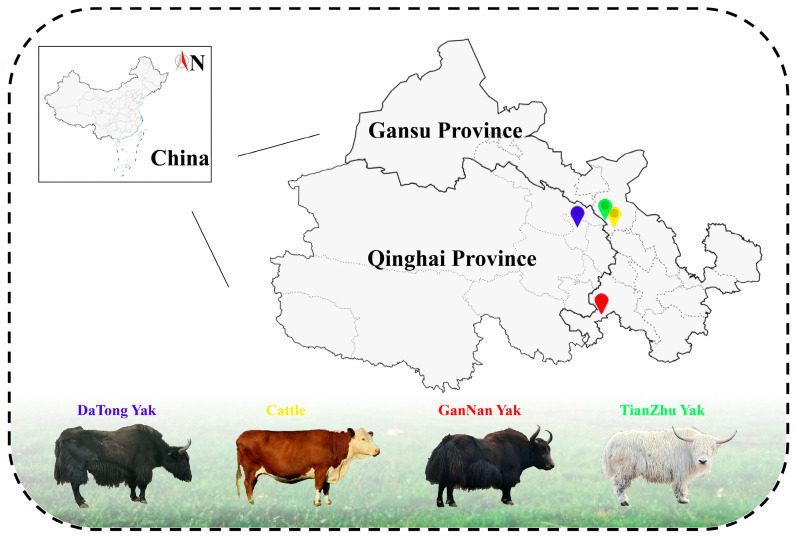
This study investigates the effects of breeds, feeding methods, and parts on the volatile flavor of yak meat. Gas chromatography-ion mobility spectrometry (GC-IMS) and multivariate analysis were used to analyze the volatile organic components (VOCs) in yak meat from various sources. A total of 71 volatile compounds were identified, 53 of which were annotated based on the GC-IMS database. These include 20 alcohols, 16 ketones, 10 aldehydes, four alkenes, one ester, one acid, and one furan. Using VOC fingerprinting and multivariate analysis, yak meats from different sources were distinctly categorized. Breed had the most significant impact on yak meat VOCs, followed by feeding method and then part. Six volatiles with a variable importance in projection value greater than one were identified as potential markers for distinguishing yak meat. This study offers insights into the flavor profile of yak meat from different sources and demonstrates the efficacy of GC-IMS and multivariate analysis in characterizing and discriminating meats.
本研究调查了品种、饲养方式和部位对牦牛肉挥发性风味的影响。采用气相色谱-离子迁移谱(GC-IMS)和多变量分析方法,对不同来源牦牛肉中的挥发性有机成分(VOCs)进行分析。共鉴定出71种挥发性化合物,其中53种基于GC-IMS数据库进行了注释。这些化合物包括20种醇类、16种酮类、10种醛类、4种烯烃、1种酯类、1种酸类和1种呋喃类。通过VOC指纹图谱和多变量分析,不同来源的牦牛肉被明显区分开来。品种对牦牛肉VOCs的影响最为显著,其次是饲养方式,然后是部位。鉴定出六种投影变量重要性大于1的挥发性物质作为区分牦牛肉的潜在标志物。本研究为不同来源牦牛肉的风味特征提供了见解,并证明了GC-IMS和多变量分析在肉类表征和鉴别方面的有效性。