Franz Maria, Jairam Ravi Kumar, Kuepfer Lars, Hanke Nina
Translational Medicine and Clinical Pharmacology, Boehringer Ingelheim Pharma GmbH and Co. KG, Ingelheim, Germany.
Institute for Systems Medicine with Focus on Organ Interaction, University Hospital RWTH Aachen, Aachen, Germany.
Front Pharmacol. 2024 Oct 1;15:1418870. doi: 10.3389/fphar.2024.1418870. eCollection 2024.
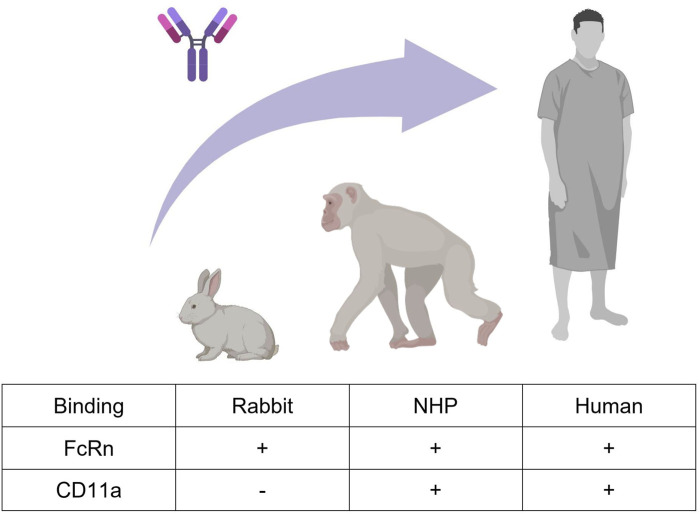
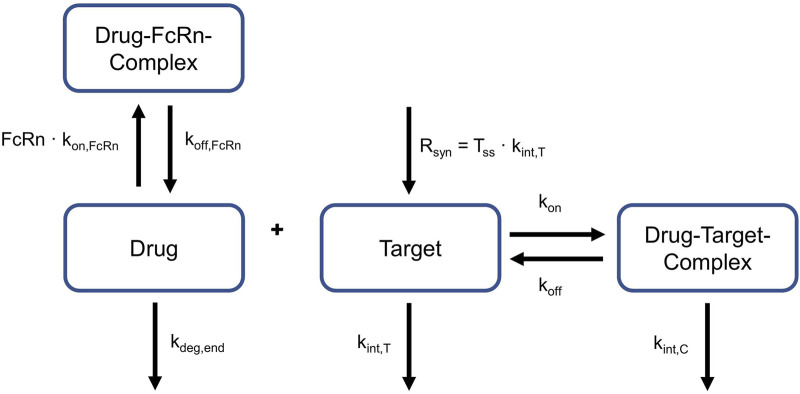
Animal models play a vital role in pharmaceutical research and development by supporting the planning and design of later clinical studies. To improve confidence and reliability of first in human dose estimates it is essential to assess the comparability of animal studies with the human situation. In the context of large molecules, it is particularly important to evaluate the cross-species-translatability of parameters related to neonatal fragment crystallizable receptor (FcRn) binding and target mediated drug disposition (TMDD), as they greatly influence distribution and disposition of proteins in the body of an organism.
Plasma pharmacokinetic data of the therapeutic protein efalizumab were obtained from literature. Physiologically based pharmacokinetic (PBPK) models were built for three different species (rabbit, non-human primate (NHP), human). Target binding was included in the NHP and human models. The assumption of similar target turnover and target-binding in NHP and human was explored, to gain insights into how these parameters might be translated between species.
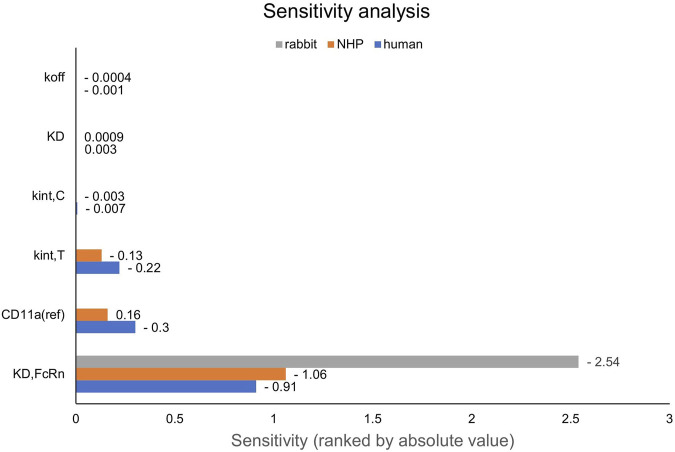
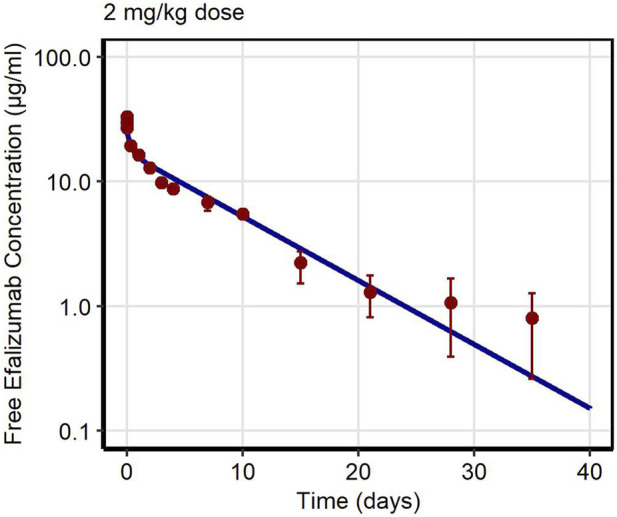
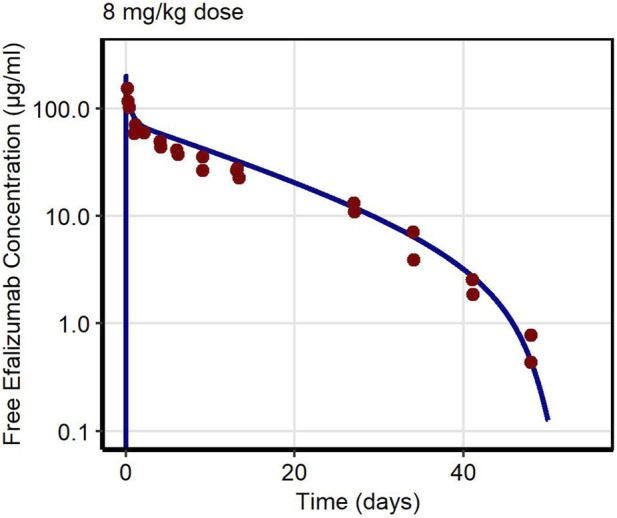
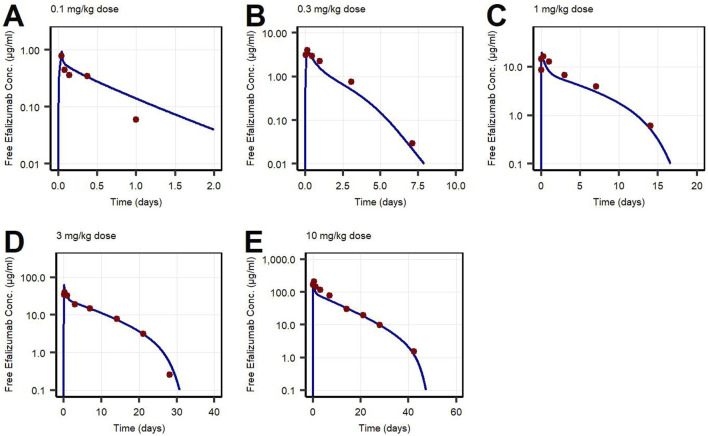
Efalizumab PBPK models were successfully developed for three species and concentration-time-profiles could be described appropriately across different intravenously administered doses. The final NHP and human models feature a common set of parameters for target turnover and drug-target-complex internalization, as well as comparable target-binding parameters. Our analyses show that different parameter values for FcRn affinity are crucial to accurately describe the concentration-time profiles.
Based on the available data in rabbits, NHP and humans, parameters for FcRn affinity cannot be translated between species, but parameters related to target mediated drug disposition can be translated from NHP to human. The inclusion of additional pharmacokinetic (PK) data including different efalizumab doses would further support and confirm our findings on identifying TMDD and, thus, binding kinetics of efalizumab in NHPs. Furthermore, we suggest that information on target expression and internalization rates could make it possible to develop comprehensive human PBPK models with minimal animal testing. In this project, we compared the pharmacokinetics of a therapeutic protein in rabbit, NHP and human using an open PBPK modeling platform (Open Systems Pharmacology Suite, http://www.open-systems-pharmacology.org). Our findings could support similar translatory studies for first in human dose predictions in the future.
动物模型通过支持后续临床研究的规划和设计,在药物研发中发挥着至关重要的作用。为提高首次人体剂量估计的可信度和可靠性,评估动物研究与人体情况的可比性至关重要。在大分子药物的背景下,评估与新生儿可结晶片段受体(FcRn)结合及靶点介导的药物处置(TMDD)相关参数的跨物种可翻译性尤为重要,因为它们极大地影响蛋白质在生物体体内的分布和处置。
从文献中获取治疗性蛋白依法利珠单抗的血浆药代动力学数据。为三种不同物种(兔、非人灵长类动物(NHP)、人类)构建了基于生理的药代动力学(PBPK)模型。在NHP和人类模型中纳入了靶点结合情况。探讨了NHP和人类中靶点周转率和靶点结合相似的假设,以深入了解这些参数如何在不同物种间进行转换。
成功为三种物种开发了依法利珠单抗PBPK模型,且不同静脉给药剂量下的浓度 - 时间曲线均可得到适当描述。最终的NHP和人类模型具有一组共同的靶点周转率和药物 - 靶点复合物内化参数,以及可比的靶点结合参数。我们的分析表明,FcRn亲和力的不同参数值对于准确描述浓度 - 时间曲线至关重要。
基于兔、NHP和人类的现有数据,FcRn亲和力参数无法在不同物种间进行转换,但与靶点介导的药物处置相关的参数可以从NHP转换到人类。纳入包括不同依法利珠单抗剂量在内的更多药代动力学(PK)数据,将进一步支持并证实我们关于识别TMDD以及依法利珠单抗在NHP中的结合动力学的研究结果。此外,我们建议关于靶点表达和内化速率的信息可能使在最少动物试验的情况下开发全面的人类PBPK模型成为可能。在本项目中,我们使用开放的PBPK建模平台(开放系统药理学套件,http://www.open - systems - pharmacology.org)比较了治疗性蛋白在兔、NHP和人类中的药代动力学。我们的研究结果可为未来首次人体剂量预测的类似转化研究提供支持。