Centre Des Sciences Du Goût Et de L' Alimentation, CNRS, INRAE, Institut Agro, Université Bourgogne, 17 Rue Sully, Dijon Cedex, 21065, France.
MoISA, University Montpellier, CIRAD, CIHEAM-IAMM, INRAE, Institut Agro, IRD, Montpellier, France.
Int J Behav Nutr Phys Act. 2024 Oct 16;21(1):118. doi: 10.1186/s12966-024-01669-5.
While complementary feeding can be challenging, little emphasis has been placed on the introduction to food texture/pieces, especially in terms of neurodevelopmental outcomes. This study aims to determine the association between the timing of introduction to food pieces during infancy and neurodevelopment in early childhood. We hypothesized that late introduction to food texture/pieces relates to unfavorable neurodevelopmental outcomes.
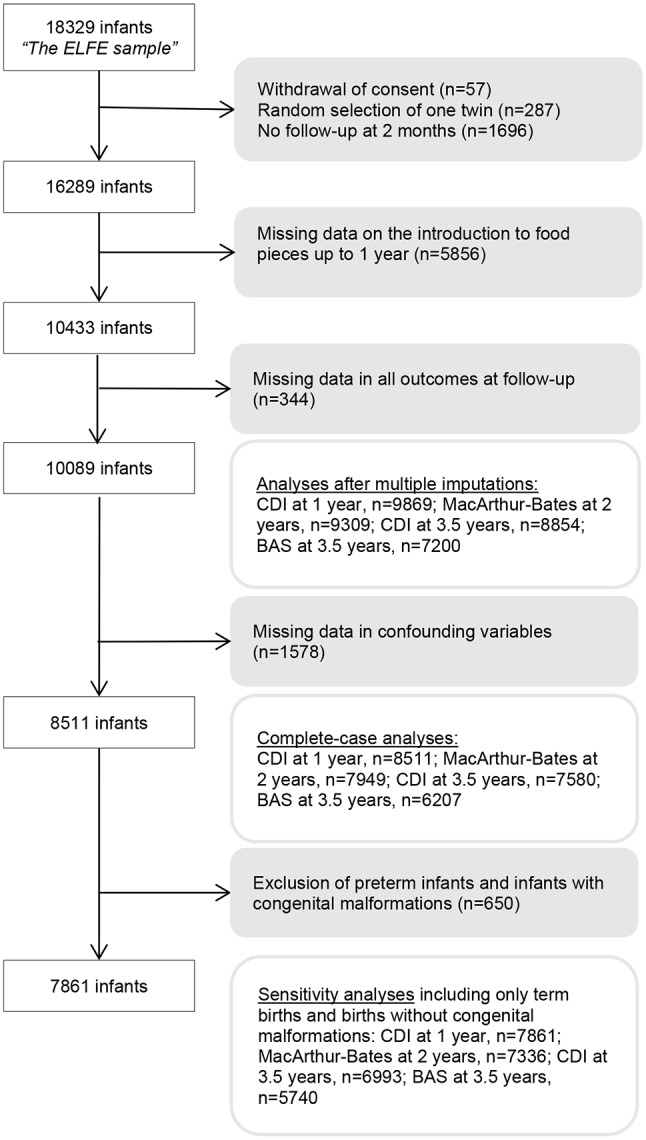
Families (n = 18329) were recruited from the general population during the nationwide ELFE (Étude Longitudinale Française depuis l'Enfance) birth cohort in France, and 8511 were selected for a complete case analysis. Age at introduction to food pieces was determined based on repeated assessments during the first year. A range of neurodevelopmental outcomes among children were assessed using validated instruments, i.e. composite scores at 1 and 3.5 years, and a score for language acquisition at 2 years. Risk for developmental delay at 3.5 years was defined based on a developmental quotient (DQ) below 90 according to the child's chronological age and the respective composite score at this age. We used linear regression modelling to evaluate associations between age at introduction to food pieces and the standardised neurodevelopmental scores, while logistic regression models were used in the analyses according to the risk for developmental delay.
Our findings highlight consistent associations between late introduction to food pieces (i.e., after 10 months, compared to early (before 8 months)) and lower estimates of standardised neurodevelopmental scores at ages 1, 2 and 3.5 years (-0.35 [-0.40; -0.30], -0.15 [-0.20; -0.10] and - 0.18 [-0.23; -0.13], respectively). Infants introduced to pieces late were also more likely to be at risk for developmental delay according to DQ < 90 (OR [95%CI] = 1.62 [1.36; 1.94]).
This study shows that late introduction to food pieces (> 10 months) is related to lower neurodevelopmental scores. Given the challenges that complementary feeding may pose, concerted efforts are required to enhance our understanding of the sensory aspects of early diets and to ultimately provide guidance.
尽管补充喂养可能具有挑战性,但很少有人关注食物质地/块状物的引入,特别是在神经发育结果方面。本研究旨在确定婴儿期食物质地/块状物引入时间与儿童早期神经发育之间的关联。我们假设,食物质地/块状物的引入较晚与不利的神经发育结果有关。
本研究从法国全国性的 ELFE(Étude Longitudinale Française depuis l'Enfance)出生队列的一般人群中招募了家庭(n=18329),并选择了 8511 个完整的病例进行分析。食物质地/块状物的引入时间根据婴儿期第一年的多次评估确定。使用经过验证的工具评估儿童的一系列神经发育结果,即 1 岁和 3.5 岁时的综合评分,以及 2 岁时的语言习得评分。3.5 岁时发育迟缓的风险定义为根据儿童的实际年龄和该年龄的相应综合评分,发育商(DQ)低于 90。我们使用线性回归模型评估食物质地/块状物引入时间与标准化神经发育评分之间的关系,而在分析中则使用逻辑回归模型根据发育迟缓的风险进行评估。
我们的研究结果突出表明,食物质地/块状物引入较晚(即 10 个月后,与早期(8 个月前)相比)与 1、2 和 3.5 岁时标准化神经发育评分较低有关(-0.35[-0.40;-0.30],-0.15[-0.20;-0.10]和-0.18[-0.23;-0.13])。根据 DQ<90,引入食物质地/块状物较晚的婴儿也更有可能面临发育迟缓的风险(OR[95%CI]=1.62[1.36;1.94])。
本研究表明,食物质地/块状物引入较晚(>10 个月)与神经发育评分较低有关。鉴于补充喂养可能带来的挑战,需要共同努力加强我们对早期饮食感官方面的理解,并最终提供指导。