Amin Ahmed Mazen, Nazir Abubakar, Abuelazm Mohamed T, Ibrahim Ahmed A, Elbenawi Hossam, Aboutaleb Aya, Ellabban Mohamed, Arnaout Moumen, Turkmani Mustafa, Abdelazeem Basel, Volgman Annabelle S
Faculty of Medicine Mansoura University Mansoura Egypt.
Faculty of Medicine King Edward Medical University Lahore Pakistan.
J Arrhythm. 2024 Jul 18;40(5):1059-1074. doi: 10.1002/joa3.13118. eCollection 2024 Oct.
Pulsed-field ablation (PFA) has emerged as an innovative alternative to radiofrequency (RF) and cryoablation because it selectively targets myocardial tissue. Thus, we aim to estimate the efficacy and safety of PFA versus thermal ablation for atrial fibrillation (AF) ablation.
A systematic review and meta-analysis were retrieved from PubMed, WOS, SCOPUS, EMBASE, and CENTRAL through September 2023. We used RevMan V. 5.4 to pool dichotomous data using risk ratio (RR) and continuous data using mean difference (MD) with a 95% confidence interval (CI). PROSPERO ID: CRD42023480321.
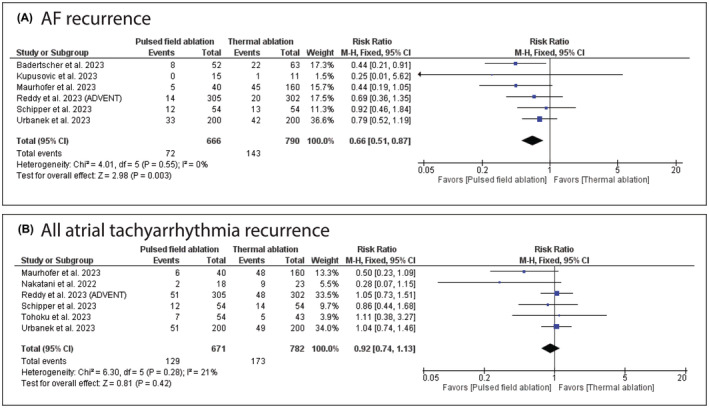
We included 17 studies with a total of 2255 patients. PFA was significantly associated with a decreased incidence of AF recurrence (RR: 0.66 with 95% CI [0.51, 0.87], = .003). However, there was no significant difference between PFA and thermal ablation in arrhythmia recurrence (RR: 0.92 with 95% CI [0.74, 1.46], = .42). PFA was significantly associated with decreased total procedure time (MD: -15.15 with 95% CI [-20.23, -10.07], < .00001), decreased heart rate change (MD: -7.39 with 95% CI [-12.16, -2.62], = .002), decreased phrenic nerve palsy (RR: 0.38 with 95% CI [0.15, 0.98], = .05), and reduced esophageal lesions (RR: 0.09 with 95% CI [0.01, 0.69], = .02). On the contrary, PFA was significantly associated with increased pericardial tamponade (RR: 6.14 with 95% CI [1.43, 26.33], = .01).
PFA was significantly associated with decreased AF recurrence, total procedure time, heart rate change, phrenic nerve palsy, esophageal lesion, and increased incidence of pericardial tamponade compared with thermal ablation.
脉冲场消融(PFA)已成为一种创新的替代射频(RF)和冷冻消融的方法,因为它能选择性地靶向心肌组织。因此,我们旨在评估PFA与热消融治疗心房颤动(AF)的疗效和安全性。
通过检索截至2023年9月的PubMed、WOS、SCOPUS、EMBASE和CENTRAL数据库进行系统评价和荟萃分析。我们使用RevMan V. 5.4软件,采用风险比(RR)汇总二分类数据,采用均差(MD)汇总连续数据,并给出95%置信区间(CI)。PROSPERO注册号:CRD42023480321。
我们纳入了17项研究,共2255例患者。PFA与房颤复发率降低显著相关(RR:0.66,95%CI[0.51, 0.87],P = 0.003)。然而,PFA与热消融在心律失常复发方面无显著差异(RR:0.92,95%CI[0.74, 1.46],P = 0.42)。PFA与总手术时间缩短显著相关(MD:-15.15,95%CI[-20.23, -10.07],P < 0.00001),心率变化降低(MD:-7.39,95%CI[-12.16, -2.62],P = 0.002),膈神经麻痹减少(RR:0.38,95%CI[0.15, 0.98],P = 0.05),食管损伤减少(RR:0.09,95%CI[0.01, 0.69],P = 0.02)。相反,PFA与心包填塞发生率增加显著相关(RR:6.14,95%CI[1.43, 26.33],P = 0.01)。
与热消融相比,PFA与房颤复发率降低、总手术时间缩短、心率变化降低、膈神经麻痹减少、食管损伤减少以及心包填塞发生率增加显著相关。