Nadarajan Renjith, Dey Sraboni, Kayal Arijit, Mitra Joy, Shaijumon Manikoth M
School of Physics, Indian Institute of Science Education and Research Thiruvananthapuram Maruthamala PO Thiruvananthapuram Kerala 695551 India
Chem Sci. 2024 Oct 14;15(43):18127-34. doi: 10.1039/d4sc04874a.
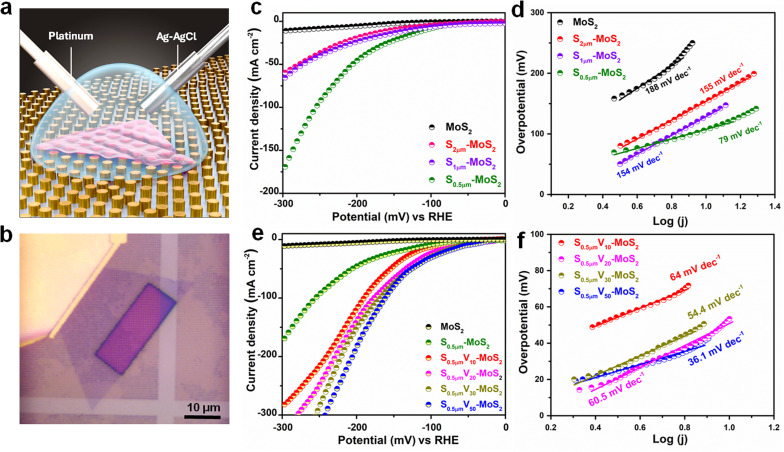
Molybdenum disulfide (MoS) has recently emerged as a promising electrocatalyst for the hydrogen evolution reaction (HER). However, the poor in-plane electrical conductivity and inert basal plane activity pose major challenges in realizing its practical application. Herein, we demonstrate a new approach to induce biaxial strain into CVD-grown MoS monolayers by draping it over an array of patterned gold nanopillar arrays (AuNAs) as an efficient strategy to enhance its HER activity. We vary the magnitude of applied strain by changing the inter-pillar spacing, and its effect on the HER activity is investigated. To capitalize on the synergistic effect of improved Δ strain engineering and leverage basal plane activation by introduction of sulphur vacancies, we further exposed the strained MoS monolayers to oxygen plasma treatment to create S-vacancies. The strained MoS on AuNAs with optimal inter-pillar spacing is exposed to oxygen plasma treatment for different durations, and we study its electrocatalytic activity towards the HER using on-chip microcell devices. The strained and vacancy-rich monolayer MoS draped on AuNAs with a 0.5 μm inter-pillar spacing and exposed to plasma for 50 s (SV-MoS) is shown to exhibit remarkable improvement in HER activity, with an overpotential of 53 mV in 0.5 M HSO. Thus, the synergistic creation of additional vacancy defects, along with strain-induced active sites, results in enhancement in HER performance of CVD-grown monolayer MoS. The present study provides a highly promising route for engineering 2D electrocatalysts towards efficient hydrogen evolution.
二硫化钼(MoS)最近已成为一种有前景的用于析氢反应(HER)的电催化剂。然而,其面内电导率差和基面活性惰性在实现其实际应用方面构成了重大挑战。在此,我们展示了一种新方法,通过将化学气相沉积(CVD)生长的MoS单层覆盖在一系列图案化的金纳米柱阵列(AuNAs)上来诱导双轴应变,作为增强其HER活性的有效策略。我们通过改变柱间距来改变施加应变的大小,并研究其对HER活性的影响。为了利用改进的Δ应变工程的协同效应并通过引入硫空位来利用基面活化,我们进一步将应变的MoS单层暴露于氧等离子体处理以产生S空位。将具有最佳柱间距的AuNAs上的应变MoS暴露于不同持续时间的氧等离子体处理中,我们使用片上微电池装置研究其对HER的电催化活性。结果表明,覆盖在柱间距为0.5μm且暴露于等离子体50s的AuNAs上的应变且富含空位的单层MoS在HER活性方面有显著提高,在0.5M HSO中的过电位为53mV。因此,额外空位缺陷与应变诱导活性位点的协同产生导致CVD生长的单层MoS的HER性能增强。本研究为设计高效析氢的二维电催化剂提供了一条极有前景的途径。