Wolff Béatrice, Julier Bernadette, Louarn Gaëtan
INRAE UR4 URP3F, BP6, Lusignan, France.
Front Plant Sci. 2024 Sep 30;15:1356506. doi: 10.3389/fpls.2024.1356506. eCollection 2024.
Increasing intraspecific genetic variation (IV) has been identified as a potential factor to improve productivity and stabilise botanical composition in plant communities. In grasslands systems, this could offer a lever to manage uncertainties of production and variability in the harvested species balance. However, little is known about the conditions to favour IV impact and the mechanisms at play.
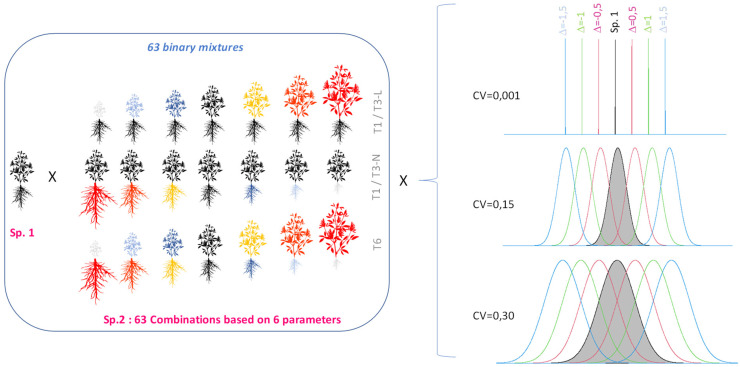
The dependency of IV impact on traits holding it and environmental stressors were analysed using a spatially-explicit individual-based model (IBM) of grassland communities. Sixty-three binary mixtures were defined to reflect a gradient of functional divergence between species regarding light and nitrogen (N) acquisition. The growth and dynamics of these communities were simulated for one year with three possible IV levels under two environments contrasting in terms of soil N fertility.
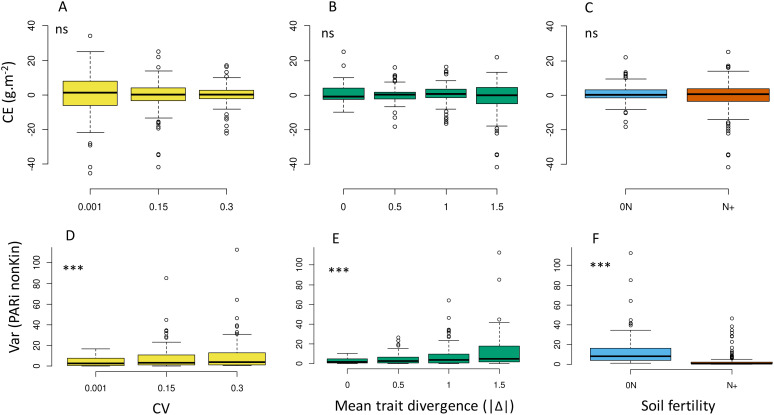
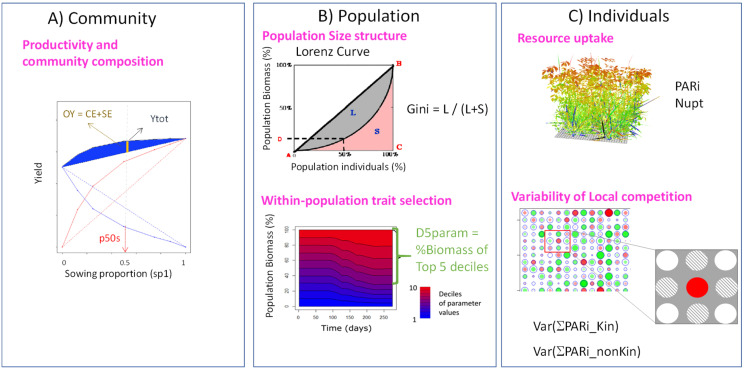
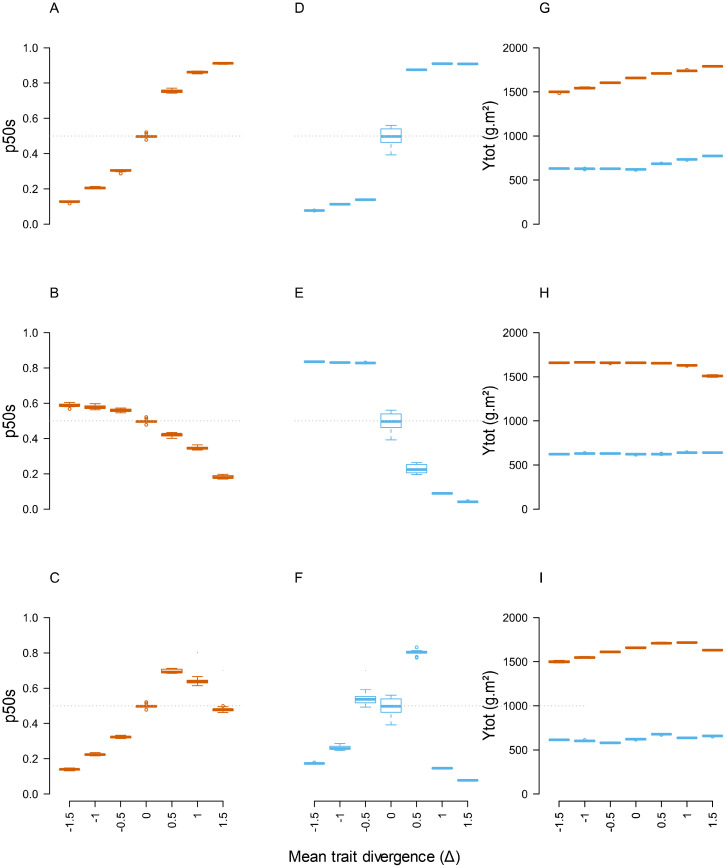
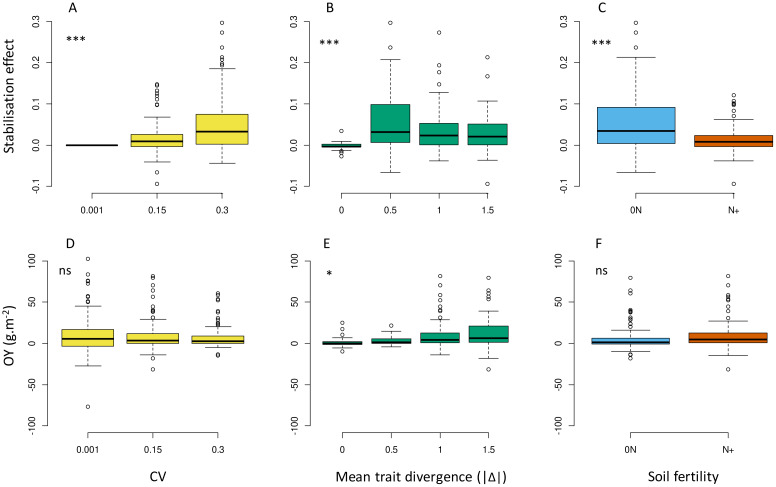
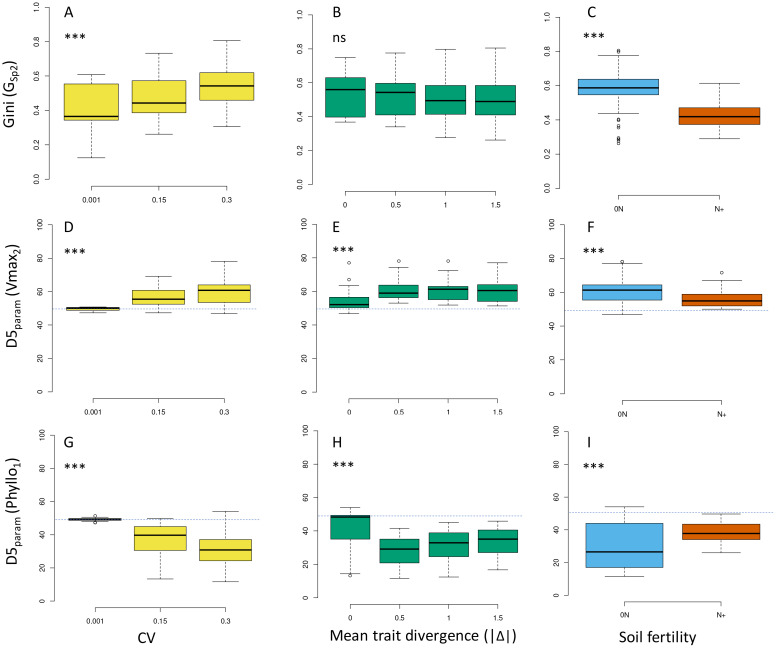
The model predicted a positive impact of moderate and high IV levels on maintaining the species balance over time, but no marked effects on mixture productivity. This stabilising effect increased at higher IV levels and under low soil N fertility. It also tended to be more pronounced in communities with intermediate functional divergence offering a significant overlap between light and N acquisition parameter values of both species. The major traits involved in the plant response to neighbours differed depending on the most contested resource, as indicated by the within-population selection of individuals with favourable N-related parameters under low N and light-related parameters under high N environments. The hypothesis that IV favours a complementarity of resource use between species was not supported. Rather, a greater spatial heterogeneity in competitive interactions was demonstrated, leading to a higher probability of growth and survival for individuals within the subordinate species. These results highlight the potential usefulness of IV to design forage mixtures with improved stability and resilience.
种内遗传变异(IV)增加已被确定为提高植物群落生产力和稳定植物组成的一个潜在因素。在草地系统中,这可能为应对生产不确定性和收获物种平衡变化提供一个手段。然而,对于有利于IV发挥作用的条件及其作用机制,我们知之甚少。
利用基于个体的草地群落空间明确模型(IBM)分析了IV影响对相关性状和环境压力源的依赖性。定义了63种二元混合物,以反映物种间在光照和氮(N)获取方面功能差异的梯度。在土壤氮肥力不同的两种环境下,对这些群落的生长和动态进行了为期一年的模拟,设置了三种可能的IV水平。
模型预测,中等和高IV水平对长期维持物种平衡有积极影响,但对混合物生产力没有显著影响。这种稳定作用在较高IV水平和低土壤氮肥力条件下增强。在功能差异中等、两个物种的光照和氮获取参数值有显著重叠的群落中,这种作用也往往更明显。植物对邻体响应所涉及的主要性状因最具竞争性的资源而异,如在低氮环境下种群内选择具有有利氮相关参数的个体,在高氮环境下选择具有有利光照相关参数的个体所示。IV有利于物种间资源利用互补性的假设未得到支持。相反,竞争相互作用中表现出更大的空间异质性,导致从属物种内个体生长和存活的概率更高。这些结果突出了IV在设计具有更高稳定性和恢复力的饲料混合物方面的潜在用途。