Texas State University, San Marcos, TX, USA.
University of the Incarnate Word, San Antonio, TX, USA.
Inquiry. 2024 Jan-Dec;61:469580241292170. doi: 10.1177/00469580241292170.
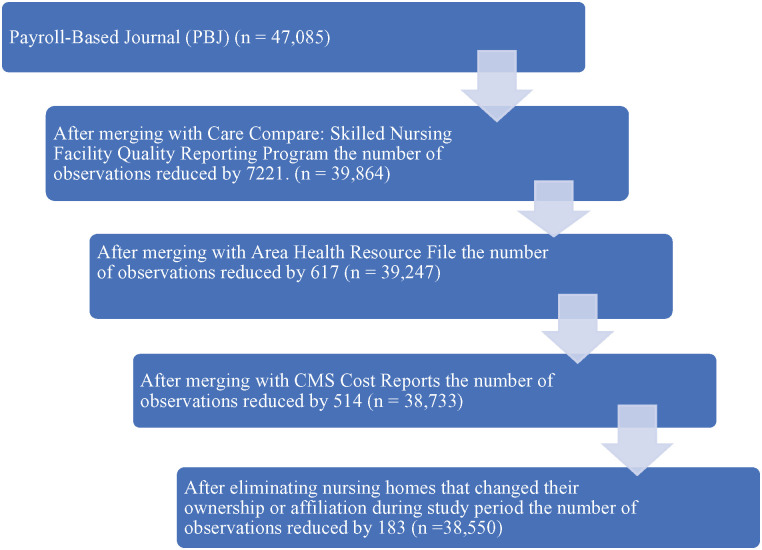
Nursing homes (NHs) have long struggled with nurse shortages, leading to a greater reliance on agency nurses. The purpose of this study was to examine the impact of NH ownership on agency nurse utilization. Data were derived from multiple sources, including the Payroll-Based Journal and NH Five-Star Facility Quality Reporting System (n: 38,550 years: 2020-2022). A 2-part logistic regression model with 2-way fixed effects (state and year) was used to assess the association of ownership and agency nurse utilization. Model 1 compared facilities with and without agency nurse use, while Model 2 focused on NHs using agency nurses, examining high utilization (top 10%). The dependent variables were agency nurse utilization ratios for registered nurses (RNs), licensed practical nurses (LPNs), and certified nursing assistants (CNAs). The primary independent variable was ownership/chain affiliation: for-profit chain (FPC), for-profit independent (FPI), not-for-profit chain (NFPC), and not-for-profit independent (NFPI). Model 1 showed that NFPC facilities had higher odds of using agency RNs (OR = 1.65), LPNs (OR = 1.53), and CNAs (OR = 1.38) compared to NFPI facilities (all < .001), while FPC facilities also had increased odds for RNs (OR = 1.43), LPNs (OR = 1.30), and CNAs (OR = 1.15) (all < .001). Model 2 indicated that NFPC, FPC, and FPI facilities were more likely to be high utilizers (top 10%) of agency nurses, with NFPC facilities having the highest odds across all categories. Pairwise comparisons showed that NFPC had the highest utilization of agency RNs and LPNs compared to other ownership groups. These results highlight the significant impact of NH ownership on staffing practices, suggesting that ownership type influences agency nurse utilization.
养老院(NH)长期以来一直面临护士短缺问题,这导致对代理护士的依赖程度更大。本研究旨在探讨 NH 所有权对代理护士使用的影响。数据来自多个来源,包括薪资日志和 NH 五星级设施质量报告系统(n:38550 年:2020-2022 年)。使用具有双向固定效应(州和年)的 2 部分逻辑回归模型来评估所有权与代理护士使用之间的关联。模型 1 比较了使用和未使用代理护士的设施,而模型 2则侧重于使用代理护士的 NH,考察了高利用率(前 10%)。因变量是注册护士(RN)、持照实习护士(LPN)和认证护理助理(CNA)的代理护士使用率。主要自变量是所有权/连锁隶属关系:营利性连锁(FPC)、营利性独立(FPI)、非营利性连锁(NFPC)和非营利性独立(NFPI)。模型 1 显示,与 NFPI 设施相比,NFPC 设施使用代理 RN(OR=1.65)、LPN(OR=1.53)和 CNA(OR=1.38)的可能性更高(均<.001),而 FPC 设施的 RN(OR=1.43)、LPN(OR=1.30)和 CNA(OR=1.15)的可能性也更高(均<.001)。模型 2 表明,NFPC、FPC 和 FPI 设施更有可能成为代理护士的高利用率(前 10%)设施,NFPC 设施在所有类别中均具有最高的可能性。两两比较表明,NFPC 与其他所有权群体相比,代理 RN 和 LPN 的利用率最高。这些结果突出了 NH 所有权对人员配备实践的重大影响,表明所有权类型会影响代理护士的使用。