
在抑制控制过程中,背外侧前额叶皮层到同侧初级运动皮层的皮质间相互作用增强了开放式技能运动员的反应抑制能力。
Dorsolateral prefrontal cortex to ipsilateral primary motor cortex intercortical interactions during inhibitory control enhance response inhibition in open-skill athletes.
机构信息
School of Physical Education, Central China Normal University, Wuhan, 430079, China.
School of Psychology, Shanghai University of Sport, Shanghai, 200438, China.
出版信息
Sci Rep. 2024 Oct 17;14(1):24345. doi: 10.1038/s41598-024-75151-4.
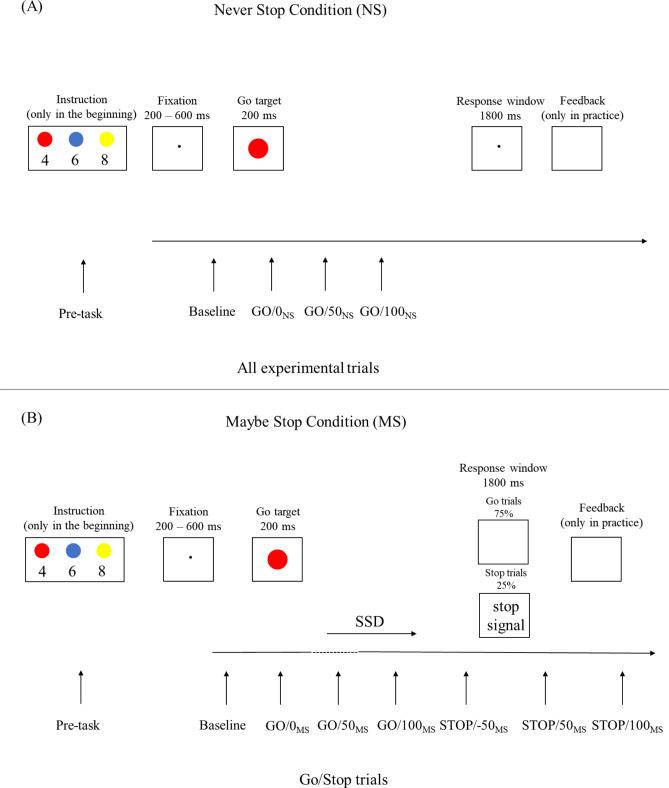
Numerous studies have reported that long-term sports training can affect inhibitory control and induce brain functional alterations. However, the influence of environmental dynamics in sports training on inter-cortical connectivity has not been well studied. In the current study, we used twin-coil transcranial magnetic stimulation to investigate the functional connectivity between dorsolateral prefrontal cortex (DLPFC) and ipsilateral primary motor cortex (M1) during proactive and reactive inhibition in participants with sports skills in dynamic environment (open-skill experts), stable environment (closed-skill experts), and no sports skills (controls). Using a modified stop signal task, proactive inhibition was measured by the response delay effect (RDE), and reactive inhibition was measured by the stop-signal reaction time (SSRT). Intra-hemispheric DLPFC-M1 interactions and single pulse motor-evoked potentials (MEPs) were measured during the task. A stronger inhibitory effect of the DLPFC over M1 was observed during early reactive control stages compared to baseline levels. In addition, this inhibitory effect was pronounced when comparing open-skill experts to non-athlete controls, a relationship that was significantly correlated with superior reactive control performance. Furthermore, DLPFC to M1 influencing direction shifted from late proactive control to reactive control. Behavioral results also demonstrated enhanced proactive control abilities in open-skill experts relative to controls. Such enhancement may be due to the combination of environmental complexity and physical fitness in long-term skill training.
大量研究表明,长期运动训练可以影响抑制控制并引起大脑功能改变。然而,运动训练中环境动态对皮质间连接的影响尚未得到很好的研究。在本研究中,我们使用双线圈经颅磁刺激来研究具有动态环境运动技能(开放式技能专家)、稳定环境运动技能(封闭式技能专家)和无运动技能(对照组)的参与者在主动和被动抑制期间背外侧前额叶皮层(DLPFC)和同侧初级运动皮层(M1)之间的功能连接。使用改良的停止信号任务,通过反应延迟效应(RDE)测量主动抑制,通过停止信号反应时间(SSRT)测量被动抑制。在任务期间测量了半球内 DLPFC-M1 相互作用和单脉冲运动诱发电位(MEPs)。与基线水平相比,在早期的被动控制阶段,DLPFC 对 M1 的抑制作用更强。此外,当将开放式技能专家与非运动员对照组进行比较时,这种抑制作用更为明显,与更出色的被动控制表现呈显著相关。此外,DLPFC 对 M1 的影响方向从主动控制后期转变为被动控制。行为结果还表明,开放式技能专家相对于对照组具有更强的主动控制能力。这种增强可能是由于长期技能训练中环境复杂性和身体素质的结合所致。


 Zotero 插件