Centre for Mathematical Modelling of Infectious Diseases, London School of Hygiene & Tropical Medicine, London, UK.
Immunisation Unit, Robert Koch Institute, Berlin, Germany.
BMC Med. 2024 Oct 17;22(1):478. doi: 10.1186/s12916-024-03687-3.
Recently, several novel RSV immunisation products that protect infants and older adults against RSV disease have been licensed in Europe. We estimated the effectiveness and efficiency of introducing these RSV immunisation strategies in Germany.
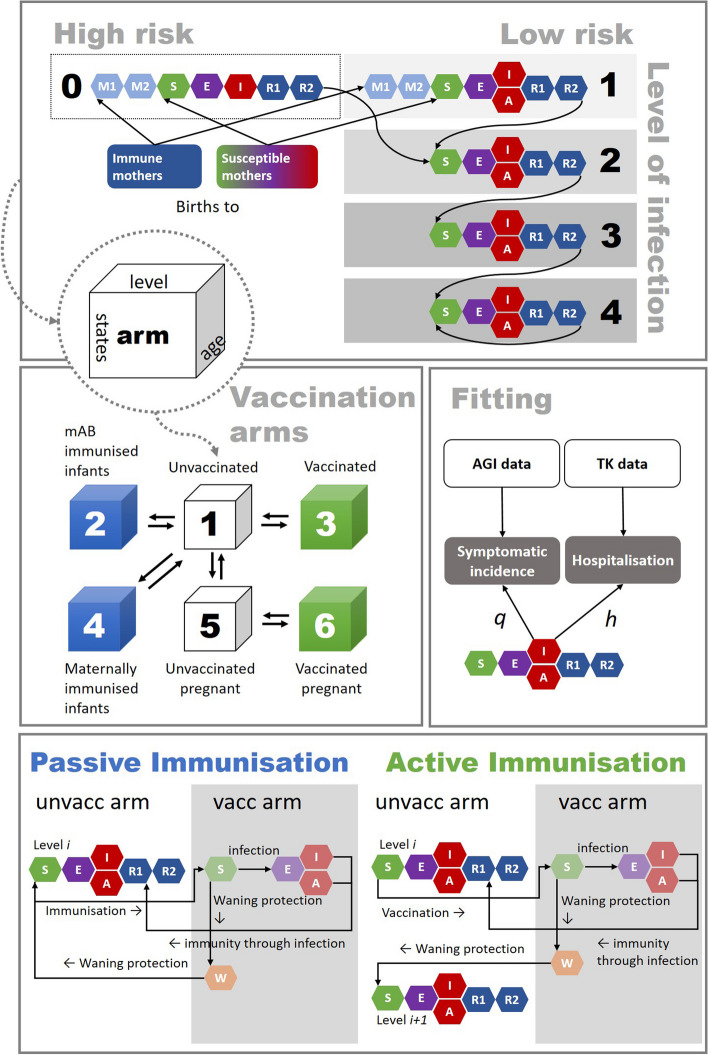
We used a Bayesian framework to fit a deterministic age-structured dynamic transmission model of RSV to sentinel surveillance and RSV-specific hospitalisation data in Germany from 2015 to 2019. The calibrated model was used to evaluate different RSV intervention strategies over 5 years: long-acting, single-dose monoclonal antibodies (mAbs) in high-risk infants aged 1-5 months; long-acting mAbs in all infants aged 1-5 months; seasonal vaccination of pregnant women and one-time seasonal vaccination of older adults (75 + /65 + /55 + years). We performed sensitivity analysis on vaccine uptake, seasonal vs. year-round maternal vaccination, and the effect of under-ascertainment for older adults.
The model was able to match the various RSV datasets. Replacing the current short-acting mAB for high-risk infants with long-acting mAbs prevented 1.1% of RSV-specific hospitalisations in infants per year at the same uptake. Expanding the long-acting mAB programme to all infants prevented 39.3% of infant hospitalisations per year. Maternal vaccination required a larger number to be immunised to prevent one additional hospitalisation than a long-acting mAB for the same uptake. Vaccination of adults older than 75 years at an uptake of 40% in addition to Nirsevimab in all infants prevented an additional 4.5% of all RSV hospitalisations over 5 years, with substantial uncertainty in the correction for under-ascertainment of the RSV burden.
Immunisation has the potential to reduce the RSV disease burden in Germany.
最近,几种新型 RSV 免疫制剂已在欧洲获得许可,可预防 RSV 疾病,包括婴幼儿和老年人。我们评估了在德国采用这些 RSV 免疫策略的效果和效率。
我们使用贝叶斯框架,根据德国 2015 年至 2019 年的监测数据和 RSV 特异性住院数据,对 RSV 的定态年龄结构动态传播模型进行拟合。利用校准后的模型,评估了 RSV 干预策略在 5 年内的效果:长效、单剂量单克隆抗体(mAbs)用于 1-5 月龄高风险婴儿;长效 mAbs 用于所有 1-5 月龄婴儿;孕妇季节性疫苗接种和老年人一次性季节性疫苗接种(75 岁+/65 岁+/55 岁+)。我们对疫苗接种率、季节性与全年性孕妇疫苗接种以及老年人检测不足的影响进行了敏感性分析。
该模型能够匹配各种 RSV 数据集。用长效 mAbs 替代目前用于高风险婴儿的短效 mAb,每年可预防 1.1%的 RSV 特异性住院。将长效 mAb 方案扩大到所有婴儿,每年可预防 39.3%的婴儿住院。与长效 mAb 相比,为达到相同的接种率,孕妇疫苗接种需要更多的免疫人数才能预防一次住院。在所有婴儿中接种 Nirsevimab 的基础上,75 岁以上人群的接种率为 40%,每年可预防所有 RSV 住院的 4.5%,但 RSV 负担检测不足的校正存在较大不确定性。
免疫接种有可能降低德国 RSV 疾病负担。