Universidade Federal de São Paulo São PauloSP Brasil Disciplina de Endocrinologia, Universidade Federal de São Paulo (Unifesp), São Paulo, SP, Brasil.
Departamento de Ciências da Vida Universidade do Estado da Bahia SalvadorBA Brasil Departamento de Ciências da Vida, Universidade do Estado da Bahia (Uneb), Salvador, BA, Brasil.
Arch Endocrinol Metab. 2024 Jul 30;68:e230314. doi: 10.20945/2359-4292-2023-0314. eCollection 2024.
To evaluate the accuracy of routinely available parameters in screening for GCK maturity-onset diabetes of the young (MODY), leveraging data from two large cohorts - one of patients with GCK-MODY and the other of patients with type 1 diabetes (T1D).
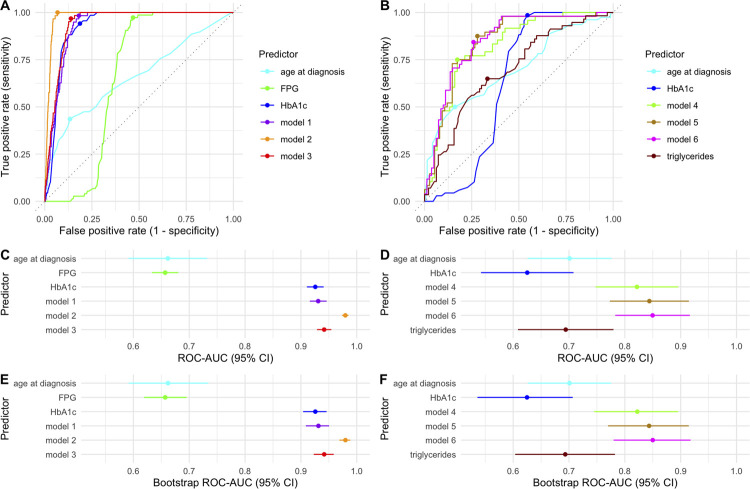
The study included 2,687 patients with T1D, 202 patients with clinical features of MODY but without associated genetic variants (NoVar), and 100 patients with GCK-MODY (GCK). Area under the receiver-operating characteristic curve (ROC-AUC) analyses were used to assess the performance of each parameter - both alone and incorporated into regression models - in discriminating between groups.
The best parameter discriminating between GCK-MODY and T1D was a multivariable model comprising glycated hemoglobin (HbA1c), fasting plasma glucose, age at diagnosis, hypertension, microvascular complications, previous diabetic ketoacidosis, and family history of diabetes. This model had a ROC-AUC value of 0.980 (95% confidence interval [CI] 0.974-0.985) and positive (PPV) and negative (NPV) predictive values of 43.74% and 100%, respectively. The best model discriminating between GCK and NoVar included HbA1c, age at diagnosis, hypertension, and triglycerides and had a ROC-AUC value of 0.850 (95% CI 0.783-0.916), PPV of 88.36%, and NPV of 97.7%; however, this model was not significantly different from the others. A novel GCK variant was also described in one individual with MODY (7-44192948-T-C, p.Ser54Gly), which showed evidence of pathogenicity on in silico prediction tools.
This study identified a highly accurate (98%) composite model for differentiating GCK-MODY and T1D. This model may help clinicians select patients for genetic evaluation of monogenic diabetes, enabling them to implement correct treatment without overusing limited resources.
利用两个大型队列(一个是 GCK-MODY 患者队列,另一个是 1 型糖尿病(T1D)患者队列)的数据,评估常规参数在筛查 GCK 青少年发病的成年型糖尿病(MODY)中的准确性。
该研究纳入了 2687 例 T1D 患者、202 例有 MODY 临床特征但无相关基因突变的患者(NoVar)和 100 例 GCK-MODY(GCK)患者。采用受试者工作特征曲线(ROC-AUC)分析评估各参数(单独和纳入回归模型)在区分各组间的性能。
区分 GCK-MODY 和 T1D 的最佳参数是一个多变量模型,包括糖化血红蛋白(HbA1c)、空腹血糖、诊断时年龄、高血压、微血管并发症、既往糖尿病酮症酸中毒和糖尿病家族史。该模型的 ROC-AUC 值为 0.980(95%置信区间[CI] 0.974-0.985),阳性(PPV)和阴性(NPV)预测值分别为 43.74%和 100%。区分 GCK 和 NoVar 的最佳模型包括 HbA1c、诊断时年龄、高血压和甘油三酯,其 ROC-AUC 值为 0.850(95%CI 0.783-0.916)、PPV 为 88.36%、NPV 为 97.7%;然而,该模型与其他模型无显著差异。在一名 MODY 患者中还描述了一种新的 GCK 变体(7-44192948-T-C,p.Ser54Gly),该变体在计算预测工具中显示出致病性证据。
本研究确定了一种用于区分 GCK-MODY 和 T1D 的高度准确(98%)综合模型。该模型可能有助于临床医生选择需要进行单基因糖尿病基因评估的患者,使他们能够在不滥用有限资源的情况下实施正确的治疗。