Department of Life Science and Technology, Tokyo Institute of Technology, Nagatsuta 4259, Midori-ku, Yokohama 226-8501, Japan.
Institute of Quantum Life Science, National Institutes for Quantum Science and Technology (QST), Anagawa 4-9-1, Inage-ku, Chiba 263-8555, Japan.
Anal Chem. 2024 Oct 29;96(43):17145-17153. doi: 10.1021/acs.analchem.4c02488. Epub 2024 Oct 18.
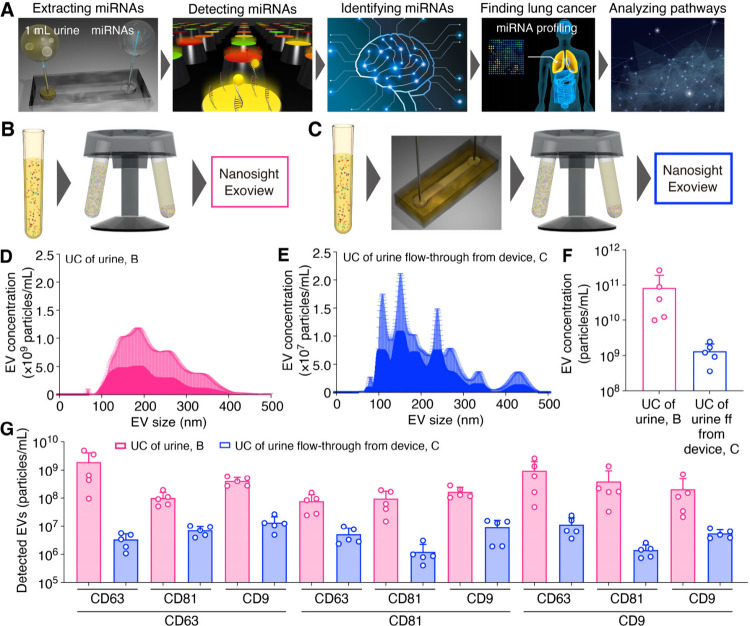
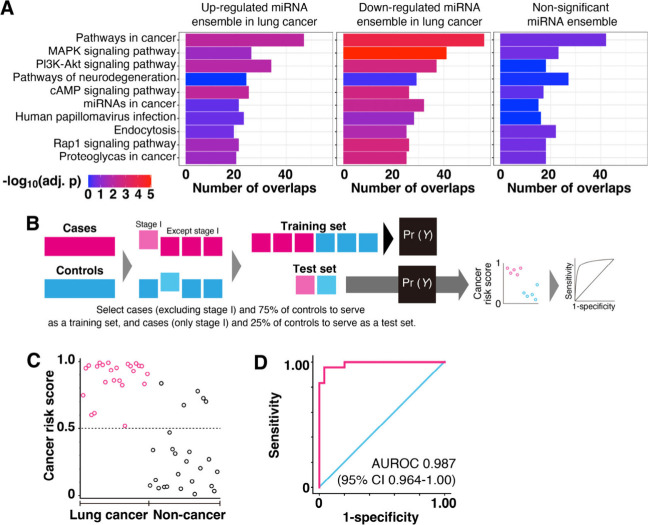
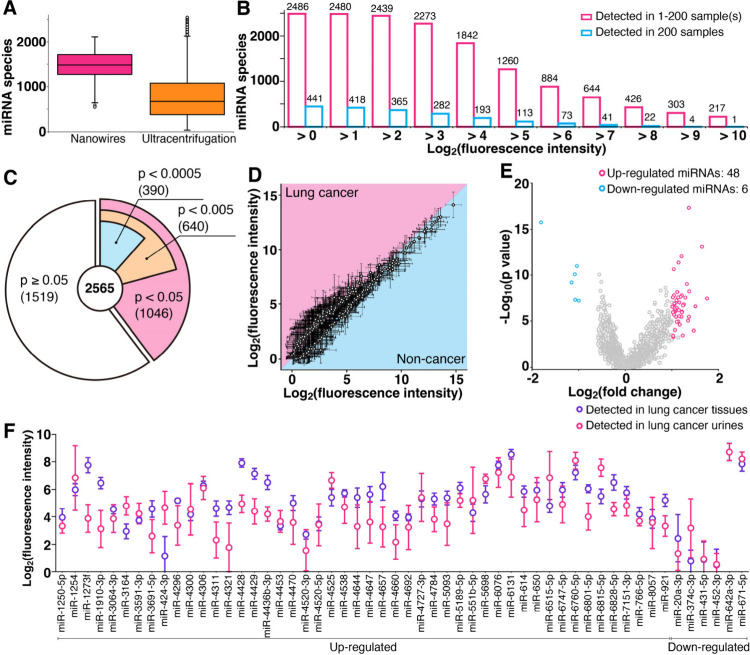
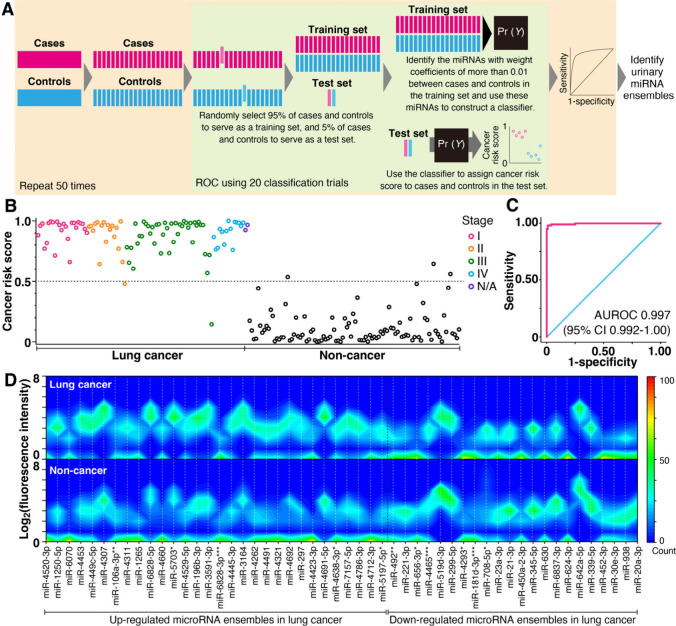
Multiple microRNAs encapsulated in extracellular vesicles (EVs) including exosomes, unique subtypes of EVs, differ in healthy and cancer groups of people, and they represent a warning sign for various cancer scenarios. Since all EVs in blood cannot be transferred from donor to recipient cells during a single blood circulation, kidney filtration could pass some untransferred EVs from blood to urine. Previously, we reported on the ability of zinc oxide nanowires to capture EVs based on surface charge and hydrogen bonding; these nanowires extracted massive numbers of microRNAs in urine, seeking cancer-related microRNAs through statistical analysis. Here, we report on the scalability of the nanowire performance capability to comprehensively capture EVs, including exosomes, in urine, extract microRNAs from the captured EVs , and identify multiple microRNAs in the extracted microRNAs differing in noncancer and lung cancer subjects through machine learning-based analysis. The nanowire-based extraction allowed the presence of about 2500 species of urinary microRNAs to be confirmed, meaning that urine includes almost all human microRNA species. The machine learning-based analysis identified multiple microRNAs from the extracted microRNA species. The ensembles could classify cancer and noncancer subjects with the area under the receiver operating characteristic curve of 0.99, even though the former were staged early.
多种 microRNAs 被包裹在细胞外囊泡 (EVs) 中,包括外泌体,这是 EVs 的独特亚型,在健康人群和癌症人群中存在差异,它们代表了各种癌症情况的警告信号。由于在单次血液循环中,所有血液中的 EVs 都不能从供体转移到受体细胞,因此肾脏过滤可以将一些未转移的 EVs 从血液转移到尿液中。以前,我们报道了氧化锌纳米线基于表面电荷和氢键捕获 EVs 的能力; 这些纳米线从尿液中提取了大量的 microRNAs,通过统计分析寻找与癌症相关的 microRNAs。在这里,我们报告了纳米线性能能力的可扩展性,以全面捕获尿液中的 EVs,包括外泌体,从捕获的 EVs 中提取 microRNAs,并通过基于机器学习的分析鉴定出在非癌症和肺癌患者中存在差异的多个 microRNAs。基于纳米线的提取方法允许确认大约 2500 种尿液 microRNAs 的存在,这意味着尿液中包含几乎所有人类 microRNA 种类。基于机器学习的分析从提取的 microRNA 种类中鉴定出多个 microRNAs。尽管前者处于早期阶段,但集合可以用 0.99 的接收器操作特性曲线下面积对癌症和非癌症患者进行分类。