Impact Research and Development Organization, P.O Box 9171-40141, Kisumu, Kenya.
Masinde Muliro University of Science and Technology, Kakamega, Kenya.
BMC Public Health. 2024 Oct 18;24(1):2873. doi: 10.1186/s12889-024-20348-5.
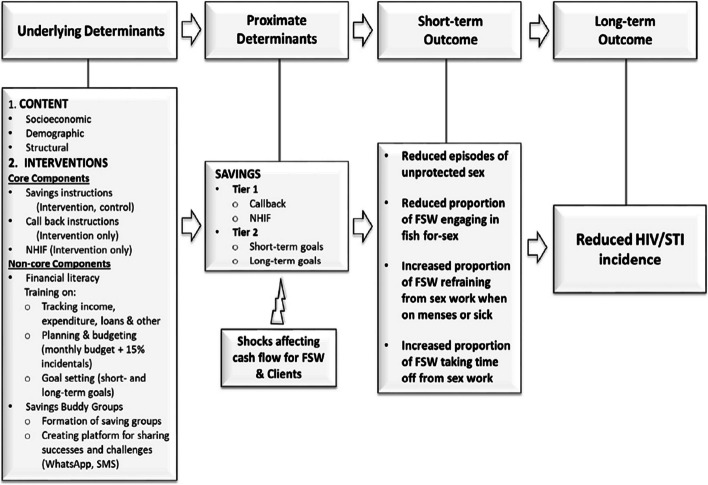
HIV prevalence among female sex workers (FSW) is significantly higher than among women in the general population. Studies have shown that FSW engage in unprotected sex which provides higher compensation when they face emergency situations. We co-created a savings intervention - Jitegemee (rely on yourself) - with FSW to encourage them to save part of their earnings to withdraw in emergency situations in order to reduce risk.
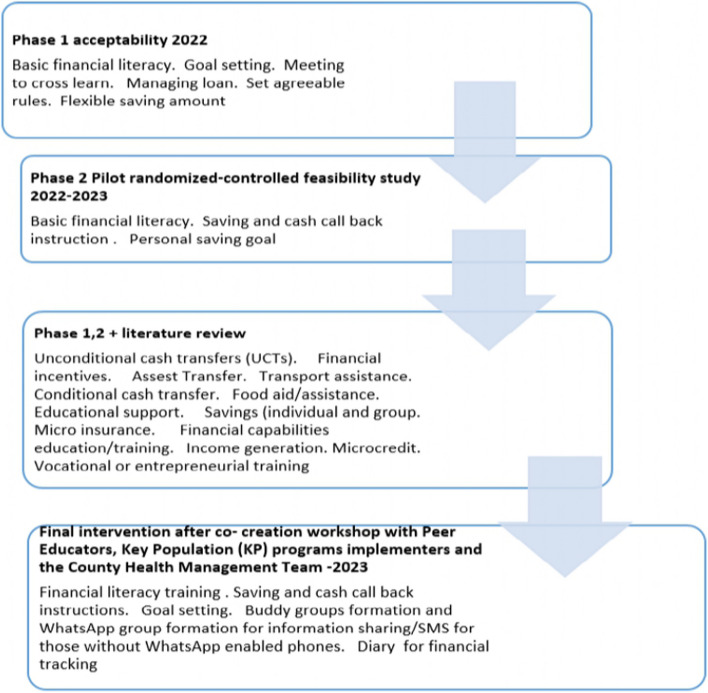
We undertook a five-phase intervention development process between February 2021 and July 2023: 1) qualitative interviews with FSW to identify essential intervention features; 2) pilot trial to assess intervention feasibility; 3) literature review of studies on economic empowerment of FSW; 4) scoring of key components of Phases 1-3 on a scale of 1-5 (1 = definitely exclude, 5 = definitely include), for inclusion in the intervention package; 5) workshops with FSW and other key stakeholders to co-design the intervention.
In phase 1, nearly all participants (99%) found the intervention acceptable to them and 95% believed it would be acceptable to other FSW. Participants suggested inclusion of financial literacy (75%), savings groups (38%) and goal-setting (24%). In the feasibility assessment, 41% saved, of whom 46% withdrew some savings. Condom use was higher among FSW who withdrew their savings compared to those who did not (χ 7.52; p = 0.006). In Phase 3, we identified 14 intervention components. In phase 4, all suggested intervention components scored 4.5 on average. In phase 5, we held 3 workshops with FSW to co-design the intervention, which included instructions for how to save and make withdrawals, financial literacy training, and formation of savings groups.
A savings intervention for and by FSW was highly acceptable and feasible. Involving end-users in the design process is likely to result in greater economic security among FSW and lower engagement in higher risk transactional sex.
女性性工作者(FSW)中的艾滋病毒感染率明显高于普通女性人群。研究表明,FSW 会进行无保护性行为,以便在紧急情况下获得更高的报酬。我们与 FSW 共同创建了一个储蓄干预措施——Jitegemee(依靠自己)——以鼓励她们将部分收入储蓄起来,以便在紧急情况下提取,从而降低风险。
我们在 2021 年 2 月至 2023 年 7 月期间进行了一个五阶段的干预措施发展过程:1)对 FSW 进行定性访谈,以确定干预措施的必要特征;2)进行试点试验,以评估干预措施的可行性;3)对 FSW 经济赋权的研究进行文献综述;4)对第 1-3 阶段的关键组成部分进行 1-5 分制评分(1=肯定排除,5=肯定包括),以纳入干预措施包;5)与 FSW 和其他利益相关者合作设计干预措施。
在第 1 阶段,几乎所有参与者(99%)都认为该干预措施对他们是可以接受的,95%的人认为它对其他 FSW 也是可以接受的。参与者建议纳入金融扫盲(75%)、储蓄小组(38%)和目标设定(24%)。在可行性评估中,有 41%的 FSW 进行了储蓄,其中 46%的人提取了部分储蓄。与未提取储蓄的 FSW 相比,提取储蓄的 FSW 使用避孕套的比例更高(χ 7.52;p=0.006)。在第 3 阶段,我们确定了 14 个干预组成部分。在第 4 阶段,所有建议的干预组成部分平均得分为 4.5。在第 5 阶段,我们与 FSW 合作举办了 3 次研讨会,共同设计了干预措施,包括如何储蓄和取款的说明、金融扫盲培训和储蓄小组的组建。
FSW 的储蓄干预措施是高度可接受和可行的。让最终用户参与设计过程,可能会使 FSW 获得更大的经济安全,并减少从事高风险交易性性行为的情况。