Division of Rheumatology, Hospital for Special Surgery, Weill Cornell Medical College, 535 East 70th St, New York, NY, 10021, USA.
Division of Rheuamtology, Duke University School of Medicine, 2301 Erwin Rd, Chc, T-Level, Durham, NC, 27713, USA.
Pediatr Rheumatol Online J. 2024 Oct 19;22(1):91. doi: 10.1186/s12969-024-01026-7.
The aim of the study was to evaluate the effectiveness of a novel e-learning module in teaching the physical exam of the temporomandibular joint (TMJ) in Juvenile idiopathic arthritis (JIA.).
An e-learning module was developed to convey the TMJ physical examination maneuvers that are considered to be best practice in JIA. Pediatric rheumatology fellows were randomized to two groups. One group received an article describing the physical examination skills while the second group received both the article and module. All participants completed a written pre-test, an in-person objective structured clinical examination (OSCE), a written post-test, and a follow-up survey.
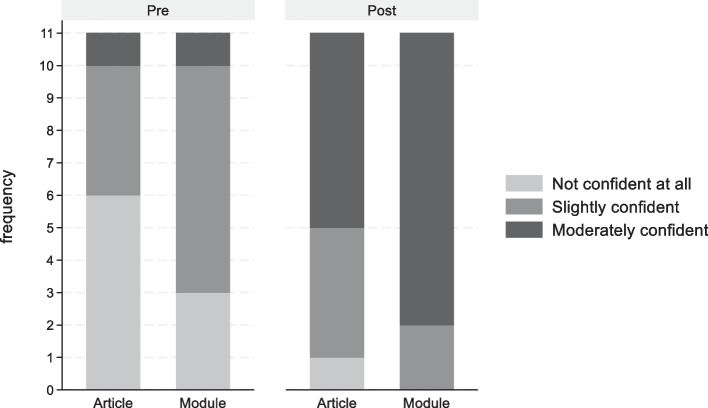
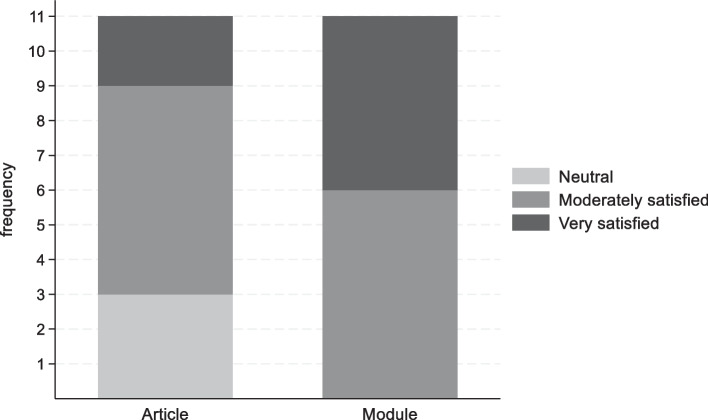
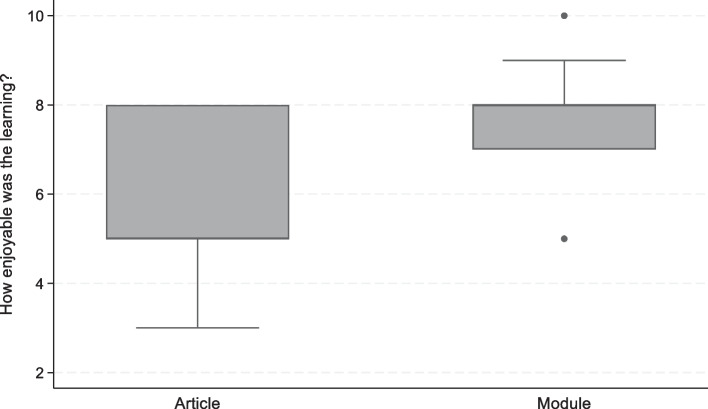
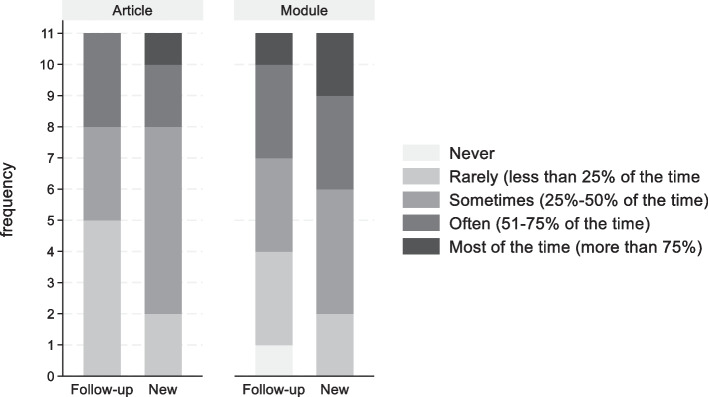
Twenty-two pediatric rheumatology fellows enrolled, with 11 per group. Written test: The two groups improved equally, although there was a trend toward improved defining of maximal incisal opening (MIO) in the module group. OSCE: The mean OSCE score was 11.1 (SD 3.3) in the article group and 13.5 (SD 1.9) in the module group (p = 0.06); significant differences were seen in measuring MIO (p = 0.01), calculating maximal unassisted mouth opening (MUMO; p = 0.01), and assessment of facial symmetry (p = 0.03), all favoring the module. Enjoyment scores in the module group were higher than in the article group (mean 7.7/10 vs. 5.9/10, p = 0.02). The two groups self-reported performing TMJ examinations at comparable rates three months following the intervention.
The study demonstrated that a formalized educational program improved knowledge of the physical exam of the TMJ in JIA. Learners viewing the module were more adept at obtaining quantitative TMJ measurements.
本研究旨在评估一种新的电子学习模块在教授青少年特发性关节炎(JIA)颞下颌关节(TMJ)体格检查方面的有效性。
开发了一个电子学习模块来传达被认为是 JIA 最佳实践的 TMJ 体格检查操作。小儿风湿病研究员被随机分为两组。一组接受一篇描述体格检查技能的文章,另一组则同时接受文章和模块。所有参与者均完成了书面预测试、面对面客观结构化临床考试(OSCE)、书面后测试和随访调查。
共有 22 名小儿风湿病研究员入组,每组 11 名。书面测试:两组均有提高,尽管模块组在定义最大开口度(MIO)方面有改善趋势。OSCE:文章组的平均 OSCE 得分为 11.1(SD 3.3),模块组为 13.5(SD 1.9)(p=0.06);在测量 MIO(p=0.01)、计算最大自主开口度(MUMO;p=0.01)和评估面部对称性(p=0.03)方面,模块组的得分显著更高,均有利于模块组。模块组的满意度评分高于文章组(平均 7.7/10 比 5.9/10,p=0.02)。干预后三个月,两组均报告以相似的频率进行 TMJ 检查。
该研究表明,规范化的教育计划可提高 JIA 中 TMJ 体格检查的知识水平。观看模块的学习者更擅长获取 TMJ 的定量测量。