
自体组织工程化眼及口腔黏膜组织移植物的对比评价——一项前瞻性随机对照临床试验。
Comparative evaluation of autologous tissue-engineered ocular and oral mucosal tissue grafts- a prospective randomized controlled trial.
机构信息
Cornea, Cataract & Refractive Services, Dr. Rajendra Prasad Centre for Ophthalmic Sciences Institute of Medical Sciences, New Delhi, India.
Department of Biostatistics, All India Institute of Medical Sciences, New Delhi, India.
出版信息
BMC Biotechnol. 2024 Oct 18;24(1):82. doi: 10.1186/s12896-024-00876-z.
BACKGROUND
Bilateral ocular surface disease resulting from Stevens Johnson Syndrome (SJS) and chemical injuries are visually debilitating and difficult to treat. Ocular surface reconstruction by various means has been reported with variable results. This study addresses an unmet need for a prospective clinical trial comparing the outcomes of transplanting autologous oral and conjunctival epithelial cell constructs on human amniotic membrane by ex vivo tissue engineering.
METHODS
A prospective, randomized controlled clinical trial was prospectively applied for registration, with the clinical trial registry of India (CTRI), with the approval of the Institute Ethics Committee number IEC/NP-99/11.04.2014 and CTRI No. REF/2018/10/021791, the study also registered with the WHO-recognized trial registry, International Standard Randomised Controlled Trial Number (ISRCTN) registration reference number 45780. The study was conducted to compare clinical outcomes of two different tissue-engineered cell grafts, Cultivated Oral Mucosal Epithelial Transplantation (COMET) and Conjunctival Cultivated Epithelial Transplantation (CCET) for ocular surface reconstruction in patients with bilateral ocular surface disease due to Stevens-Johnson Syndrome or chemical injuries. Fifty patients were enrolled and randomized to either the COMET or CCET group. A uniform pre-op and post-op protocol using standard medications was followed for all patients Parameters assessed at baseline, day 1, 1 week, 2 weeks, 1 month, 2 months, 3 months and 6 months postoperatively included patient comfort, best corrected visual acuity (BCVA), ocular surface status and corneal clarity. The efficacy was measured in terms of improvement of vision, reduction in vascularization, symblepharon and corneal clarity.
RESULTS
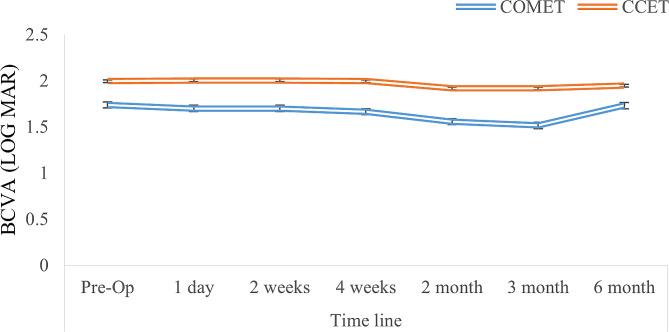
In the study, 50 patients (50 eyes; mean ages of 29 ± 15.86 years and 26.36 ± 10.85 years, respectively; range, 12-65 years) were enrolled, with 25 patients each in the COMET and CCET groups. Out of them, 36% were female and 64% were male; the causes were Steven Johnson syndrome (48), and chemical injury (2). Mean pre-operative BCVA was log MAR 1.73 ± 0.57 for COMET and 1.99 ± 0.33 for the CCET group. Pre-operatively all 50 enrolled patients had opaque corneas pre-operatively, symblepharon that extended to the cornea categorised as grade 3 and corneal vascularization that went beyond the pupil's boundary into the central zone encluaching on the visual axis. The minimal follow-up time was six months. Following surgery postoperatively, the BCVA considerably improved in the COMET group by 1.51 ± 0.58 compared to the CCET group by 1.91 ± 0.33 at 3 months. BCVA at 6 months was 1.73 ± 0.56 in the COMET group and 1.99 ± 0.31 in the CCET group, which is not statistically significant and comparable to the BCVA before surgery. The corneal clarity was significantly improved in COMET group 25 eye (100%) at 2 month, 3month and 19 eye (76%), 6eye (24%) at 6 months when compared to CCET group 15 eye improved (60%), 9 eyes (36%) not improved and one eye with opaque cornea (4%) at 2 months. 22 eye (88%) had not improved, 2 eye (8%) opaque cornea and 1 eye (4%) improved at 3 months. At 6 months 21 eye (84%) were not improved, 4 eye (16%) eye became opaqued at 6 months. Compared to preoperative conditions, both groups had improved corneal clarity significantly (p > 0.005). Of the 50 patients with grade 3 symblepharon extended to the cornea, were completely resolved 19 (76%) in COMET group when compared to CCET group 22 eye (88%) not improved. Similarly, 19 eye (76%) had a improvement in corneal vascularization when compared to the CCET group not improved 25 eye (100%) at 6months. No adverse event was observed in any of either group during the follow up periods.
CONCLUSION
Both cell types are effective to restore the ocular surface integrity in bilateral ocular surface disease. Whereas COMET is safe and efficacious in terms of improvement of clinical parameters including, BCVA, corneal clarity, reduction in vascularization and preventing the recurrence of symblepharon postoperatively 3months and 6 months. In addition, the CCET group maintained the stability of the ocular surface and had improvement in corneal clarity and a decrease in vascularization at 3 months compared to their pre-operative characteristics.
背景
史蒂文斯-约翰逊综合征(SJS)和化学性损伤导致的双侧眼表疾病具有明显的致盲性且难以治疗。各种方法的眼表重建已取得不同的效果。本研究旨在通过体外组织工程学方法,前瞻性地比较自体口腔和结膜上皮细胞构建体在人羊膜上移植的结果,以满足对患有 SJS 或化学性损伤的双侧眼表疾病患者进行眼表重建的未满足需求。
方法
前瞻性、随机对照临床试验前瞻性地进行了注册,印度临床试验注册中心(CTRI),并获得了机构伦理委员会编号 IEC/NP-99/11.04.2014 和 CTRI No. REF/2018/10/021791,该研究还在世界卫生组织认可的试验注册处注册,国际标准随机对照试验编号(ISRCTN)注册号为 45780。该研究旨在比较两种不同组织工程细胞移植物的临床结果,即培养的口腔黏膜上皮移植(COMET)和结膜培养上皮移植(CCET),用于治疗由于史蒂文斯-约翰逊综合征或化学性损伤导致的双侧眼表疾病患者的眼表重建。共纳入 50 例(50 只眼;平均年龄 29±15.86 岁和 26.36±10.85 岁,范围 12-65 岁)患者,随机分为 COMET 组和 CCET 组,每组 25 例。其中,女性占 36%,男性占 64%;病因分别为史蒂文斯-约翰逊综合征(48 例)和化学性损伤(2 例)。COMET 组和 CCET 组的平均术前最佳矫正视力(BCVA)分别为 logMAR 1.73±0.57 和 1.99±0.33。所有 50 例入组患者术前均存在角膜混浊、延伸至角膜的 3 级睑球粘连和超出瞳孔边界进入中央区并遮挡视轴的角膜血管化。最小随访时间为 6 个月。术后,COMET 组的 BCVA 较术前提高了 1.51±0.58,而 CCET 组仅提高了 1.91±0.33,差异有统计学意义(p<0.001),且在 3 个月时,COMET 组的 BCVA 为 1.73±0.56,CCET 组为 1.99±0.31,与术前 BCVA 相比差异无统计学意义。COMET 组 25 只眼(100%)在术后 2 个月、3 个月和 19 只眼(76%)、6 只眼(24%)在 6 个月时角膜清晰度显著改善,而 CCET 组 15 只眼(60%)改善,9 只眼(36%)无改善,1 只眼(4%)出现角膜混浊。22 只眼(88%)无改善,4 只眼(16%)出现角膜混浊,1 只眼(4%)改善。与术前相比,两组患者的角膜清晰度均有显著改善(p>0.005)。在 50 例 3 级睑球粘连延伸至角膜的患者中,COMET 组 19 例(76%)完全缓解,而 CCET 组 22 例(88%)无改善。同样,COMET 组 19 只眼(76%)的角膜血管化有改善,而 CCET 组无改善的有 25 只眼(100%)。在 6 个月时,两组均无角膜血管化改善。在随访期间,两组均未观察到任何不良反应。
结论
两种细胞类型均能有效恢复双侧眼表疾病的眼表完整性。COMET 在改善临床参数方面是安全有效的,包括 BCVA、角膜清晰度、血管化减少和预防术后 3 个月和 6 个月的睑球粘连复发。此外,CCET 组在 3 个月时保持了眼表的稳定性,并改善了角膜清晰度和血管化减少,与术前特征相比。



 Zotero 插件