Cottu Paul, Cheeseman Sue, Hall Peter, Wöckel Achim, Scholz Christian W, Bria Emilio, Orlandi Armando, Ribelles Nuria, Vallet Mahéva, Niklas Nicolas, Hogg Catherine, Aggarwal Shivani, Moreira Joana, Lucerna Markus, Collin Simon M, Logue Amanda, Long Gráinne H
Department of Medical Oncology, Institut Curie, Université Paris Cité, Paris, France.
Leeds Teaching Hospitals NHS Trust, Leeds, UK.
Breast Cancer Res Treat. 2025 Jan;209(2):419-430. doi: 10.1007/s10549-024-07506-4. Epub 2024 Oct 20.
To characterize real-world attrition rates across first-line (1L) to third-line (3L) therapies in patients with HER2-positive (HER2 +) metastatic breast cancer (mBC) receiving routine care in seven hospital systems across Europe (France, Germany, Italy, Spain, and the UK).
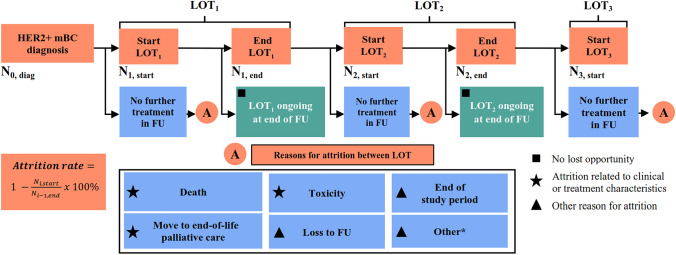
This retrospective, observational, multi-country, cohort study collected electronic medical record data from women aged ≥ 18 years diagnosed with HER2 + mBC from 2017-2021. The primary endpoint was attrition rate (the proportion of patients receiving a line of therapy [LOT] with no further evidence of subsequent LOTs). Key additional endpoints included treatment patterns, real-world time to treatment discontinuation (TTD), and time to next treatment (TTNT).
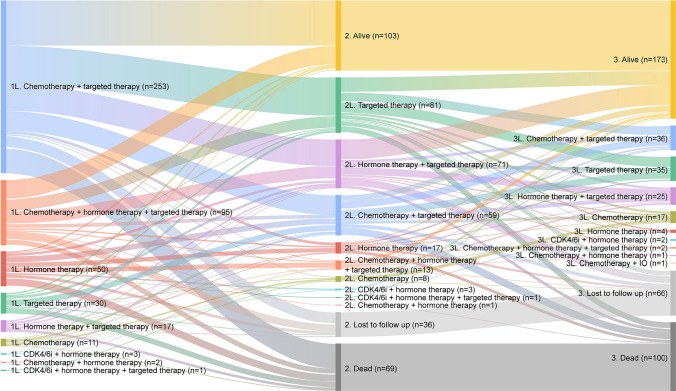
29.6% (95% confidence interval [CI] 25.0-34.6) and 34.2% (95% CI 27.5-41.5) of treated patients with HER2 + mBC had no further evidence of treatment beyond 1L and second-line (2L) therapy, respectively. Attrition was primarily owing to death, move to end-of-life palliative care, loss to follow up, and "other" reasons. Treatment patterns were generally aligned with clinical guidelines. Decreases in TTD (12.1 months [95% CI 10.4-14.5] for 1L, 8.9 months [95% CI 7.3-11.9] for 2L, 6.4 months [95% CI 5.2-8.9] for 3L) and TTNT (15.4 months [95% CI 13.6-20.6] for 1L, 13.5 months [95% CI 10.8-19.4] for 2L) were observed with each subsequent LOT.
Results unveil a large proportion of patients who do not benefit from state-of-the-art subsequent LOT, and suggest diminishing effectiveness with each subsequent LOT.
在欧洲七个医院系统(法国、德国、意大利、西班牙和英国)接受常规治疗的人表皮生长因子受体2阳性(HER2+)转移性乳腺癌(mBC)患者中,描述从一线(1L)到三线(3L)治疗的实际脱落率。
这项回顾性、观察性、多国队列研究收集了2017年至2021年期间年龄≥18岁、诊断为HER2+mBC的女性的电子病历数据。主要终点是脱落率(接受某一线治疗[LOT]且无后续LOT进一步证据的患者比例)。关键的附加终点包括治疗模式、实际治疗中断时间(TTD)和下次治疗时间(TTNT)。
接受治疗的HER2+mBC患者中,分别有29.6%(95%置信区间[CI]25.0-34.6)和34.2%(95%CI 27.5-41.5)在1L和二线(2L)治疗后没有进一步的治疗证据。脱落主要归因于死亡、转为临终姑息治疗、失访和“其他”原因。治疗模式总体上与临床指南一致。随着后续每一LOT的进行,观察到TTD(1L为12.1个月[95%CI 10.4-14.5],2L为8.9个月[95%CI 7.3-11.9],3L为6.4个月[95%CI 5.2-8.9])和TTNT(1L为15.4个月[95%CI 13.6-20.6],2L为13.5个月[95%CI 10.8-19.4])均有所下降。
结果揭示了很大一部分患者无法从后续的先进LOT中获益,并表明随着后续每一LOT的进行,疗效逐渐降低。