Department of Ophthalmology, University of Auckland, Auckland, New Zealand.
Department of Ophthalmology, University of Ulsan College of Medicine, Asan Medical Center, 88, Olympic-ro 43-gil, Songpa-gu, Seoul, 05505, South Korea.
BMC Ophthalmol. 2024 Oct 21;24(1):459. doi: 10.1186/s12886-024-03720-2.
To compare long-term intraocular lens (IOL) decentration and tilt following femtosecond laser-assisted cataract surgery (FLACS) and conventional surgery using swept-source anterior segment ocular coherence tomography (SS-ASOCT).
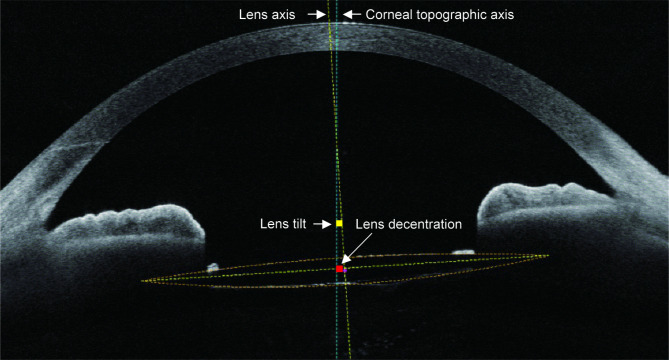
In this retrospective cross-sectional study, all patients underwent FLACS or conventional cataract surgery. Those with a minimum of 12-months follow-up since surgery were included. Patients with surgical complications were excluded. Demographics, preoperative ocular measurements (axial length, anterior chamber depth), and postoperative measurements [corrected distance visual acuity (CDVA), autorefraction, keratometry, IOL type] were collected. Postoperative IOL tilt and decentration were compared using SS-ASOCT between patients with FLACS and conventional cataract surgery. Subgroup analysis was conducted to analyze tilt and decentration by haptic type (single-piece vs. three-piece).
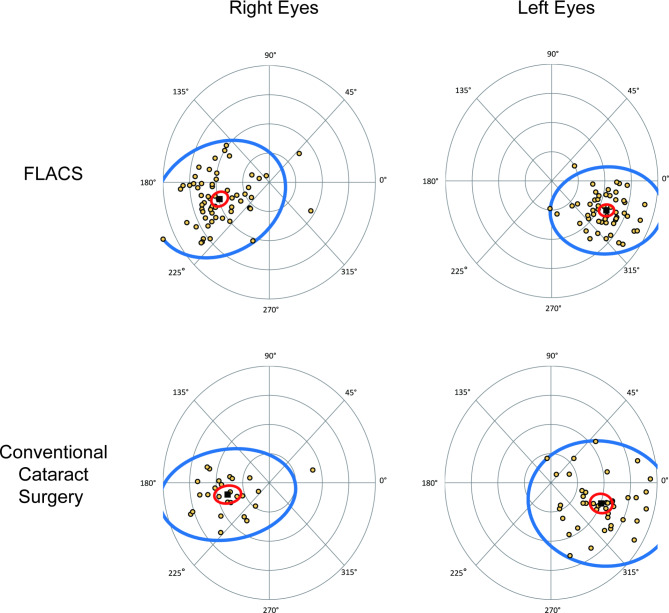
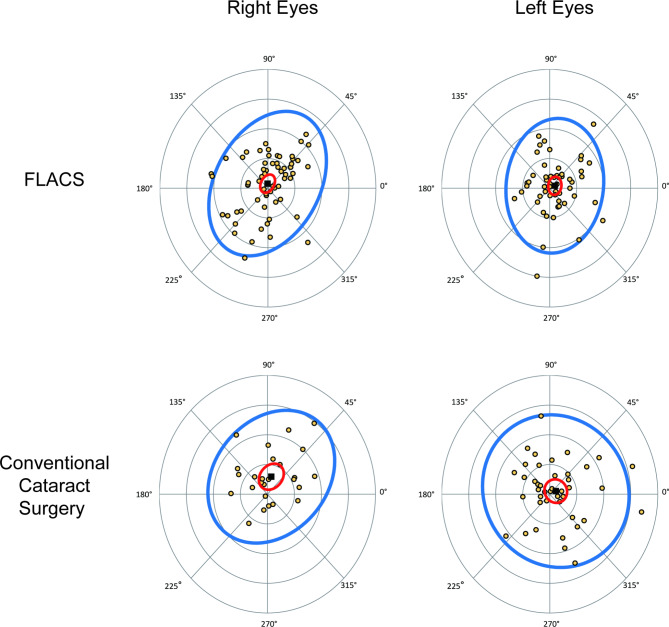
A total of 188 eyes were included [110 (58.5%) in the FLACS group and 78 (41.5%) in the conventional group]. No differences were observed between the FLACS and conventional groups regarding preoperative parameters. FLACS resulted in less IOL decentration compared to conventional cataract surgery (170 μm vs. 240 μm, p = 0.002). No statistically significant differences were observed between the FLACS and conventional groups in the magnitude and axis of IOL tilt. Both groups had a trend of IOL tilt toward the inferotemporal aspects. Moreover, no difference regarding postoperative CDVA, spherical equivalent, and keratometric astigmatism was observed.
FLACS resulted in significantly better long-term IOL centration than conventional surgery with manual capsulotomy. No significant difference in IOL tilt or postoperative CDVA was observed between FLACS and conventional cataract surgery.
使用扫频源眼前节光学相干断层扫描(SS-ASOCT)比较飞秒激光辅助白内障手术(FLACS)和传统手术治疗后长期的人工晶状体(IOL)偏心和倾斜。
在这项回顾性的横断面研究中,所有患者均接受了 FLACS 或传统白内障手术。纳入术后随访至少 12 个月的患者。排除有手术并发症的患者。收集患者的人口统计学资料、术前眼部测量值(眼轴长度、前房深度)和术后测量值(矫正远视力(CDVA)、自动验光、角膜曲率计、IOL 类型)。使用 SS-ASOCT 比较 FLACS 与传统白内障手术患者术后 IOL 倾斜和偏心。进行亚组分析,根据 IOL 襻类型(一体式与三片式)分析倾斜和偏心。
共纳入 188 只眼[110 只眼(58.5%)行 FLACS,78 只眼(41.5%)行传统白内障手术]。FLACS 组和传统白内障手术组在术前参数方面无差异。与传统白内障手术相比,FLACS 导致 IOL 偏心更小(170μm 比 240μm,p=0.002)。FLACS 组和传统白内障手术组在 IOL 倾斜的幅度和轴线上均无统计学差异。两组均有 IOL 向颞下倾斜的趋势。此外,两组术后 CDVA、等效球镜和角膜散光无差异。
与手动撕囊的传统白内障手术相比,FLACS 可显著提高长期 IOL 中心定位的效果。FLACS 和传统白内障手术在 IOL 倾斜或术后 CDVA 方面无显著差异。