ATR Computational Neuroscience Laboratories, Kyoto, Japan.
Department of Psychology, Graduate School of Humanities and Sociology, The University of Tokyo, Tokyo, Japan.
Nat Commun. 2024 Oct 21;15(1):8706. doi: 10.1038/s41467-024-52733-4.
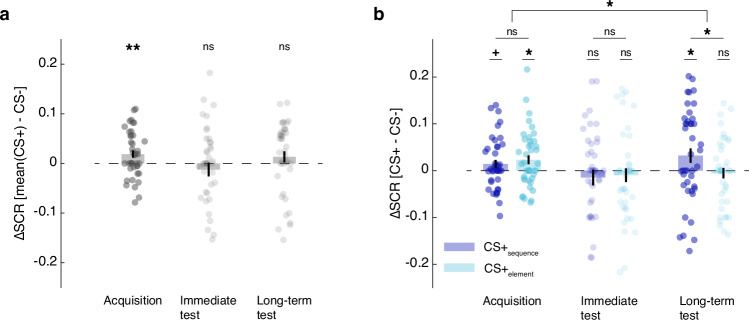
After traumatic events, simple cue-threat associative memories strengthen while episodic memories become incoherent. However, how the brain prioritises cue associations over episodic coding of traumatic events remains unclear. Here, we developed an original episodic threat conditioning paradigm in which participants concurrently form two memory representations: cue associations and episodic cue sequence. We discovered that these two distinct memories compete for physiological fear expression, reorganising overnight from an overgeneralised cue-based to a precise sequence-based expression. With multivariate fMRI, we track inter-area communication of the memory representations to reveal that a rebalancing between hippocampal- and prefrontal control of the fear regulatory circuit governs this memory maturation. Critically, this overnight re-organisation is altered with heightened trait anxiety. Together, we show the brain prioritises generalisable associative memories under recent traumatic stress but resorts to selective episodic memories 24 h later. Time-dependent memory competition may provide a unifying account for memory dysfunctions in post-traumatic stress disorders.
在创伤性事件后,简单的线索-威胁联想记忆增强,而情景记忆变得不连贯。然而,大脑如何优先考虑线索联想,而不是对创伤性事件进行情景编码,仍不清楚。在这里,我们开发了一种原始的情景威胁条件反射范式,其中参与者同时形成两种记忆表现:线索联想和情景线索序列。我们发现,这两种不同的记忆在生理恐惧表达上相互竞争,在一夜之间从基于泛化的线索表达重新组织为基于精确序列的表达。通过多变量 fMRI,我们跟踪记忆表现的区域间通讯,揭示了海马体和前额叶对恐惧调节回路的控制之间的平衡,这控制着这种记忆成熟。关键的是,这种夜间的重新组织在特质焦虑增加时会发生改变。总之,我们表明,大脑在最近的创伤性应激下优先考虑可泛化的联想记忆,但在 24 小时后会选择选择性的情景记忆。时间依赖性记忆竞争可能为创伤后应激障碍中的记忆功能障碍提供了一个统一的解释。