Sohn Suk Ho, Kim Kyung Hwan, Kang Yoonjin, Choi Jae Woong, Lee Seung Hyun, Shinn Sung Ho, Yoo Jae Suk, Lim Cheong
Department of Thoracic and Cardiovascular Surgery, Seoul National University Hospital, Seoul National University College of Medicine, Seoul, Korea.
Department of Thoracic and Cardiovascular Surgery, Severance Cardiovascular Hospital, Yonsei University College of Medicine, Seoul, Korea.
J Chest Surg. 2024 Nov 5;57(6):536-546. doi: 10.5090/jcs.24.048. Epub 2024 Oct 22.
This study compared the costs associated with transcatheter aortic valve implantation (TAVI) and surgical aortic valve replacement (SAVR) in Korea by utilizing the National Health Insurance Service database.
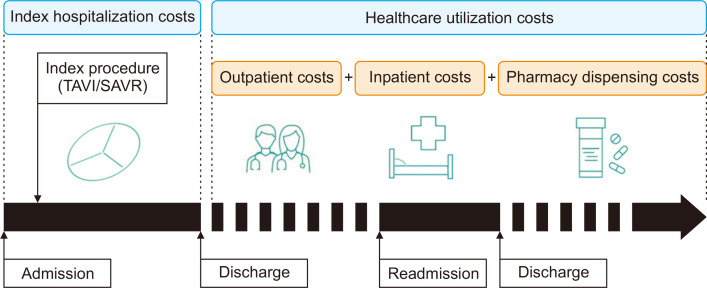
Between June 2015 and May 2019, 1,468 patients underwent primary isolated transfemoral TAVI, while 2,835 patients received primary isolated SAVR with a bioprosthesis. We assessed the costs of index hospitalization and subsequent healthcare utilization, categorizing the cohort into 6 age subgroups: <70, 70-74, 75-79, 80-84, 85-89, and ≥90 years. The median follow-up periods were 2.5 and 3.0 years in the TAVI and SAVR groups, respectively.
The index hospitalization costs were 41.0 million Korean won (KRW) (interquartile range [IQR], 39.1-44.7) for the TAVI group and 24.6 million KRW (IQR, 21.3-30.2) for the SAVR group (p<0.001). The TAVI group exhibited relatively constant index hospitalization costs across different age subgroups. In contrast, the SAVR group showed increasing index hospitalization costs with advancing age. The healthcare utilization costs were 5.7 million KRW per year (IQR, 3.3-14.2) for the TAVI group and 4.0 million KRW per year (IQR, 2.2-9.0) for the SAVR group (p<0.001). Healthcare utilization costs were higher in the TAVI group than in the SAVR group for the age subgroups of <70, 70-74, and 75-79 years, and were comparable in the age subgroups of 80-84, 85-89, and ≥90 years.
TAVI had much higher index hospitalization costs than SAVR. Additionally, the overall healthcare utilization costs post-discharge for TAVI were also marginally higher than those for SAVR in younger age subgroups.
本研究利用韩国国民健康保险服务数据库,比较了经导管主动脉瓣植入术(TAVI)和外科主动脉瓣置换术(SAVR)的相关费用。
2015年6月至2019年5月期间,1468例患者接受了初次单纯经股动脉TAVI,而2835例患者接受了初次单纯生物瓣SAVR。我们评估了首次住院费用及后续医疗保健利用情况,将队列分为6个年龄亚组:<70岁、70 - 74岁、75 - 79岁、80 - 84岁、85 - 89岁和≥90岁。TAVI组和SAVR组的中位随访期分别为2.5年和3.0年。
TAVI组首次住院费用为4100万韩元(四分位间距[IQR],3910 - 4470万韩元),SAVR组为2460万韩元(IQR,2130 - 3020万韩元)(p<0.001)。TAVI组在不同年龄亚组中的首次住院费用相对稳定。相比之下,SAVR组的首次住院费用随着年龄增长而增加。TAVI组的医疗保健利用费用为每年570万韩元(IQR,330 - 1420万韩元),SAVR组为每年400万韩元(IQR,220 - 900万韩元)(p<0.001)。在<70岁、70 - 74岁和75 - 79岁年龄亚组中,TAVI组的医疗保健利用费用高于SAVR组,而在80 - 84岁、85 - 89岁和≥90岁年龄亚组中两者相当。
TAVI的首次住院费用远高于SAVR。此外,在较年轻年龄亚组中,TAVI出院后的总体医疗保健利用费用也略高于SAVR。