Senga Sasi S, Bisson William H, Colacci Annamaria
Nuffield Department of Medicine, University of Oxford, Oxford, United Kingdom.
Integrative Toxicology and Cancer Prevention, Durham, NC, United States.
Front Oncol. 2024 Sep 10;14:1420687. doi: 10.3389/fonc.2024.1420687. eCollection 2024.
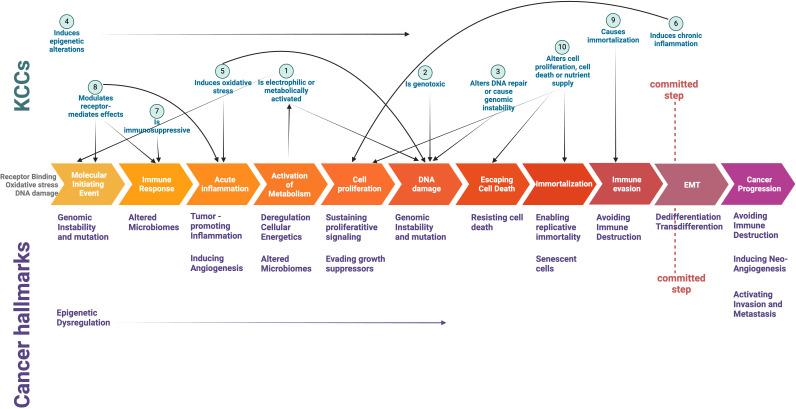
The complexity of cancer requires a comprehensive approach to understand its diverse manifestations and underlying mechanisms. Initially outlined by Hanahan and Weinberg in 2000 and updated in 2010, the hallmarks of cancer provide a conceptual basis for understanding inherent variability in cancer biology. Recent expansions have further elucidated additional hallmarks, including phenotypic plasticity and senescent cells. The International Agency for Research on Cancer (IARC) has identified the key characteristics of carcinogens (KCCs) to evaluate their carcinogenic potential. We analyzed chemicals of concern for environmental exposure that interact with specific receptors to induce genomic instability, epigenetic alterations, immune suppression, and receptor-mediated effects, thereby contributing to chronic inflammation. Despite their varying degrees of carcinogenicity, these chemicals have similar KCC profiles. Our analysis highlights the pivotal role of receptor binding in activating most other KCCs, underscoring their significance in cancer initiation. Although KCCs are associated with early molecular or cellular events, they do not encompass processes directly linked to full cellular malignancy. Thus, there is a need to integrate clear endpoints that anchor KCCs to the acquisition of a complete malignant phenotype into chemical testing. From the perspective of toxicology and cancer research, an all-encompassing strategy that incorporates both existing and novel KCCs and cancer hallmarks is essential to enable the targeted identification of prevalent carcinogens and facilitate zone-specific prevention strategies. To achieve this goal, collaboration between the KCC and cancer hallmarks communities becomes essential.
癌症的复杂性需要采用综合方法来理解其多样的表现形式和潜在机制。癌症的特征最初由哈纳汉和温伯格于2000年概述,并于2010年更新,为理解癌症生物学中的内在变异性提供了概念基础。最近的扩展进一步阐明了其他特征,包括表型可塑性和衰老细胞。国际癌症研究机构(IARC)已经确定了致癌物的关键特征(KCCs),以评估其致癌潜力。我们分析了与特定受体相互作用以诱导基因组不稳定、表观遗传改变、免疫抑制和受体介导效应从而导致慢性炎症的环境暴露相关化学物质。尽管这些化学物质的致癌程度各不相同,但它们具有相似的KCC特征。我们的分析突出了受体结合在激活大多数其他KCC中的关键作用,强调了它们在癌症起始中的重要性。尽管KCCs与早期分子或细胞事件相关,但它们并不涵盖与完全细胞恶性肿瘤直接相关的过程。因此,有必要将明确的终点纳入化学测试中,这些终点将KCCs与获得完整恶性表型联系起来。从毒理学和癌症研究的角度来看,一种包含现有和新型KCCs以及癌症特征的全面策略对于有针对性地识别常见致癌物和促进区域特异性预防策略至关重要。为实现这一目标,KCCs和癌症特征领域之间的合作变得至关重要。