Division of Endocrinology, Department of Medicine, Escola Paulista de Medicina, Universidade Federal de São Paulo, Estado de Israel 639, Vila Clementino,, São Paulo, SP, 04022-001, Brazil.
Department of Preventive Medicine, Escola Paulista de Medicina, Universidade Federal de São Paulo,, Botucatu, 740, Vila Clementino,, SP, 04024-002, São Paulo, Brazil.
Cardiovasc Diabetol. 2024 Oct 22;23(1):374. doi: 10.1186/s12933-024-02460-3.
The Steno Type 1 Risk Engine (ST1RE) was developed to aid clinical decisions in primary prevention for individuals with type 1 diabetes (T1D), as existing cardiovascular (CV) risk models for the general population and type 2 diabetes tend to underestimate CV risk in T1D. However, the applicability of ST1RE in different populations remains uncertain, as prediction models developed for one population may not accurately estimate risk in another. This study aimed to evaluate the performance of the ST1RE in predicting CV events among ethnically mixed T1D individuals and its association with the progression of microangiopathy complications.
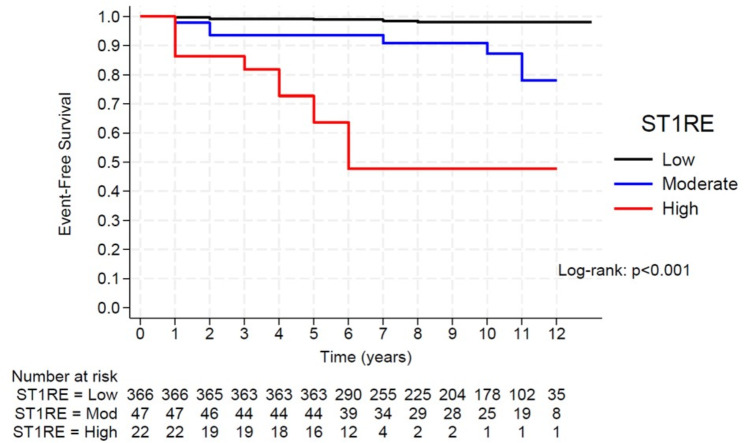
A retrospective survey of 435 adults with T1D who were free of CV events at baseline was assessed by ST1RE and chronic diabetes complications at 5 and 10 years of follow-up. The estimated CV risk rates were compared with the observed rates at 5 and 10 years using statistical analyses, including Receiver Operating Characteristic (ROC) curve analysis, Hosmer-Lemeshow test, Kaplan-Meier curves analysis and Cox-regression models.
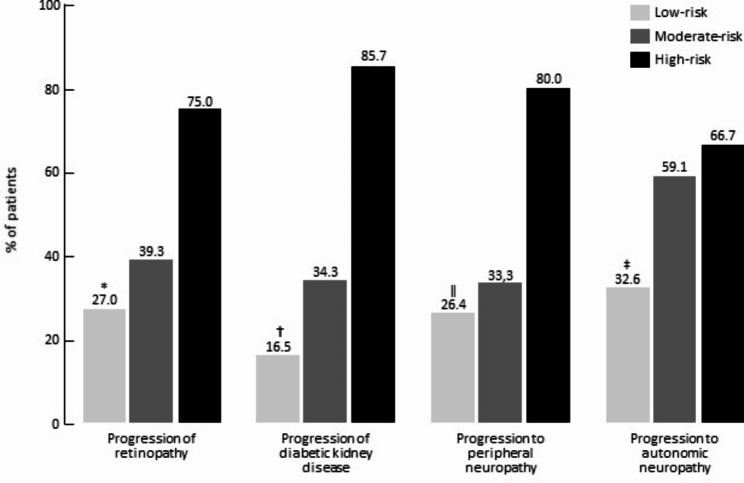
Among 435 patients (aged 25 years; interquartile range [IQR]: 21-32) with a median T1D duration of 13 years (IQR: 9-18), only 5% were categorized into the high ST1RE group. Within a median follow-up of 9.2 years (IQR 6.0-10.7), 5.5% of patients experienced a CV event (1.6%, 14.9%, and 50% from the low, moderate, and high-risk groups, respectively). The hazard ratios (HRs) for CV events were greater in the high-risk group (HR 52.02; 95% CI 18.60-145.51, p < 0.001) and in the moderate-risk group (HR 8.66; 95% CI 2.90-25.80, p < 0.001) compared to the low-risk group. The ST1RE estimated CV events were similar to the observed at 5 years (3.4% vs. 3.5%; χ = 10.12, p = 0.899) and 10 years (6.8% vs. 9.9%; χ = 14.80, p = 0.676) of follow-up. The progression of microangiopathies was greater in the high vs. low for retinopathy (p = 0.008), diabetic kidney disease (p < 0.001), peripheral neuropathy (p = 0.021), and autonomic neuropathy (p = 0.008).
ST1RE performed well in predicting CV events at 5 and 10 years of follow-up. Moreover, higher ST1RE scores were associated with the progression of microangiopathy complications in this genetically heterogeneous T1D population.
Steno Type 1 Risk Engine(ST1RE)旨在辅助 1 型糖尿病(T1D)患者的一级预防中的临床决策,因为现有的心血管(CV)风险模型在普通人群和 2 型糖尿病中往往低估了 T1D 的 CV 风险。然而,ST1RE 在不同人群中的适用性仍不确定,因为为一个人群开发的预测模型可能无法准确估计另一个人群的风险。本研究旨在评估 ST1RE 在预测混合种族 T1D 个体 CV 事件中的表现及其与微血管并发症进展的关系。
对 435 名基线时无 CV 事件的 T1D 成年患者进行回顾性调查,通过 ST1RE 评估,并在 5 年和 10 年随访时评估慢性糖尿病并发症。使用统计分析(包括接受者操作特征(ROC)曲线分析、Hosmer-Lemeshow 检验、Kaplan-Meier 曲线分析和 Cox 回归模型)比较估计的 CV 风险率与 5 年和 10 年的观察率。
在 435 名(年龄 25 岁;四分位距 [IQR]:21-32)中位 T1D 病程为 13 年(IQR:9-18)的患者中,仅有 5%被归入高 ST1RE 组。在中位随访 9.2 年(IQR 6.0-10.7)期间,5.5%的患者发生 CV 事件(低、中、高危组分别为 1.6%、14.9%和 50%)。高危组(危险比 [HR] 52.02;95%置信区间 [CI] 18.60-145.51,p<0.001)和中危组(HR 8.66;95%CI 2.90-25.80,p<0.001)的 CV 事件发生 HR 高于低危组。ST1RE 估计的 CV 事件与 5 年(3.4%比 3.5%;χ=10.12,p=0.899)和 10 年(6.8%比 9.9%;χ=14.80,p=0.676)随访时的观察结果相似。微血管并发症的进展在高 vs. 低视网膜病变(p=0.008)、糖尿病肾病(p<0.001)、周围神经病变(p=0.021)和自主神经病变(p=0.008)方面更高。
ST1RE 在预测 5 年和 10 年随访时的 CV 事件方面表现良好。此外,在这个遗传异质性的 T1D 人群中,较高的 ST1RE 评分与微血管并发症的进展有关。