Yan Yuxin, Zhang Jian
Department of Medical Oncology, Fudan University Shanghai Cancer Center, Shanghai, China.
Department of Oncology, Shanghai Medical College, Fudan University, Shanghai, China.
Front Oncol. 2024 Oct 8;14:1458588. doi: 10.3389/fonc.2024.1458588. eCollection 2024.
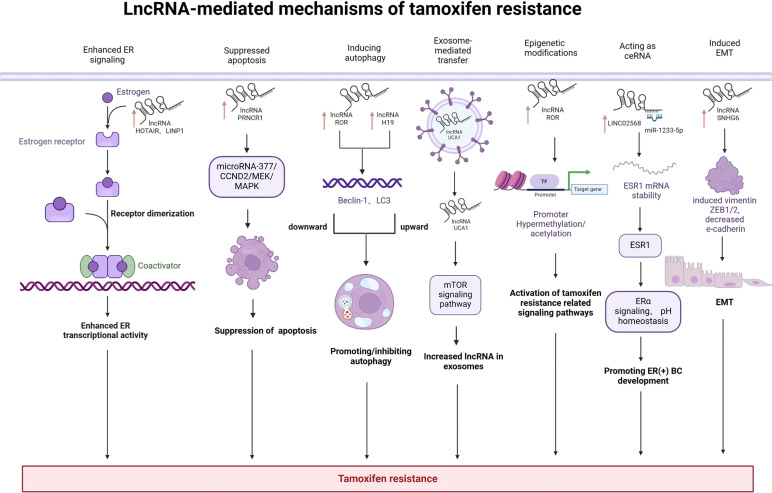
Breast cancer(BC) is the second most prevalent tumor in the world and one of the most lethal tumors in women. Patients with estrogen receptor-positive breast cancer can obtain significant advantages from endocrine therapies including tamoxifen, aromatase inhibitors, and others. However, the development of primary or acquired drug resistance ultimately leads to discontinuation of treatment with adverse consequences for breast cancer patients, and the underlying mechanisms have not been fully elucidated. Long non-coding RNAs (lncRNAs) play pivotal roles in orchestrating fundamental biochemical and cellular processes. They exert regulatory control over various processes including epigenetics, gene transcription, post-transcriptional modifications, and translation. Additionally, they influence key biological events like cell cycle progression, cell differentiation, and development. For the past few years, the relationship between lncRNAs and endocrine resistance has gained increasing attention, leading to a surge in related studies. LncRNAs mediate tamoxifen resistance in cancer by utilizing a variety of molecular mechanisms, including enhanced estrogen receptor (ER) signaling, inhibition of apoptosis, autophagy, exosome-mediated transfer, epigenetic alterations, epithelial-to-mesenchymal transition, and acting as competitive endogenous RNAs(ceRNAs). In this comprehensive review, we systematically summarize the critical role and intricate molecular mechanisms by which lncRNAs influence the development of tamoxifen resistance in breast cancer. Furthermore, we propose the potential clinical significance of lncRNAs as innovative therapeutic targets and prognostic biomarkers for breast cancer.
乳腺癌(BC)是全球第二大常见肿瘤,也是女性中最致命的肿瘤之一。雌激素受体阳性乳腺癌患者可从包括他莫昔芬、芳香化酶抑制剂等在内的内分泌治疗中获得显著益处。然而,原发性或获得性耐药的发展最终会导致治疗中断,给乳腺癌患者带来不良后果,其潜在机制尚未完全阐明。长链非编码RNA(lncRNAs)在协调基本生化和细胞过程中发挥关键作用。它们对包括表观遗传学、基因转录、转录后修饰和翻译等各种过程施加调控。此外,它们还影响细胞周期进程、细胞分化和发育等关键生物学事件。在过去几年中,lncRNAs与内分泌耐药之间的关系越来越受到关注,相关研究激增。lncRNAs通过多种分子机制介导癌症中的他莫昔芬耐药,包括增强雌激素受体(ER)信号传导、抑制细胞凋亡、自噬、外泌体介导的转移、表观遗传改变、上皮-间质转化以及作为竞争性内源RNA(ceRNAs)。在这篇综述中,我们系统地总结了lncRNAs影响乳腺癌他莫昔芬耐药发展的关键作用和复杂分子机制。此外,我们提出了lncRNAs作为乳腺癌创新治疗靶点和预后生物标志物的潜在临床意义。