Department of Neurology and Clinical Pharmacology, Ehime University Graduate School of Medicine, Ehime, Japan.
Department of Neurology, Faculty of Medicine, Fukuoka University, Fukuoka, Japan.
PLoS One. 2024 Oct 23;19(10):e0309297. doi: 10.1371/journal.pone.0309297. eCollection 2024.
Non-motor symptoms (NMS) are important factors when selecting treatments for patients with advanced Parkinson's disease (PD). We sought to elucidate the prescribing practices for advanced PD patients with NMS in Japanese clinical practice.
We examined the prescription rates and doses of anti-PD drugs, and the use of non-steroidal anti-inflammatory drugs (NSAIDs) in post hoc analyses of a 52-week observational study of 996 PD patients with wearing-off on levodopa-containing therapy and ≥1 NMS.
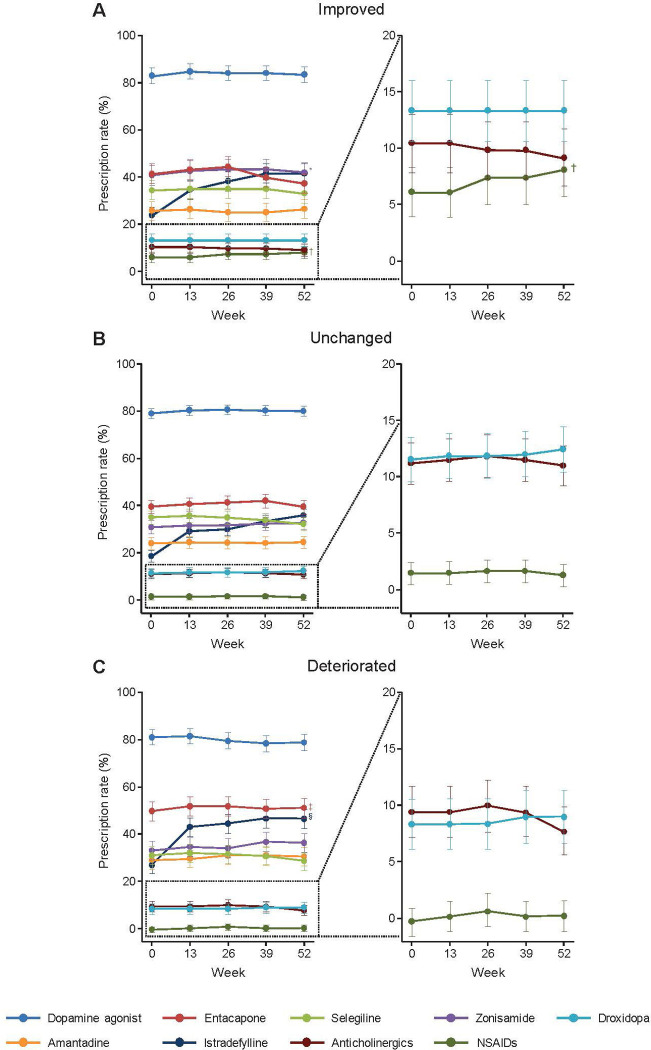
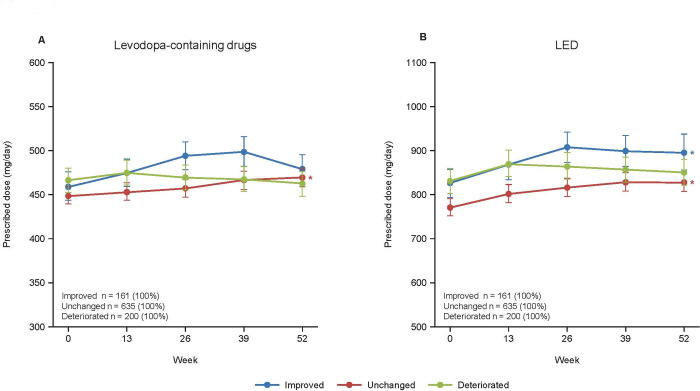
Dopamine agonists were the most frequently prescribed drugs combined with levodopa-containing drugs, followed by entacapone, zonisamide, istradefylline, selegiline, and amantadine. The daily dose of levodopa-containing drugs, rotigotine, entacapone, istradefylline, and droxidopa, and the levodopa-equivalent dose increased during the observation period. In a subgroup analysis of patients stratified by NMS status (improved/unchanged/deteriorated), the deteriorated group had higher prescription rates of entacapone and istradefylline, whereas the improved group had higher prescription rates of NSAIDs and zonisamide at Week 52. Prescriptions varied by geographical region for anti-PD drugs and by NMS status for NSAIDs.
There were significant changes in the prescriptions and dosing of selected anti-PD drugs, especially newer drugs. Anti-PD drug and NSAID prescriptions also varied by changes in NMS status and geographic region.
非运动症状(NMS)是选择晚期帕金森病(PD)患者治疗方案的重要因素。我们旨在阐明日本临床实践中晚期伴有 NMS 的 PD 患者的处方实践。
我们在后设分析中检查了 996 例服用左旋多巴药物且出现症状波动且存在≥1 种 NMS 的 PD 患者的 52 周观察性研究中抗 PD 药物的处方率和剂量,以及非甾体抗炎药(NSAIDs)的使用情况。
与含左旋多巴药物联合使用时,多巴胺激动剂是最常开的药物,其次是恩他卡朋、唑尼沙胺、依曲茶碱、司来吉兰和金刚烷胺。在观察期间,含左旋多巴药物、罗替高汀、恩他卡朋、依曲茶碱和屈昔多巴的日剂量和左旋多巴等效剂量增加。在按 NMS 状态(改善/不变/恶化)分层的患者亚组分析中,恶化组的恩他卡朋和依曲茶碱处方率更高,而改善组在第 52 周时 NSAIDs 和唑尼沙胺的处方率更高。抗 PD 药物的处方因地理区域而异,NSAIDs 的处方因 NMS 状态而异。
选择的抗 PD 药物的处方和剂量发生了重大变化,尤其是新型药物。抗 PD 药物和 NSAIDs 的处方也因 NMS 状态和地理区域的变化而有所不同。