Schwarz Patricia, Hellmers Sandra, Spanknebel Sebastian, Hurlemann Rene, Hein Andreas
Assistance Systems and Medical Device Technology, Department for Health Services Research, School of Medicine and Health Sciences, Carl von Ossietzky University, Oldenburg, Germany.
Department of Psychiatry and Psychotherapy, School of Medicine and Health Sciences, Carl von Ossietzky University, Oldenburg, Germany.
Front Robot AI. 2024 Oct 9;11:1424845. doi: 10.3389/frobt.2024.1424845. eCollection 2024.
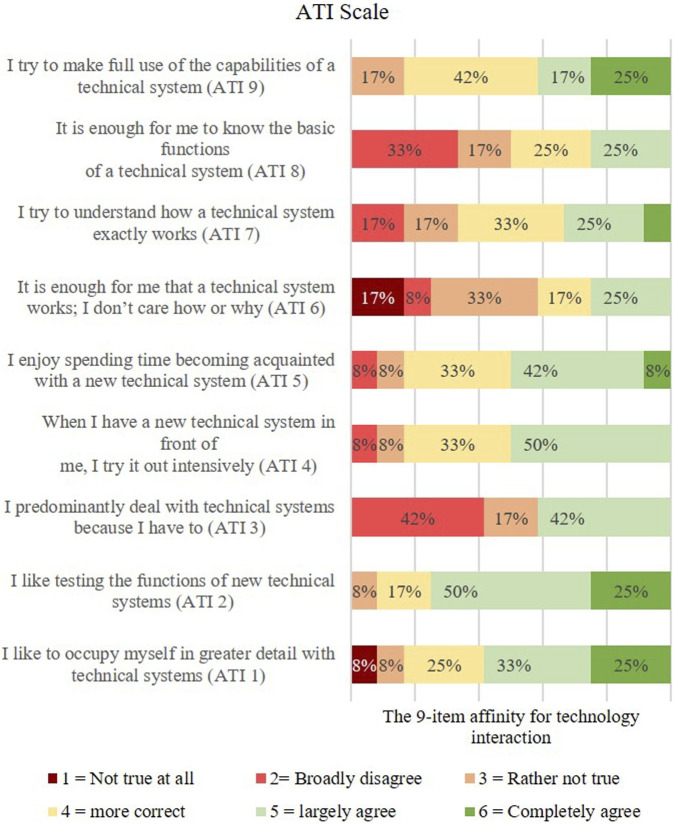
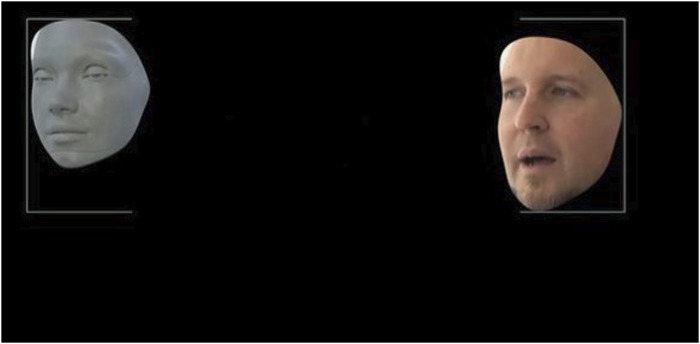
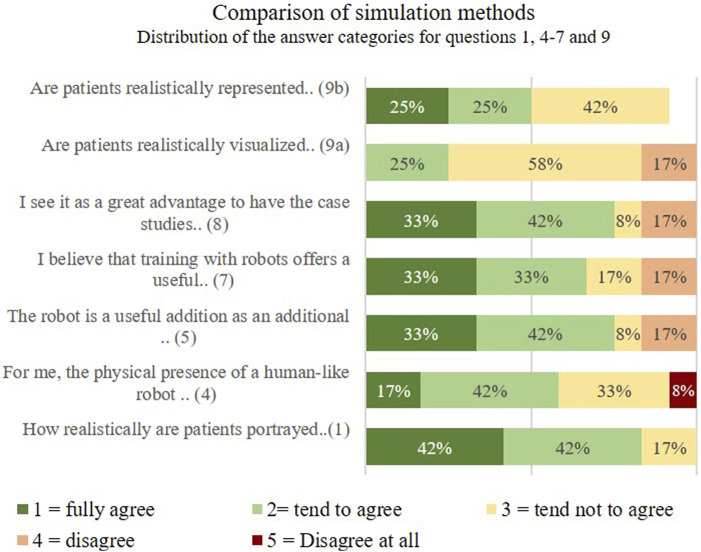
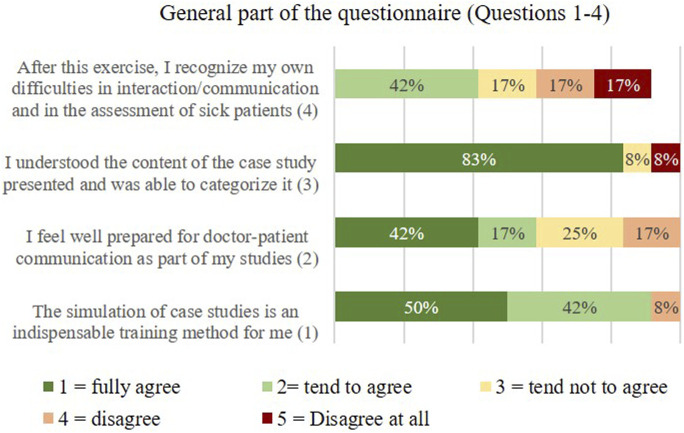
Simulation-based learning is an integral part of hands-on learning and is often done through role-playing games or patients simulated by professional actors. In this article, we present the use of a humanoid robot as a simulation patient for the presentation of disease symptoms in the setting of medical education. In a study, 12 participants watched both the patient simulation by the robotic patient and the video with the actor patient. We asked participants about their subjective impressions of the robotic patient simulation compared to the video with the human actor patient using a self-developed questionnaire. In addition, we used the Affinity for Technology Interaction Scale. The evaluation of the questionnaire provided insights into whether the robot was able to realistically represent the patient which features still need to be improved, and whether the robot patient simulation was accepted by the participants as a learning method. Sixty-seven percent of the participants indicated that they would use the robot as a training opportunity in addition to the videos with acting patients. The majority of participants indicated that they found it very beneficial to have the robot repeat the case studies at their own pace.
基于模拟的学习是实践学习的一个组成部分,通常通过角色扮演游戏或由专业演员模拟的患者来进行。在本文中,我们介绍了使用人形机器人作为模拟患者,在医学教育环境中呈现疾病症状的情况。在一项研究中,12名参与者观看了机器人患者的模拟以及有真人演员患者的视频。我们使用自行编制的问卷,询问参与者与有真人演员患者的视频相比,他们对机器人患者模拟的主观印象。此外,我们还使用了技术交互亲和力量表。问卷评估提供了关于机器人是否能够逼真地呈现患者、哪些特征仍需改进,以及机器人患者模拟是否被参与者作为一种学习方法所接受的见解。67%的参与者表示,除了有真人演员患者的视频外,他们会将机器人作为一种培训机会。大多数参与者表示,他们发现让机器人按照自己的节奏重复案例研究非常有益。