School of Kinesiology, Auburn University, Auburn, AL, USA.
Department of Educational Foundations, Leadership, and Technology, Auburn University, Auburn, AL, USA.
Exp Brain Res. 2024 Dec;242(12):2815-2825. doi: 10.1007/s00221-024-06929-1. Epub 2024 Oct 24.
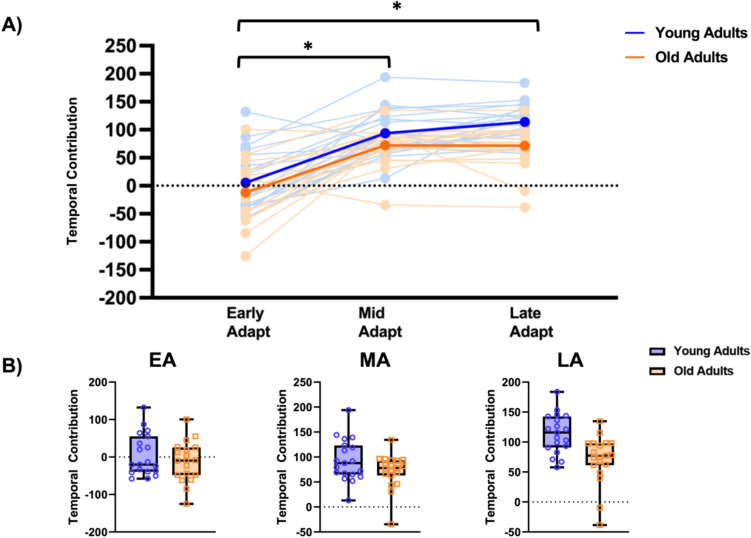
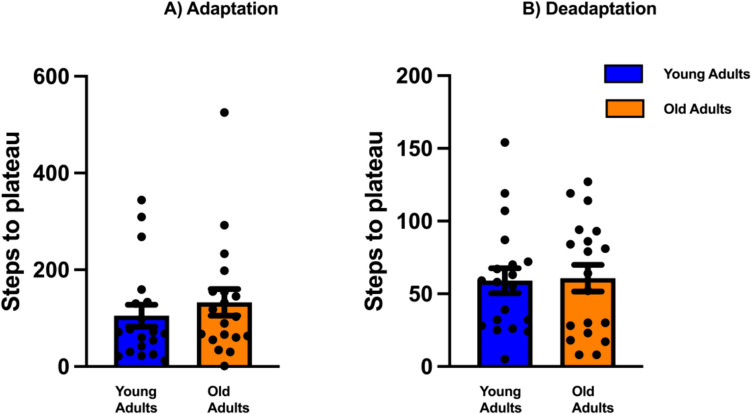
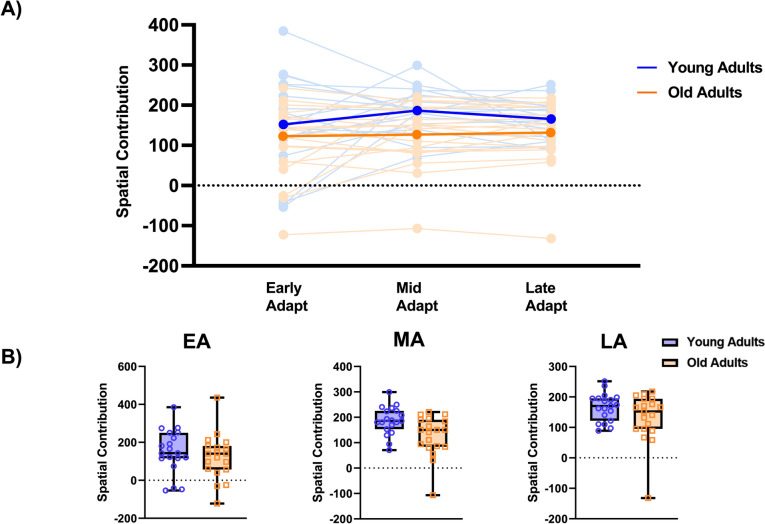
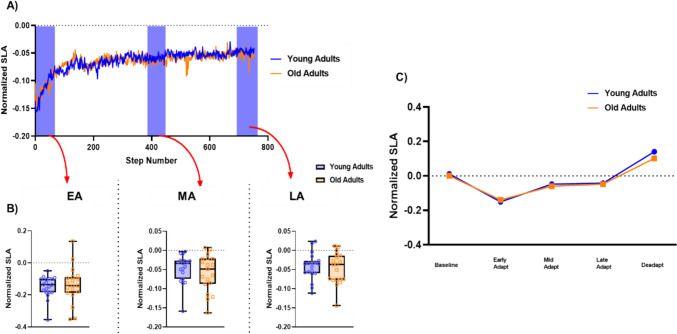
Gait adaptability is crucial for meeting environmental demands, and impaired gait adaptation increases fall risk, particularly in older adults. While prior research exists on older adults' gait adaptation, particularly in perturbation studies, the specific contributions of temporal and spatial adaptation strategies to step length asymmetry (SLA) during split-belt treadmill walking require further examination. This study fills this gap by evaluating how distinct adaptation strategies contribute to SLA in healthy young and older adults. 19 healthy young adults (20.4 ± 1.1 years) and 19 healthy older adults (68.3 ± 8.1 years) walked on a split-belt treadmill requiring their non-dominant leg to move twice as fast as their dominant leg. Repeated measures ANOVA investigated (1) spatial and temporal contributions to SLA, (2) SLA across gait adaptation epochs, and (3) rates of adaptation and deadaptation. Older adults displayed reduced temporal contributions to SLA compared to younger adults (F = 6.42, p = .02, ŋ = .15), but no group differences were observed in spatial contributions to SLA (F = 3.23, p = .08, ŋ = .082). SLA during adaptation and deadaptation did not differ by age group, nor did the rate of adaptation (F = 0.594, p = .45) or deadaptation F = 2.886, p = .09). These findings suggest that while older adults rely less on temporal strategies for gait adaptation, but maintain overall adaptability comparable to younger adults. Findings enhance our understanding of age-related changes in gait adaptation mechanisms and may inform targeted interventions to improve gait adaptability in older populations.
步态适应性对于满足环境需求至关重要,而步态适应性受损会增加跌倒风险,尤其是在老年人中。虽然先前有关于老年人步态适应性的研究,特别是在扰动研究中,但在分带跑步机行走中,时间和空间适应策略对步长不对称性(SLA)的具体贡献仍需要进一步研究。本研究通过评估不同适应策略如何有助于健康的年轻和老年人的 SLA 来填补这一空白。19 名健康的年轻成年人(20.4±1.1 岁)和 19 名健康的老年人(68.3±8.1 岁)在分带跑步机上行走,要求他们的非优势腿比优势腿快两倍。重复测量方差分析研究了(1)SLA 的空间和时间贡献,(2)适应期的 SLA,以及(3)适应和去适应的速度。与年轻人相比,老年人的 SLA 时间贡献减少(F=6.42,p=0.02,ŋ=0.15),但 SLA 的空间贡献没有组间差异(F=3.23,p=0.08,ŋ=0.082)。适应和去适应期间的 SLA 不因年龄组而异,适应速度(F=0.594,p=0.45)或去适应速度(F=2.886,p=0.09)也不因年龄组而异。这些发现表明,尽管老年人在步态适应中较少依赖时间策略,但仍保持与年轻人相当的整体适应性。这些发现增强了我们对与年龄相关的步态适应机制变化的理解,并可能为改善老年人群的步态适应性提供有针对性的干预措施。