4(th) Department of Internal Medicine, National and Kapodistrian University of Athens, Medical School, Athens, Greece; Hellenic Institute for the Study of Sepsis, Athens, Greece.
Dipartimento di Scienze Biotecnologiche di Base, Cliniche Intensivologiche e Perioperatorie, Università Cattolica del Sacro Cuore, Rome, Italy; Dipartimento di Scienze dell'Emergenza, Anestesiologiche e della Rianimazione, Fondazione Policlinico Universitario A. Gemelli IRCCS, Rome, Italy.
EBioMedicine. 2024 Nov;109:105414. doi: 10.1016/j.ebiom.2024.105414. Epub 2024 Oct 23.
Endotype classification becomes the cornerstone of understanding sepsis pathogenesis. Macrophage activation-like syndrome (MALS) and immunoparalysis are the best recognized major endotypes, so far. Interferon-gamma (IFNγ) action on tissue macrophages stimulates the release of the cytotoxic chemokine CXCL9. It was investigated if this mechanism may be an independent sepsis endotype.
In this cohort study, 14 patient cohorts from Greece, Germany and Italy were studied. The cohorts were 2:1 randomly split into discovery and validation sets. Sepsis was defined by the Sepsis-3 definitions and blood was sampled the first 24 h from meeting the Sepsis-3 definitions. Concentrations of IFNγ, CXCL9, IP-10 (IFNγ induced protein-10), soluble CD163 and ferritin were measured. The endotype of IFNγ-driven sepsis (IDS) was defined in the discovery set as the combination of a) blood IFNγ above a specified cut-off associated with the minimal risk for immunoparalysis (defined as ≥8000 HLA-DR receptors on CD45/CD14-monoytes); and b) increase of CXCL9. Results were compared to the validation set.
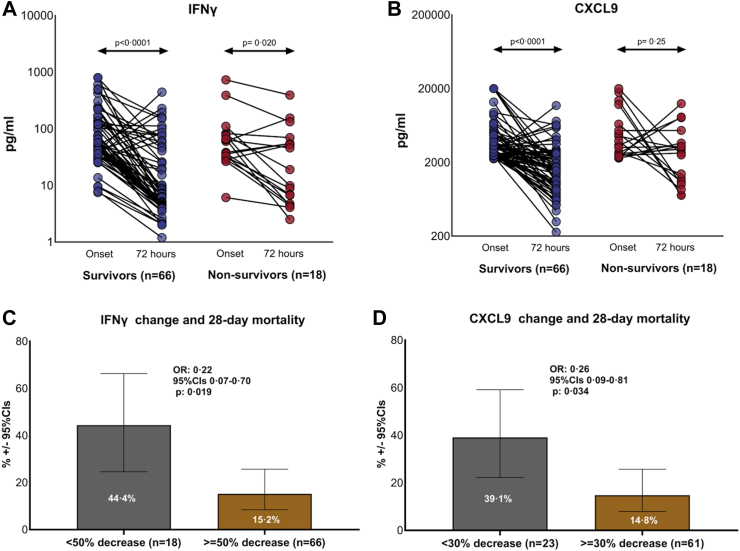
5503 patients were studied; 3670 in the discovery set and 1833 in the validation set. IDS was defined as IFNγ more than 3 pg/ml and CXCL9 more than 2200 pg/ml. The frequency of IDS in the discovery set was 19.9% (732 patients; 95% confidence intervals-CIs 18.7-21.3%) and in the validation set 20.0% (366 patients; 95% CIs 18.2-21.9%). Soluble CD163, a marker of macrophage activation, was greater in IDS and IDS had features distinct from MALS. The mortality in IDS patients was 43.0% (315 patients; 95% CIs 39.5-46.6%) in the discovery set and 40.4% in the validation set (148 patients; 95% CIs 35.5-45.5%) (p = 0.44 compared to patients of the discovery set). IDS was an independent risk factor for death in the presence of other endotypes, severity scores and organ dysfunctions of the multivariate model [hazard ratio 1.71 (95% CIs 1.45-2.01) in the discovery set and 1.70 (95% CIs 1.34-2.16) in the validation set]. Decreases of IFNγ and CXCL9 blood levels within the first 72 h were associated with better outcome.
IDS is a new sepsis endotype independently associated with unfavorable outcome.
Hellenic Institute for the Study of Sepsis; Horizon 2020 project ImmunoSep; Swedish Orphan BioVitrum AB (publ) and German Federal Ministry of Education and Research.
内型分类成为理解脓毒症发病机制的基石。巨噬细胞激活样综合征(MALS)和免疫麻痹是迄今为止最被认可的主要内型。干扰素-γ(IFNγ)对组织巨噬细胞的作用刺激了细胞毒性趋化因子 CXCL9 的释放。研究了这一机制是否可能是一种独立的脓毒症内型。
在这项队列研究中,研究了来自希腊、德国和意大利的 14 个患者队列。队列随机分为 2:1 的发现和验证集。脓毒症的定义采用 Sepsis-3 定义,并且在满足 Sepsis-3 定义后的 24 小时内采集血液样本。测量了 IFNγ、CXCL9、IFNγ诱导蛋白-10(IP-10)、可溶性 CD163 和铁蛋白的浓度。在发现集中,IFNγ 驱动的脓毒症(IDS)内型被定义为 a)血液 IFNγ 高于与免疫麻痹最小风险相关的特定截止值(定义为 CD45/CD14-单核细胞上≥8000 个 HLA-DR 受体);和 b)CXCL9 的增加。结果与验证集进行了比较。
研究了 5503 名患者;发现集中有 3670 名患者,验证集中有 1833 名患者。IDS 被定义为 IFNγ 超过 3pg/ml 和 CXCL9 超过 2200pg/ml。发现集中 IDS 的频率为 19.9%(732 名患者;95%置信区间 95%CI 为 18.7-21.3%),验证集中为 20.0%(366 名患者;95%CI 为 18.2-21.9%)。IDS 中可溶性 CD163(一种巨噬细胞激活的标志物)增加,并且 IDS 具有与 MALS 不同的特征。在发现集中,IDS 患者的死亡率为 43.0%(315 名患者;95%CI 为 39.5-46.6%),在验证集中为 40.4%(148 名患者;95%CI 为 35.5-45.5%)(与发现集中的患者相比,p=0.44)。在存在其他内型、严重程度评分和器官功能障碍的多变量模型中,IDS 是死亡的独立危险因素[发现集中的危险比为 1.71(95%CI 为 1.45-2.01),验证集中的危险比为 1.70(95%CI 为 1.34-2.16)]。在最初 72 小时内 IFNγ 和 CXCL9 血液水平的降低与更好的结果相关。
IDS 是一种与不良预后相关的新的脓毒症内型。
希腊脓毒症研究协会;地平线 2020 项目 ImmunoSep;瑞典孤儿生物维生素 AB(publ)和德国联邦教育与研究部。