Evidence Synthesis Branch, International Agency for Research On Cancer (IARC), World Health Organization, 25 Avenue Tony Garnier, CS 90627, 69366, CEDEX 07, LYON, France.
Centro Nacional de Epidemiología, Instituto de Salud Carlos IIII, Calle de Melchor Fernández Almagro 5, 28029, Madrid, Spain.
Virchows Arch. 2024 Nov;485(5):869-878. doi: 10.1007/s00428-024-03886-6. Epub 2024 Oct 25.
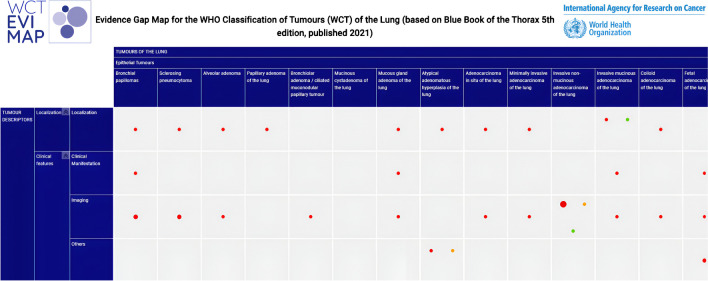
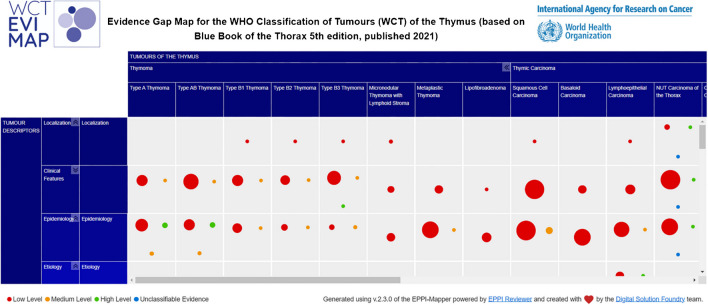
The WHO Classification of Tumours (WCT) guides cancer diagnosis, treatment, and research. However, research evidence in pathology continuously changes, and new evidence emerges. Correct assessment of evidence in the WCT 5th edition (WCT-5) and identification of high level of evidence (LOE) studies based on study design are needed to improve future editions. We aimed at producing exploratory evidence maps for WCT-5 Thoracic Tumours, specifically lung and thymus tumors. We extracted citations from WCT-5, and imported and coded them in EPPI-Reviewer. The maps were plotted using EPPI-Mapper. Maps displayed tumor types (columns), descriptors (rows), and LOE (bubbles using a four-color code). We included 1434 studies addressing 51 lung, and 677 studies addressing 25 thymus tumor types from WCT-5 thoracic tumours volume. Overall, 87.7% (n = 1257) and 80.8% (n = 547) references were low, and 4.1% (n = 59) and 2.2% (n = 15) high LOE for lung and thymus tumors, respectively. Invasive non-mucinous adenocarcinoma of the lung (n = 215; 15.0%) and squamous cell carcinoma of the thymus (n = 93; 13.7%) presented the highest number of references. High LOE was observed for colloid adenocarcinoma of the lung (n = 11; 18.2%) and type AB thymoma (n = 4; 1.4%). Tumor descriptors with the highest number of citations were prognosis and prediction (n = 273; 19.0%) for lung, and epidemiology (n = 186; 28.0%) for thymus tumors. LOE was generally low for lung and thymus tumors. This study represents an initial step in the WCT Evidence Gap Map (WCT-EVI-MAP) project for mapping references in WCT-5 for all tumor types to inform future WCT editions.
世界卫生组织肿瘤分类(WCT)指导癌症的诊断、治疗和研究。然而,病理学研究证据不断变化,新证据不断涌现。为了改进未来的版本,需要对第五版 WCT(WCT-5)中的证据进行正确评估,并根据研究设计确定高水平证据(LOE)研究。我们旨在为 WCT-5 胸部肿瘤,特别是肺和胸腺肿瘤制作探索性证据图谱。我们从 WCT-5 中提取引文,并将其导入和编码在 EPPI-Reviewer 中。使用 EPPI-Mapper 绘制图谱。图谱显示肿瘤类型(列)、描述符(行)和 LOE(使用四色代码的气泡)。我们纳入了来自 WCT-5 胸部肿瘤卷的 51 种肺肿瘤和 677 种胸腺肿瘤类型的 1434 项研究。总体而言,肺和胸腺肿瘤的低水平证据(n=1257;87.7%)和高水平证据(n=547;80.8%)分别占 87.7%(n=1257)和 80.8%(n=547),4.1%(n=59)和 2.2%(n=15)。肺的浸润性非黏液性腺癌(n=215;15.0%)和胸腺癌(n=93;13.7%)的参考文献数量最多。肺的胶样腺癌(n=11;18.2%)和 AB 型胸腺瘤(n=4;1.4%)的高水平证据。肺肿瘤描述符的参考文献数量最多的是预后和预测(n=273;19.0%),而胸腺肿瘤则是流行病学(n=186;28.0%)。肺和胸腺肿瘤的 LOE 普遍较低。这项研究代表了 WCT 证据差距图谱(WCT-EVI-MAP)项目的初步步骤,该项目旨在为所有肿瘤类型在 WCT-5 中的参考文献制作图谱,以为未来的 WCT 版本提供信息。