Turner Grace Anne, Moreira de Sousa Agostinho, O'Connell Emer, Kovats Sari, Brooks Katya, Landeg Owen, Ismail Sharif, Rajamani Anusha, Hajat Shakoor
NIHR Health Protection Research Unit in Environmental Change and Health, Department of Public Health, Environment and Society, London School of Hygiene and Tropical Medicine, London, United Kingdom.
Extreme Events and Health Protection Team, UK Health Security Agency, London, United Kingdom.
Eur J Public Health. 2024 Dec 1;34(6):1192-1198. doi: 10.1093/eurpub/ckae153.
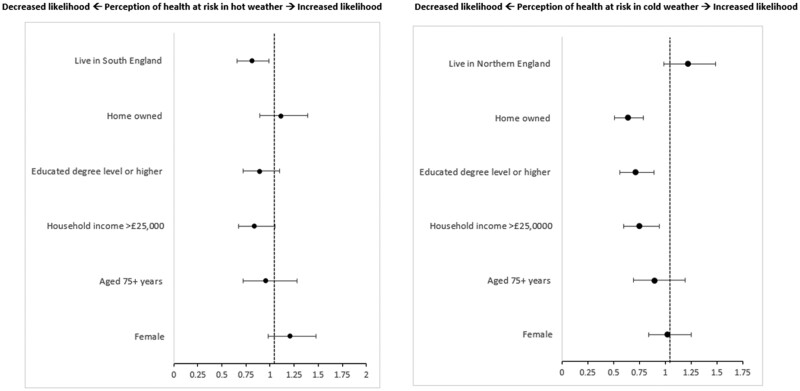
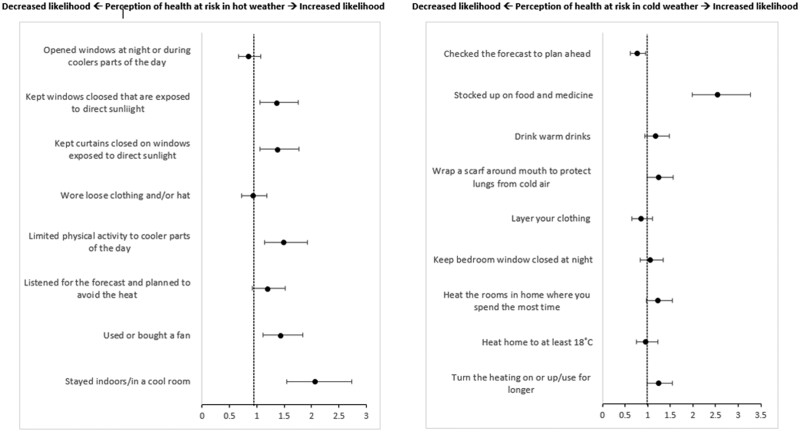
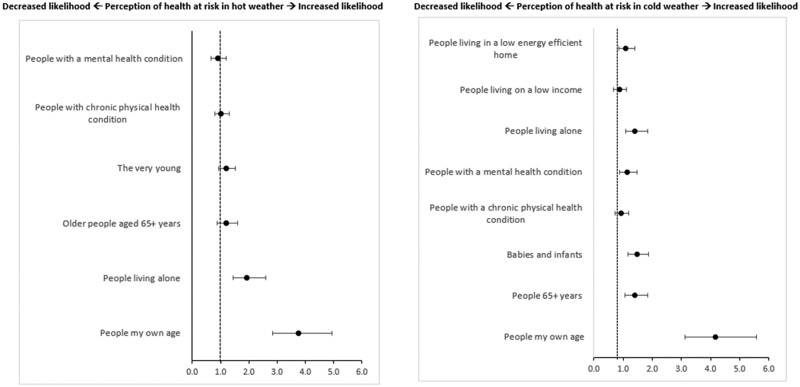
Risks to older adults (OA) (aged 65+ years) associated with hot and cold weather in the UK are well-documented. The study aim is to explore OA perception of health risks from high and low temperatures, health-protective measures undertaken, and implications for public health messaging. In 2019/20, Ipsos MORI conducted face-to-face surveys with OA in England (n = 461 cold weather survey, n = 452 hot weather survey). Participants reported temperature-related symptoms, risk perceptions for different groups, and behaviours during hot and cold weather. Analysis involved binomial logistic regression models to assess potential factors (demographics, vulnerability, behaviours) associated with older adults' health risk perception in hot and cold weather. Less than half of OA in both surveys agreed that hot or cold weather posed a risk to their health. OA with higher education, annual income >£25 000 or home ownership were less likely to perceive their health at risk during cold weather and regional differences in hot weather were identified. OA who recognized those the same age or living alone as at an increased risk were more likely to perceive their own health as at risk. OA were more likely to self-identify health risks when reporting those aged 65 yrs+ to be at an increased risk in cold weather. Various temperature-related protective behaviours were associated with older adults' risk perception in hot and cold weather. These findings provide evidence for public health agencies to target high risk individuals, and modify temperature-related public health messaging to protect OA.
英国老年人(65岁及以上)面临的与炎热和寒冷天气相关的风险已有充分记录。本研究旨在探讨老年人对高温和低温带来的健康风险的认知、采取的健康保护措施以及对公共卫生信息传播的影响。2019/20年度,益普索·莫里(Ipsos MORI)在英格兰对老年人进行了面对面调查(寒冷天气调查n = 461,炎热天气调查n = 452)。参与者报告了与温度相关的症状、对不同群体的风险认知以及在炎热和寒冷天气中的行为。分析采用二项逻辑回归模型,以评估与老年人在炎热和寒冷天气中健康风险认知相关的潜在因素(人口统计学、脆弱性、行为)。在两项调查中,不到一半的老年人认为炎热或寒冷天气会对他们的健康构成风险。受过高等教育、年收入超过25000英镑或拥有自有住房的老年人在寒冷天气中不太可能认为自己的健康有风险,并且发现了炎热天气中的地区差异。认识到同龄人或独居者风险增加的老年人更有可能认为自己的健康有风险。当报告65岁及以上人群在寒冷天气中风险增加时,老年人更有可能自我识别健康风险。各种与温度相关的保护行为与老年人在炎热和寒冷天气中的风险认知有关。这些发现为公共卫生机构针对高风险个体并调整与温度相关的公共卫生信息以保护老年人提供了证据。