Garcia-Anton Alma, Dreyfus Lélia, Portefaix Aurélie, Baudin Florent, Plaisant Franck, Loppinet Thomas, Reix Philippe, Butin Marine, Coutier Laurianne
Service de pneumologie pédiatrique, Hôpital Femme Mère Enfant, Hospices Civils de Lyon, Bron, France.
Université Claude-Bernard Lyon 1, Lyon, France.
Pediatr Pulmonol. 2025 Jan;60(1):e27367. doi: 10.1002/ppul.27367. Epub 2024 Oct 25.
Bronchopulmonary dysplasia (BPD) is the most common complication in preterm infants. This study aimed at identifying factors associated with early or with late or weaning failure from respiratory support or oxygen (O) in preterm infants with BPD requiring respiratory support or O therapy after discharge from the neonatal intensive care unit (NICU).
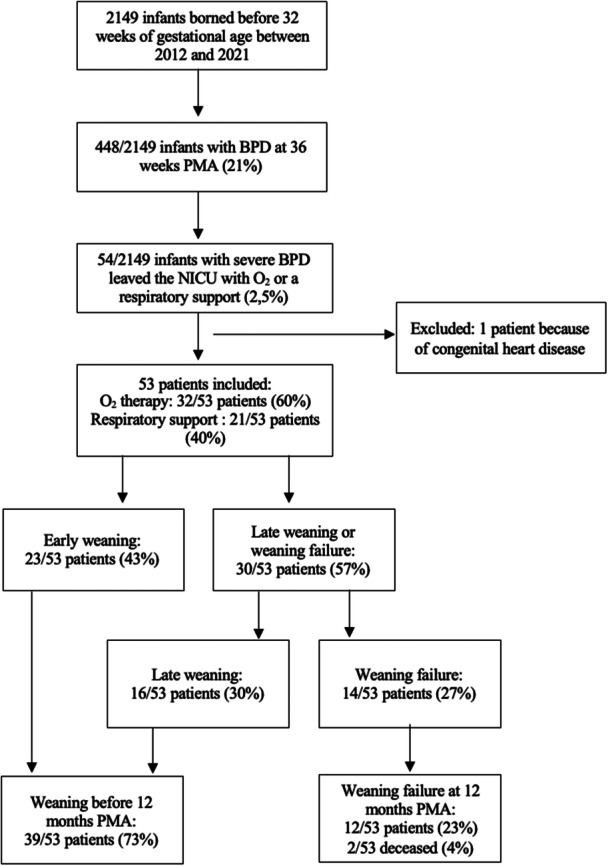
This retrospective study was conducted in the NICU of a tertiary hospital, in infants born before 32 weeks of gestation between 2012 and 2021, and discharged from the NICU with a respiratory support (tracheostomy [TT], invasive ventilation [IV], Non-IV [NIV], continuous positive airway pressure [CPAP], high flow nasal canula [HFNC]) or O therapy for BPD. Univariate and multivariate analyses were performed to identify factors associated with early weaning (before 6 months postmenstrual age [PMA]) or late (after 6 months PMA) and weaning failure.
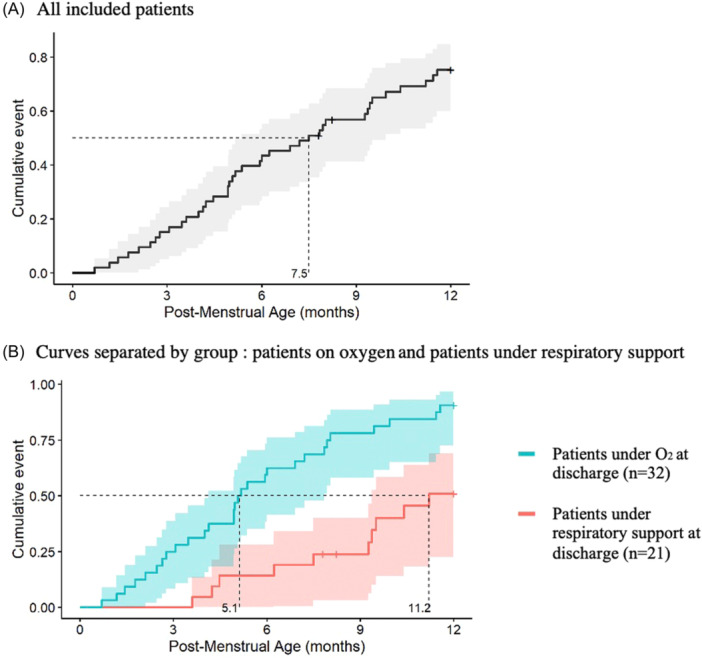
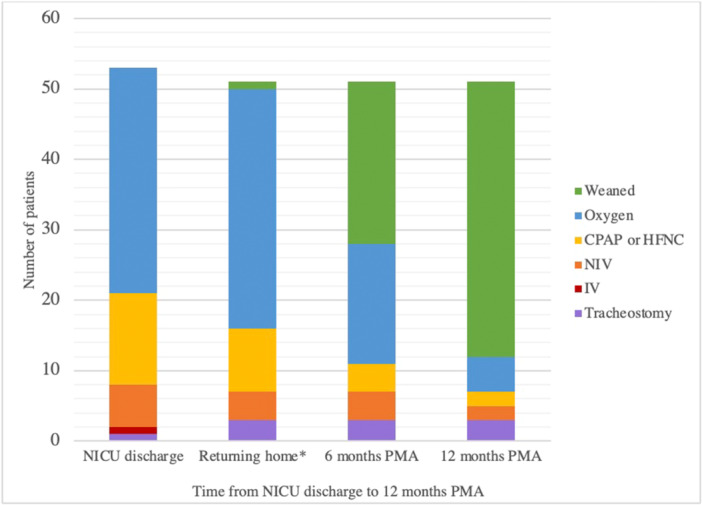
Among the 53 infants included (2% TT, 2% IV, 11% NIV, 25% CPAP or HFNC, 60% O at NICU discharge), 23 (43%) were weaned from respiratory support or O before 6 months PMA and 39 (73%) before 12 months PMA. IV duration during NICU stay and postnatal steroid treatment were identified as factors associated with a late or weaning failure (OR 1.03, p = .04 and OR 4.11, p = .023, respectively).
In this study, nearly half of preterm infants with severe BPD were weaned from respiratory support or O before 6 months PMA. IV duration and postnatal steroid treatment during NICU stay were associated with a late or weaning failure.
支气管肺发育不良(BPD)是早产儿最常见的并发症。本研究旨在确定与新生儿重症监护病房(NICU)出院后需要呼吸支持或氧疗的BPD早产儿早期或晚期撤机失败或氧疗失败相关的因素。
本回顾性研究在一家三级医院的NICU进行,研究对象为2012年至2021年间孕周小于32周出生、因BPD从NICU出院时接受呼吸支持(气管造口术[TT]、有创通气[IV]、无创通气[NIV]、持续气道正压通气[CPAP]、高流量鼻导管[HFNC])或氧疗的婴儿。进行单因素和多因素分析以确定与早期撤机(月经龄[PMA]6个月之前)或晚期撤机(PMA 6个月之后)及撤机失败相关的因素。
纳入的53例婴儿中(NICU出院时2%为TT、2%为IV、11%为NIV、25%为CPAP或HFNC、60%为吸氧),23例(43%)在PMA 6个月之前撤机或停止氧疗,39例(73%)在PMA 12个月之前撤机或停止氧疗。NICU住院期间的IV持续时间和出生后类固醇治疗被确定为与晚期撤机或撤机失败相关的因素(OR分别为1.03,p = 0.04和OR 4.11,p = 0.023)。
在本研究中,近一半患有严重BPD的早产儿在PMA 6个月之前撤机或停止氧疗。NICU住院期间的IV持续时间和出生后类固醇治疗与晚期撤机或撤机失败有关。