Antilici Livia, Vittucci Anna C, Cristaldi Sebastian, Musolino Anna M C, Pisani Mara, Rotondi Aufiero Lelia, Di Maio Chiara V, Scutari Rossana, Cutrera Renato, Dotta Andrea, Perno Carlo F, Villani Alberto
Bambino Gesù Children's Hospital IRCCS, Hospital University Pediatrics Clinical Area, Rome, Italy.
Microbiology and Diagnostic Immunology Unit, Bambino Gesù Children's Hospital, IRCCS, Rome, Italy.
Pediatr Pulmonol. 2025 Jan;60(1):e27358. doi: 10.1002/ppul.27358. Epub 2024 Oct 25.
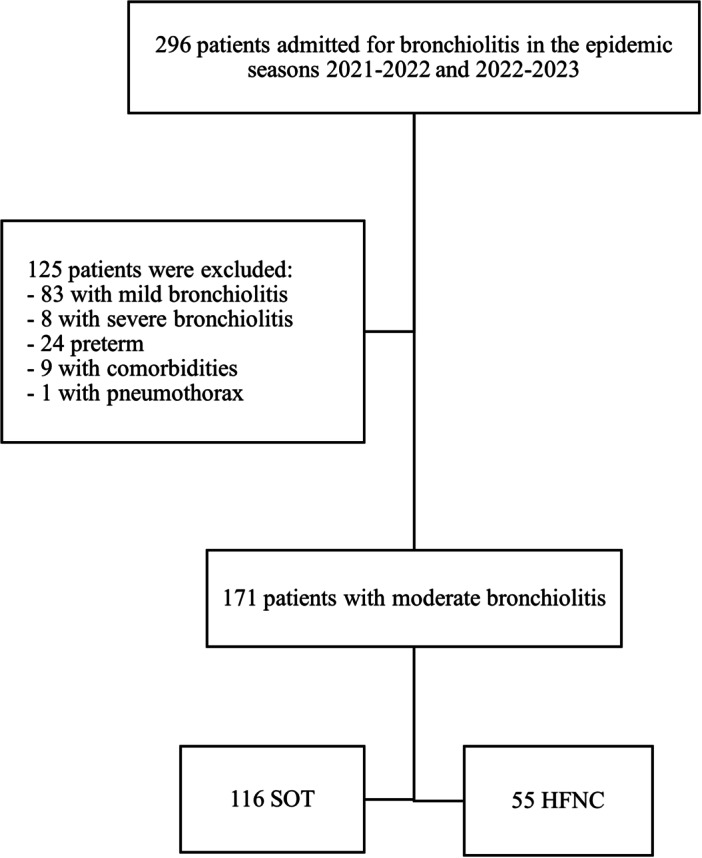
In the last decades none of the medical therapies investigated have shown clear efficacy in the treatment of bronchiolitis, and literature agrees on a general de-implementation of pharmacological therapies, recognizing an effective role only to nutritional support and oxygen therapy. High-flow nasal cannulas (HFNC) has become increasingly popular in the last decade, despite its lack of clear efficacy. Recent randomized controlled trials (RCT) comparing standard oxygen therapy (SOT) and HFNC did not demonstrate significant benefit of HFNC. To acquire more clinical data on HFNC efficacy we performed a retrospective, quasi-experimental analysis of patients admitted for bronchiolitis in the epidemic seasons 2021-2022 and 2022-2023.
To assess the efficacy of SOT and HFNC we used a pragmatic approach, a fuzzy regression discontinuity design, which is a quasi-experimental test. Unlike RCTs, this process is not a true randomization, but may be interpreted as quasi-randomization in an observational setting.
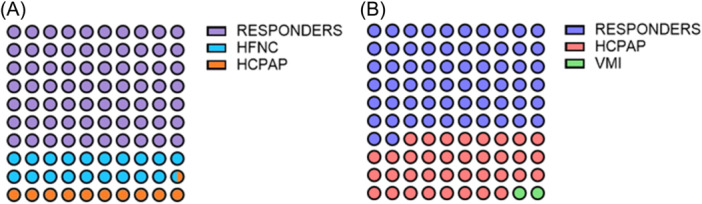
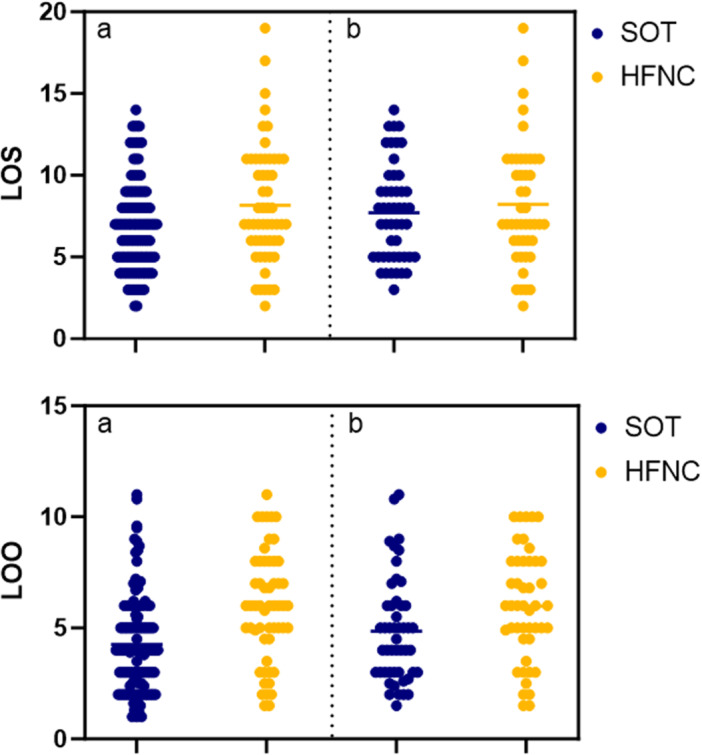
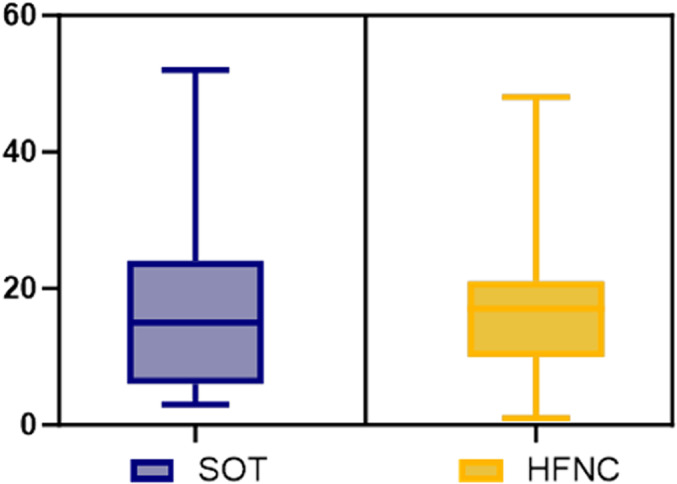
HFNC did not reduce length of oxygen therapy (LOO) nor length of hospitalization (LOS) (respectively, p: 0.383 and p: 0.454). Treatment failure was not significantly different in the treatment groups (p: 0.354).
It is crucial to perform additional RCTs with uniform protocols to determine the efficacy of HFNC more accurately in the treatment of bronchiolitis. HFNC does not reduce LOO, suggesting that early use of HFNC does not change the course of disease in moderate bronchiolitis. In view of the greater complexity and higher cost, HFNC should not be routinely used as first-line treatment in children with moderate respiratory distress and mild hypoxemia.
在过去几十年中,所研究的任何医学疗法在治疗细支气管炎方面均未显示出明确疗效,并且文献一致认为应普遍减少药物治疗的应用,仅认可营养支持和氧疗具有有效作用。尽管缺乏明确疗效,但在过去十年中,高流量鼻导管(HFNC)越来越受欢迎。最近比较标准氧疗(SOT)和HFNC的随机对照试验(RCT)并未证明HFNC有显著益处。为了获得更多关于HFNC疗效的临床数据,我们对2021 - 2022年和2022 - 2023年流行季节因细支气管炎入院的患者进行了一项回顾性、准实验性分析。
为评估SOT和HFNC的疗效,我们采用了一种实用方法,即模糊回归断点设计,这是一种准实验测试。与RCT不同,此过程并非真正的随机化,但在观察性环境中可解释为准随机化。
HFNC并未缩短氧疗时长(LOO)和住院时长(LOS)(p值分别为0.383和0.454)。治疗组之间的治疗失败率无显著差异(p值为0.354)。
至关重要的是进行更多采用统一方案的RCT,以更准确地确定HFNC在治疗细支气管炎中的疗效。HFNC并未缩短LOO,这表明在中度细支气管炎中早期使用HFNC不会改变疾病进程。鉴于HFNC更为复杂且成本更高,对于有中度呼吸窘迫和轻度低氧血症的儿童,不应将其常规用作一线治疗。