Salgado-Cardoso Aurea Mariana, Olave-Leyva José Ignacio, Morales Ivonne, Aguilar-Setién Alvaro, López-Martínez Irma, Aréchiga-Ceballos Nidia
Instituto de Diagnóstico y Referencia Epidemiológicos, Dirección General de Epidemiología, Secretaría de Salud, Francisco de P. Miranda 177, Colonia Unidad Lomas de Plateros, Alcaldía Álvaro Obregón C.P. 01480, Ciudad de México, Mexico.
Instituto de Ecología Aplicada, Universidad Autónoma de Tamaulipas, División del Golfo 356, Libertad, Ciudad Victoria C.P. 87019, Tamaulipas, Mexico.
Pathogens. 2024 Oct 16;13(10):907. doi: 10.3390/pathogens13100907.
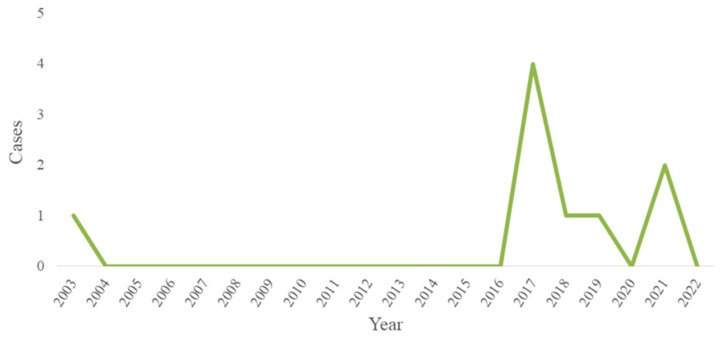
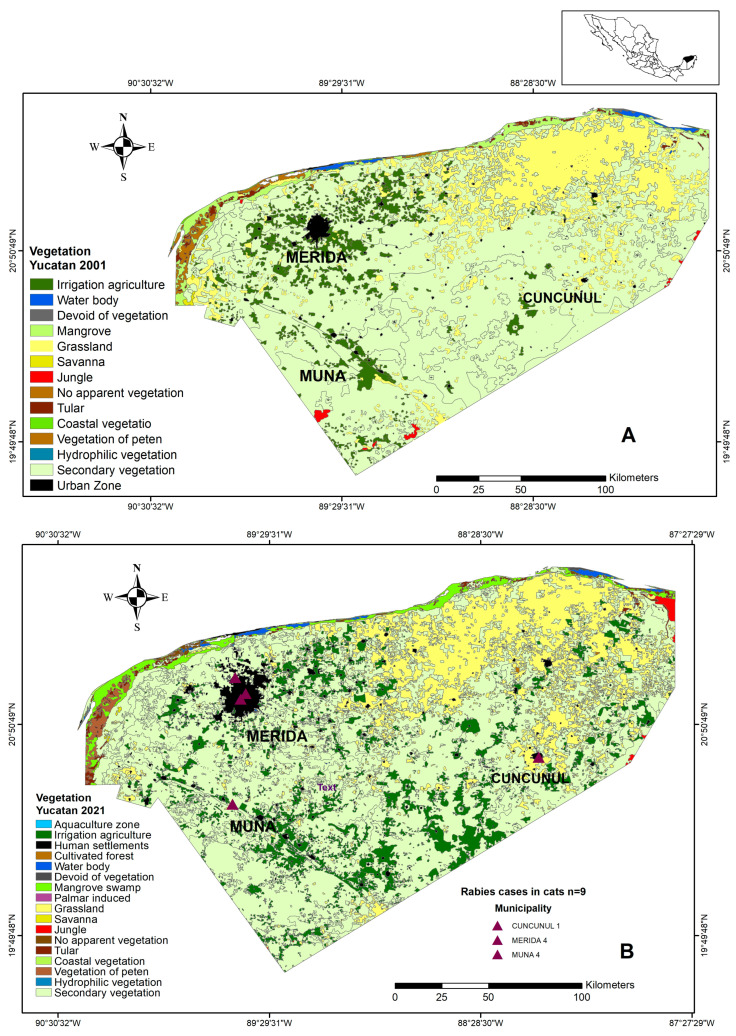
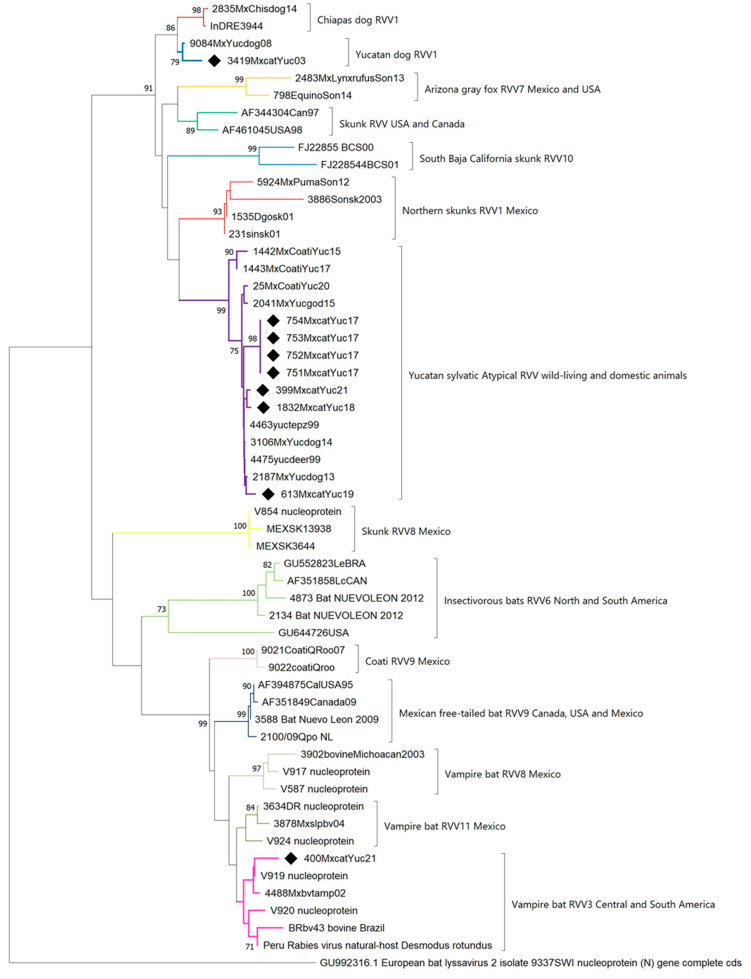
The growing population in Yucatan has led to the expansion of construction in the Mayan jungle for tourist spaces, residential areas, and agriculture. Recently, rabies cases in cats () have increased in the state. This study aimed to perform antigenic and genetic characterization of the rabies viruses in felines and to present the spatial distribution and environmental features of the areas where these cases were reported. The ArcGIS software and R were employed to generate maps depicting the geographic locations of rabies cases in cats. A total of nine feline rabies cases occurred during the period 2003-2022. Three antigenic variants were detected: dog-related RVV1 ( = 1); vampire bat variant RVV3 ( = 1); and the canine-originated atypical variant ( = 7). Cases reported in Merida ( = 4) and Muna ( = 4) were localized to urban areas, while Cuncunul ( = 1) was rural. This study highlights the concerning resurgence of rabies infections in cats, emphasizing the looming threat of its reintroduction in dogs should vaccination rates diminish. The genetic affinity between the atypical variant and the canine virus underscores the urgent need for vigilance in maintaining high vaccination coverage across all susceptible species.
尤卡坦半岛不断增长的人口导致玛雅丛林中用于旅游空间、居民区和农业的建筑不断扩张。最近,该州猫类狂犬病病例有所增加。本研究旨在对猫类狂犬病病毒进行抗原和基因特征分析,并呈现报告这些病例的地区的空间分布和环境特征。利用ArcGIS软件和R软件生成描绘猫类狂犬病病例地理位置的地图。2003年至2022年期间共发生9例猫类狂犬病病例。检测到三种抗原变体:与狗相关的RVV1(n = 1);吸血蝙蝠变体RVV3(n = 1);以及犬源非典型变体(n = 7)。在梅里达(n = 4)和穆纳(n = 4)报告的病例集中在城市地区,而昆库努尔(n = 1)的病例发生在农村地区。本研究强调了猫类狂犬病感染令人担忧的再次出现,强调了如果疫苗接种率下降,狂犬病重新传入狗类的潜在威胁。非典型变体与犬类病毒之间的基因亲和力凸显了对所有易感物种保持高疫苗接种覆盖率的迫切需要。