Yuan Haomiao, Liao Xizhou, Hu Ding, Guan Dawei, Tian Meihui
Center of Forensic Investigation, China Medical University, No. 77 Puhe Road, Shenyang North New Area, Shenyang 110122, China.
Liaoning Province Key Laboratory of Forensic Bio-Evidence Science, No. 77 Puhe Road, Shenyang North New Area, Shenyang 110122, China.
Noncoding RNA. 2024 Sep 24;10(5):49. doi: 10.3390/ncrna10050049.
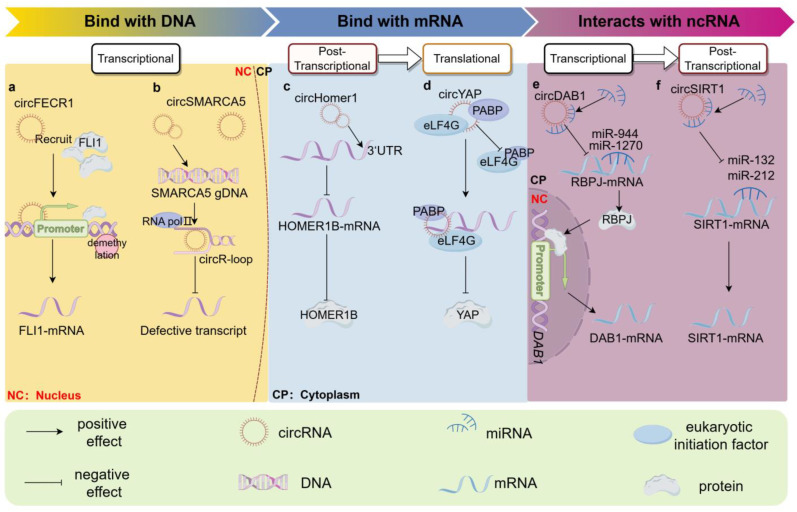
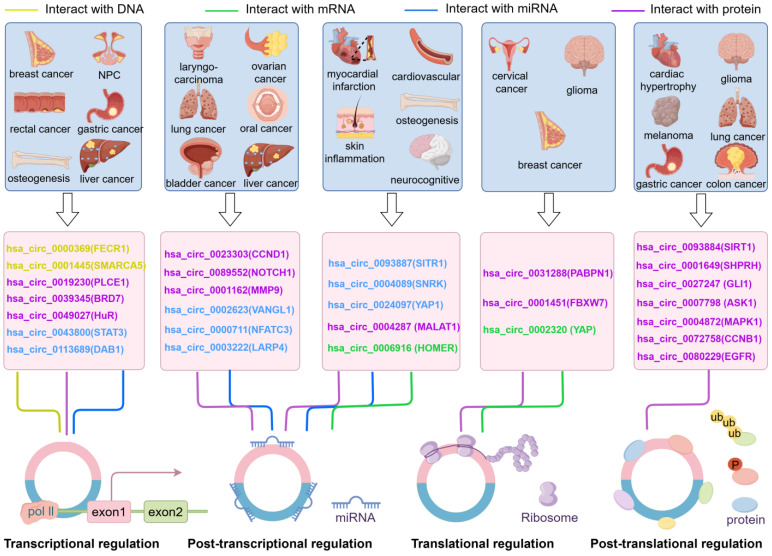
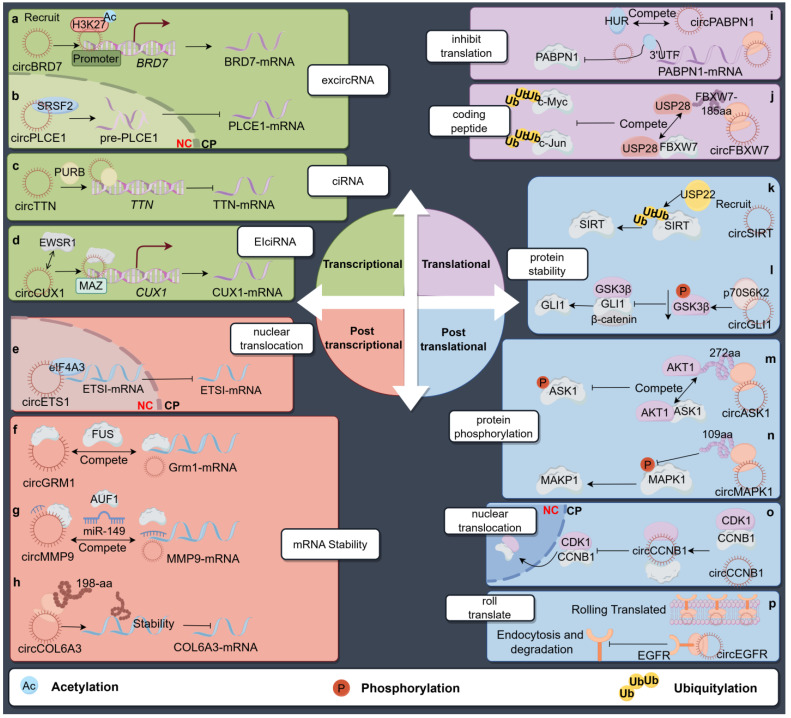
Circular RNAs (circRNAs) have been shown to be pivotal regulators in various human diseases by participating in gene splicing, acting as microRNA (miRNA) sponges, interacting with RNA-binding proteins (RBPs), and translating into short peptides. As the back-splicing products of pre-mRNAs, many circRNAs can modulate the expression of their host genes through transcriptional, post-transcriptional, translational, and post-translational control via interaction with other molecules. This review provides a detailed summary of these regulatory mechanisms based on the class of molecules that they interact with, which encompass DNA, mRNA, miRNA, and RBPs. The co-expression of circRNAs with their parental gene productions (including linear counterparts and proteins) provides potential diagnostic biomarkers for multiple diseases. Meanwhile, the different regulatory mechanisms by which circRNAs act on their host genes via interaction with other molecules constitute complex regulatory networks, which also provide noticeable clues for therapeutic strategies against diseases. Future research should explore whether these proven mechanisms can play a similar role in other types of disease and clarify further details about the cross-talk between circRNAs and host genes. In addition, the regulatory relationship between circRNAs and their host genes in circRNA circularization, degradation, and cellular localization should receive further attention.
环状RNA(circRNAs)已被证明是多种人类疾病中的关键调节因子,它们通过参与基因剪接、充当微小RNA(miRNA)海绵、与RNA结合蛋白(RBPs)相互作用以及翻译成短肽来发挥作用。作为前体mRNA的反向剪接产物,许多circRNAs可通过与其他分子相互作用,在转录、转录后、翻译和翻译后水平调控其宿主基因的表达。本综述基于circRNAs与DNA、mRNA、miRNA和RBPs等分子的相互作用类别,对这些调控机制进行了详细总结。circRNAs与其亲本基因产物(包括线性对应物和蛋白质)的共表达为多种疾病提供了潜在的诊断生物标志物。同时,circRNAs通过与其他分子相互作用作用于其宿主基因的不同调控机制构成了复杂的调控网络,这也为疾病治疗策略提供了显著线索。未来的研究应探索这些已证实的机制是否能在其他类型疾病中发挥类似作用,并进一步阐明circRNAs与宿主基因之间相互作用的更多细节。此外,circRNAs与其宿主基因在circRNA环化、降解和细胞定位中的调控关系应受到进一步关注。