Xiong Jia-Bin, Wang Shi-Hui, Zhou Yong-Juan, Xiong Zhang-Qi, Yu Ya-Jie, Zhang Zi-Kun, Yang Yi-Ming, Zhang Shan-Shan, Chen Si-Ru, Wang Zhuo
School of Material and Chemical Engineering, Center for Advanced Materials Research, Zhongyuan University of Technology, Zhengzhou, 450007, China.
Sci Rep. 2024 Oct 26;14(1):25448. doi: 10.1038/s41598-024-77287-9.
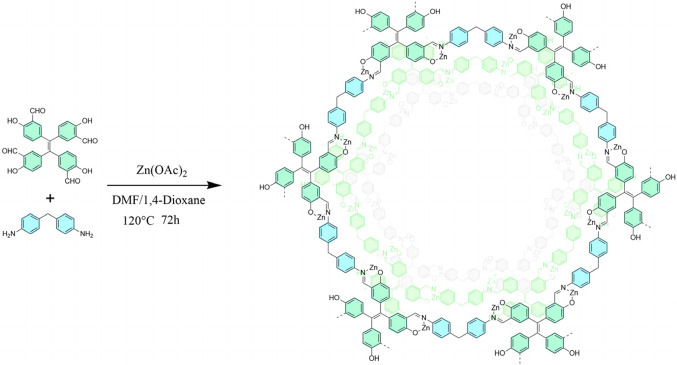
The emergence of nanogenerators, which have the ability to capture mechanical energy from the environment and to collect and transmit tiny energy, is rapidly becoming a hot research topic. The performance of electrode materials is the key to the efficiency of nanogenerators. Covalent organic skeletons (COFs), a class of crystalline organic porous materials with the advantages of large specific surface area, high porosity, tunable structure, and flexible tailorability, have very significant advantages in being used as nanogenerator materials. In this paper, we synthesised two COF materials to investigate the effect of the introduction of active metals on the friction power generation performance of COFs without changing their topology, COF-2 containing zinc ions is capable of generating a short-circuit current of 107.5 µA during friction. The porous structure increases the effective contact area to form a larger charge density, and the introduction of metal ions can accelerate the charge separation and transport. The two bidirectional synergistic effects of the materials significantly improve the output performance of the nanogenerator, and a simple and efficient method is explored for the enhancement of the output performance of COF-based triboelectric nanogenerators.
纳米发电机能够从环境中捕获机械能并收集和传输微小能量,其出现正迅速成为一个热门研究课题。电极材料的性能是纳米发电机效率的关键。共价有机骨架(COF)是一类晶体有机多孔材料,具有比表面积大、孔隙率高、结构可调和可灵活定制等优点,在用作纳米发电机材料方面具有非常显著的优势。在本文中,我们合成了两种COF材料,以研究在不改变其拓扑结构的情况下引入活性金属对COF摩擦发电性能的影响,含锌离子的COF-2在摩擦过程中能够产生107.5 μA的短路电流。多孔结构增加了有效接触面积,形成更大的电荷密度,金属离子的引入可以加速电荷分离和传输。材料的这两种双向协同效应显著提高了纳米发电机的输出性能,并探索了一种简单有效的方法来提高基于COF的摩擦电纳米发电机的输出性能。