Boltri Matteo, Traunero Fabio, Ongaro Luca, Migliozzi Francesca, Vianello Fabio, Lenardon Oliviero, Visalli Francesco, Buttazzi Lorenzo, Maruzzi Daniele, Trombetta Carlo, Simonato Alchiede, Pavan Nicola, Claps Francesco
Urological Clinic, Department of Medical, Surgical and Health Sciences, University of Trieste, 34127 Trieste, Italy.
Urology Unit, "San Giovanni di Dio" Hospital, 34170 Gorizia, Italy.
Cancers (Basel). 2024 Oct 17;16(20):3519. doi: 10.3390/cancers16203519.
We aimed at evaluating the impact of Controlling Nutritional Status (CONUT) score on clinically significant decline in estimated glomerular filtration rate (eGFR) in patients with non-metastatic Clear Cell Renal Cell Carcinoma (ccRCC) undergoing radical nephrectomy (RN).
We retrospectively analyzed a multi-institutional cohort of 140 patients with ccRCC who underwent RN between 2016 and 2018 at three Urological Centers. The CONUT score was calculated with an algorithm including serum albumin, total lymphocyte count, and cholesterol. Clinical and pathologic features were analyzed using Fisher's exact test for categorical variables and a Mann-Whitney U test for continuous variables. To define the independent predictors of clinically significant eGFR decline, univariable (UVA) and multivariable (MVA) binomial logistic regression analyses were performed in order to assess the Odds Ratio (OR) with 95% Confidence Intervals (CIs).
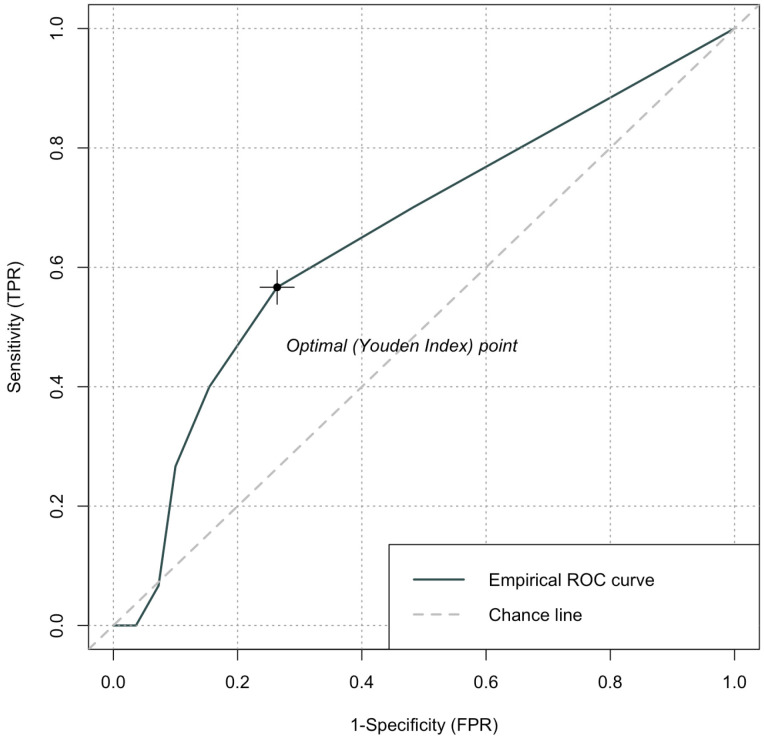
The optimal cut-off value to discriminate between a low and high CONUT score was assessed by calculating the ROC curve. The area under the curve (AUC) was 0.67 (95%CI 0.59-0.78) with the most appropriate cut-off value at 2 points. Overall, 46 patients (32.9%) had a high CONUT score (>2). Statistically significant variables associated with eGFR decline at 24 months were age ≥ 70 (OR 2.01; 95%CI 1.17-3.09; 0.05), stage II-III chronic kidney disease (CKD) (OR 6.05; 95%CI 1.79-28.3; 0.001), and a high CONUT score (OR 3.98; 95%CI 1.58-10.4; 0.004).
The CONUT score is a low-time-consuming, cost-effective, and promising tool able to preoperatively screen patients at risk of developing CKD after a RN.
我们旨在评估控制营养状况(CONUT)评分对接受根治性肾切除术(RN)的非转移性透明细胞肾细胞癌(ccRCC)患者估计肾小球滤过率(eGFR)出现临床显著下降的影响。
我们回顾性分析了2016年至2018年间在三个泌尿外科中心接受RN的140例ccRCC患者的多机构队列。CONUT评分通过包含血清白蛋白、总淋巴细胞计数和胆固醇的算法计算得出。分类变量采用Fisher精确检验,连续变量采用Mann-Whitney U检验分析临床和病理特征。为确定eGFR出现临床显著下降的独立预测因素,进行单变量(UVA)和多变量(MVA)二项逻辑回归分析,以评估95%置信区间(CI)的比值比(OR)。
通过计算ROC曲线评估区分低CONUT评分和高CONUT评分的最佳截断值。曲线下面积(AUC)为0.67(95%CI 0.59 - 0.78),最合适的截断值为2分。总体而言,46例患者(32.9%)CONUT评分较高(>2)。与24个月时eGFR下降相关的具有统计学意义的变量为年龄≥70岁(OR 2.01;95%CI 1.17 - 3.09;P = 0.05)、II - III期慢性肾脏病(CKD)(OR 6.05;95%CI 1.79 - 28.3;P = 0.001)以及高CONUT评分(OR 3.98;95%CI 1.58 - 10.4;P = 0.004)。
CONUT评分是一种耗时短、成本效益高且有前景的工具,能够在术前筛查出RN后有发生CKD风险的患者。