Fernández-Sánchez Adolfo, Hernández-Sánchez Alberto, De Ramón Cristina, Chillón María-Carmen, Vidriales María Belén, Baile-González Mónica, Fuentes-Morales Cristina-Teresa, Sierra-Pacho Magdalena, López-Corral Lucía, Sánchez-Guijo Fermín
Hematology Department, IBSAL-University Hospital of Salamanca, Department of Medicine and Cancer Research Center (CIC), University of Salamanca, 37007 Salamanca, Spain.
Biomedicines. 2024 Oct 15;12(10):2339. doi: 10.3390/biomedicines12102339.
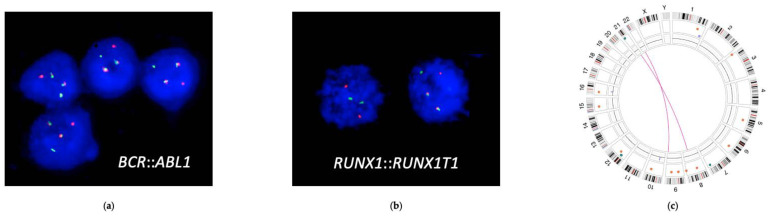
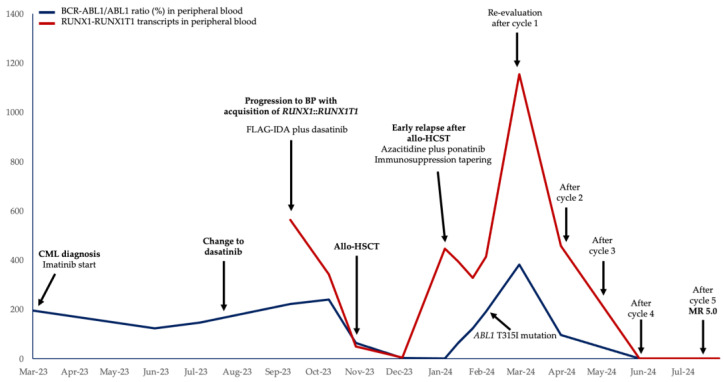
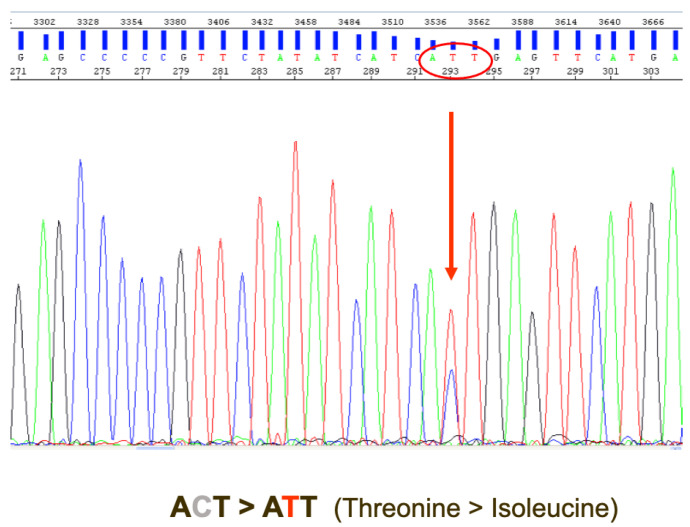
The advent of tyrosine kinase inhibitors (TKIs) has changed the natural history of chronic myeloid leukemia (CML), and the transformation from the chronic phase to the blast phase (BP) is currently an uncommon situation. However, it is one of the major remaining challenges in the management of this disease, as it is associated with dismal outcomes. We report the case of a 63-year-old woman with a history of CML with poor response to imatinib who progressed to myeloid BP-CML, driven by the acquisition of t(8;21)(q22;q22)/. The patient received intensive chemotherapy and dasatinib, followed by allogeneic hematopoietic stem cell transplantation (allo-HSCT). However, she suffered an early relapse after allo-HSCT with the acquisition of the T315I mutation in . Ponatinib and azacitidine were started as salvage treatment, allowing for the achievement of complete remission with deep molecular response after five cycles. Advances in the knowledge of disease biology and clonal evolution are crucial for optimal treatment selection, which ultimately translates into better patient outcomes.
酪氨酸激酶抑制剂(TKIs)的出现改变了慢性髓性白血病(CML)的自然病程,目前从慢性期向急变期(BP)的转变并不常见。然而,这仍是该疾病管理中主要的遗留挑战之一,因为它与预后不良相关。我们报告了一例63岁女性CML患者,该患者对伊马替尼反应不佳,因获得t(8;21)(q22;q22)/而进展为髓系BP-CML。患者接受了强化化疗和达沙替尼治疗,随后进行了异基因造血干细胞移植(allo-HSCT)。然而,allo-HSCT后她早期复发,且在中获得了T315I突变。开始使用波纳替尼和阿扎胞苷作为挽救治疗,经过五个周期后实现了完全缓解并达到深度分子反应。疾病生物学和克隆进化知识的进展对于优化治疗选择至关重要,这最终会转化为更好的患者预后。