Choi Ji Uk, Kee Tae-Hong, Lee Dong-Ho, Hwang Chang Ju, Park Sehan, Cho Jae Hwan
Department of Orthopedic Surgery, Asan Medical Center, University of Ulsan College of Medicine 88, Olympic-ro 43-gil, Songpa-gu, Seoul 05505, Republic of Korea.
J Clin Med. 2024 Oct 21;13(20):6285. doi: 10.3390/jcm13206285.
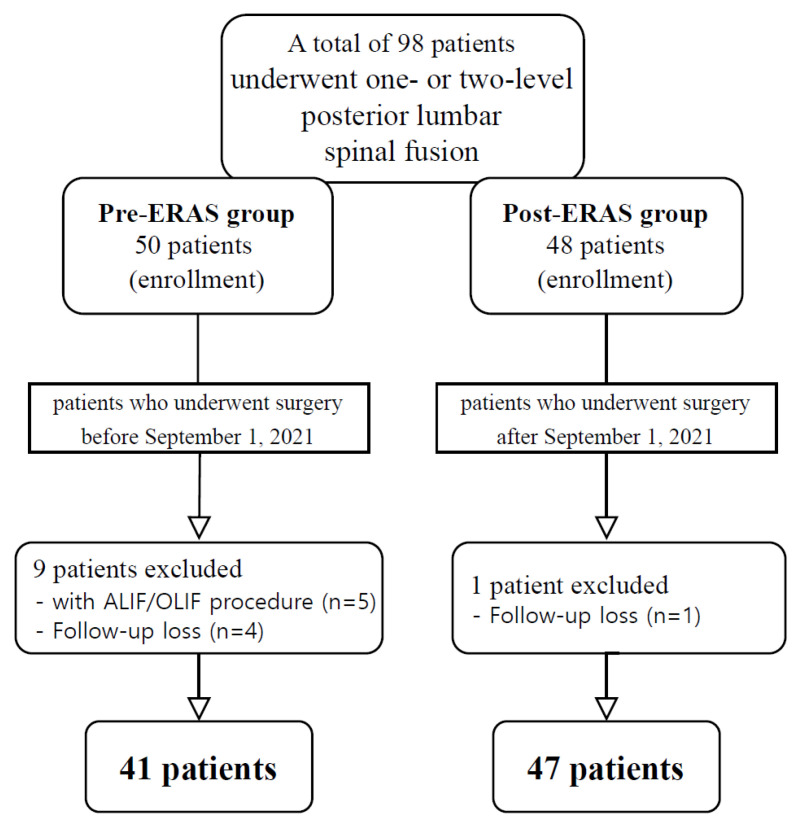
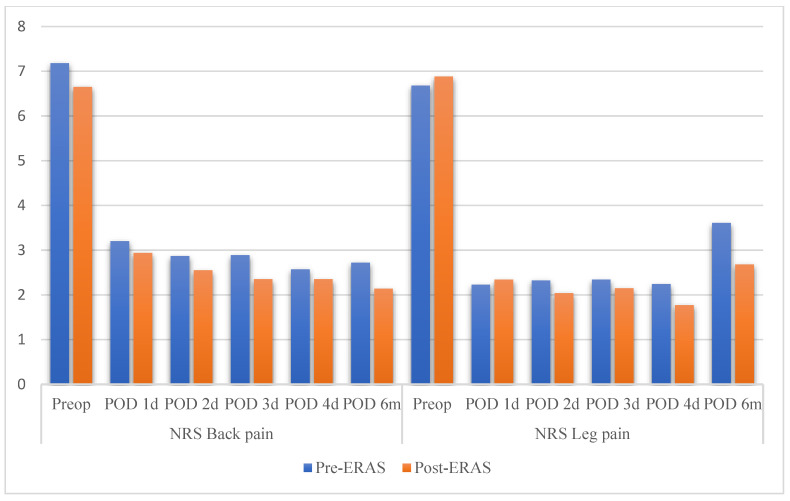
Enhanced recovery after surgery (ERAS) protocols optimize perioperative care and improve recovery. This study evaluated the effectiveness of ERAS in one- or two-level posterior lumbar fusion surgeries, focusing on perioperative medication use, pain management, and functional outcomes. Eighty-eight patients undergoing lumbar fusion surgery between March 2021 and February 2022 were allocated into pre-ERAS ( = 41) and post-ERAS (n = 47) groups. Outcomes included opioid and antiemetic consumption, pain scores (numerical rating scale (NRS)), functional recovery (Oswestry Disability Index (ODI) and EuroQol 5 Dimension (EQ-5D)), and complication rates. Pain was assessed daily for the first four postoperative days and at 6 months. Linear Mixed Effects Model analysis evaluated pain trajectories. The post-ERAS group showed significantly lower opioid ( = 0.005) and antiemetic ( < 0.001) use. No significant differences were observed in NRS pain scores in the first 4 postoperative days. At 6 months, the post-ERAS group reported significantly lower leg pain ( = 0.002). The time:group interaction was not significant for back ( = 0.848) or leg ( = 0.503) pain. Functional outcomes at 6 months, particularly ODI and EQ-5D scores, showed significant improvement in the post-ERAS group. Complication rates were lower in the post-ERAS group (4.3% vs. 19.5%, = 0.024), while hospital stay and fusion rates remained similar. The ERAS protocol significantly reduced opioid and antiemetic use, improved long-term pain management and functional recovery, and lowered complication rates in lumbar fusion patients. These findings support the implementation of ERAS protocols in spinal surgery, emphasizing their role in enhancing postoperative care.
术后加速康复(ERAS)方案可优化围手术期护理并促进康复。本研究评估了ERAS在单节段或双节段腰椎后路融合手术中的有效性,重点关注围手术期用药、疼痛管理和功能结局。2021年3月至2022年2月期间接受腰椎融合手术的88例患者被分为ERAS前组(n = 41)和ERAS后组(n = 47)。结局指标包括阿片类药物和止吐药的使用量、疼痛评分(数字评定量表(NRS))、功能恢复情况(奥斯威斯残疾指数(ODI)和欧洲五维度健康量表(EQ - 5D))以及并发症发生率。术后前4天每天评估疼痛情况,并在术后6个月进行评估。线性混合效应模型分析评估疼痛轨迹。ERAS后组的阿片类药物使用量显著更低(P = 0.005),止吐药使用量也显著更低(P < 0.001)。术后前4天NRS疼痛评分未观察到显著差异。在术后6个月时,ERAS后组报告腿痛显著更低(P = 0.002)。时间与组别的交互作用对于背痛(P = 0.848)或腿痛(P = 0.503)均无显著意义。术后6个月的功能结局,尤其是ODI和EQ - 5D评分,ERAS后组有显著改善。ERAS后组的并发症发生率更低(4.3% 对19.5%,P = 0.024),而住院时间和融合率保持相似。ERAS方案显著减少了阿片类药物和止吐药的使用,改善了长期疼痛管理和功能恢复,并降低了腰椎融合患者的并发症发生率。这些发现支持在脊柱手术中实施ERAS方案,强调了其在加强术后护理方面的作用。