Department of Individual, Family, and Community Education, University of New Mexico, Albuquerque, NM 87131, USA.
Department of Nutrition Science, Purdue University, West Lafayette, IN 47907, USA.
Nutrients. 2024 Oct 11;16(20):3441. doi: 10.3390/nu16203441.
This pilot cross-sectional study explored differences in dietary intake and eating behaviors between healthy adults and a group of adults taking insulin to manage diabetes.
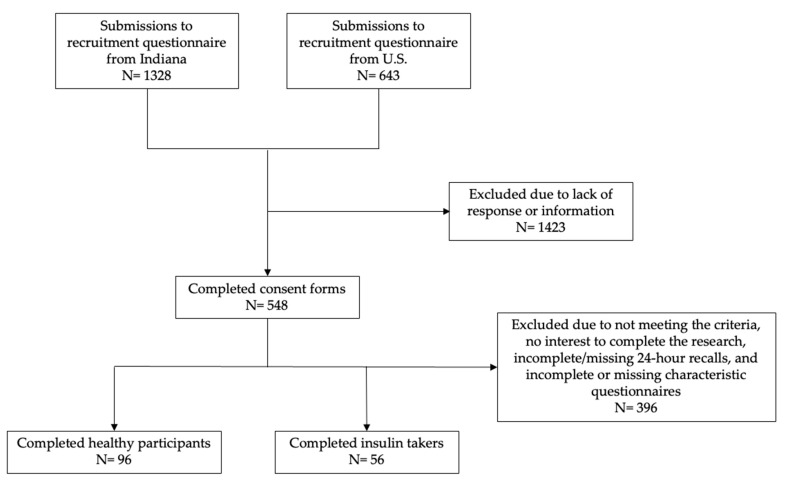
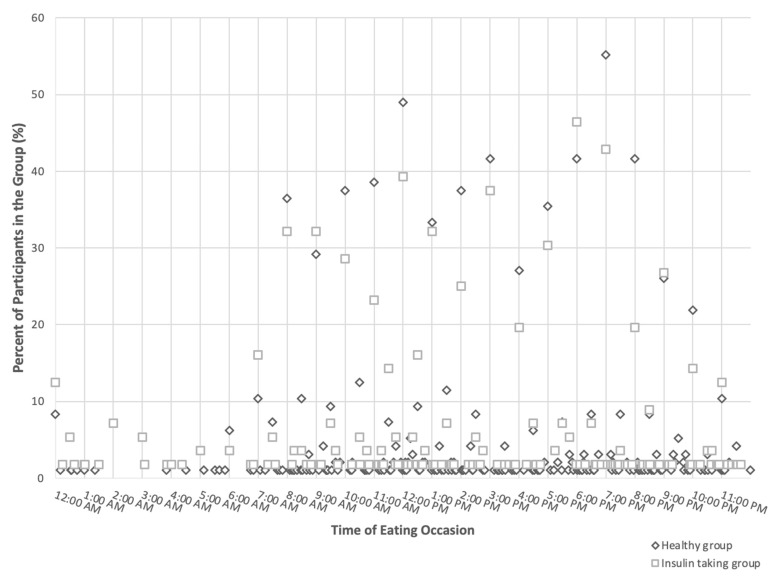
A characteristic questionnaire and up to four Automated Self-Administered 24-Hour dietary recalls were collected from 152 adults aged 18-65 years (96 healthy and 56 adults taking insulin) from Indiana and across the U.S. from 2022 to 2023. The macronutrient intake, diet quality via the Healthy Eating Index (HEI)-2015, eating frequency, and consistency of timing of eating were calculated and compared between the two groups using adjusted linear or logistic regression models.
The total mean HEI scores were very low, at 56 out of 100 and 49 out of 100 for the healthy and insulin-taking groups, respectively. Insulin-taking adults had significantly lower HEI total ( 0.003) and component scores compared to the healthy group for greens and beans (2.0 vs. 3.0, 0.02), whole fruit (2.1 vs. 2.9, 0.05), seafood and plant proteins (2.1 vs. 3.3, 0.004), and saturated fats (3.7 vs. 5.4, 0.05). Eating frequency was significantly lower in the insulin-taking group than in the healthy group (3.0 vs. 3.4 eating occasions/day, 0.05).
Evidence of the low diet quality and eating frequency of insulin takers may help inform and justify nutrition education to control and manage diabetes.
本初步横断面研究旨在探讨健康成年人和使用胰岛素控制糖尿病的成年人之间饮食摄入和饮食习惯的差异。
本研究于 2022 年至 2023 年期间,从印第安纳州和美国各地招募了 152 名年龄在 18-65 岁的成年人(96 名健康成年人和 56 名使用胰岛素的成年人),收集了他们的特征问卷和多达 4 次自动自我管理 24 小时膳食回忆。使用调整后的线性或逻辑回归模型比较了两组的宏量营养素摄入、通过健康饮食指数(HEI-2015)评估的饮食质量、进食频率和进食时间的一致性。
总 HEI 评分非常低,健康组和胰岛素组分别为 56 分和 49 分。与健康组相比,使用胰岛素的成年人的 HEI 总分( 0.003)和各成分得分均显著较低,其中绿叶蔬菜和豆类(2.0 对 3.0, 0.02)、全水果(2.1 对 2.9, 0.05)、海鲜和植物蛋白(2.1 对 3.3, 0.004)和饱和脂肪(3.7 对 5.4, 0.05)得分较低。与健康组相比,使用胰岛素的成年人的进食频率明显较低(3.0 对 3.4 次/天, 0.05)。
胰岛素使用者的低饮食质量和低进食频率的证据可能有助于为控制和管理糖尿病提供营养教育的信息和依据。