Toledo-Hernández Erubiel, Peña-Chora Guadalupe, Mancilla-Dorantes Ilse, Torres-Rojas Francisco Israel, Romero-Ramírez Yanet, Palemón-Alberto Francisco, Ortega-Acosta Santo Ángel, Delgado-Núñez Edgar Jesús, Salinas-Sánchez David Osvaldo, Tagle-Emigdio Luz Janet, Sotelo-Leyva César
Facultad de Ciencias Químico-Biológicas, Universidad Autónoma de Guerrero, Av. Lázaro Cárdenas s/n., Chilpancingo C.P. 39070, Gro., Mexico.
Centro de Investigaciones Biológicas, Universidad Autónoma del Estado de Morelos, Av. Universidad #1001, Col. Chamilpa, Cuernavaca C.P. 62209, Mor., Mexico.
Plants (Basel). 2024 Oct 14;13(20):2873. doi: 10.3390/plants13202873.
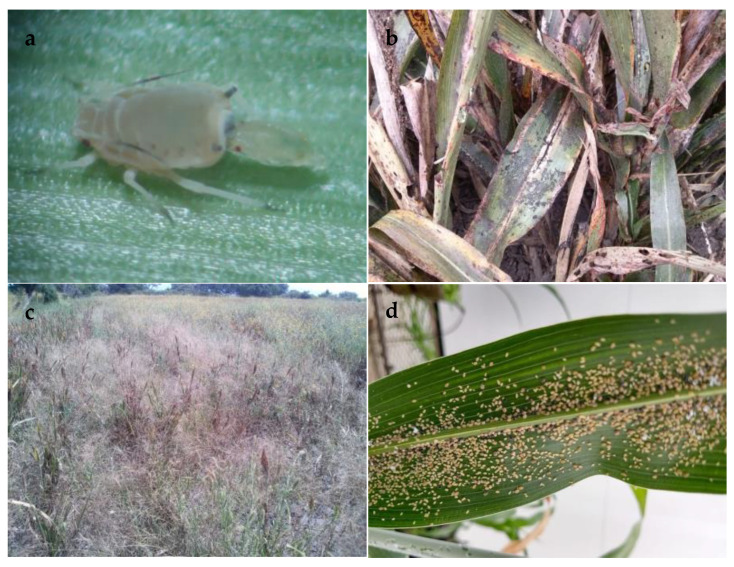
is a pest that is native to Africa but is now distributed worldwide. In 2013, its destructive capacity was demonstrated when it devastated sorghum crops in the United States and Mexico, making it a new pest of economic importance in North America. At the time, the phytosanitary authorities of both countries recommended the use of pesticides to control the outbreak, and biological control products for the management of this pest were not known. In response to the outbreak of in North America, several field studies have been performed in the last decade on sorghum crops in the USA and Mexico. Works have focused on assessing resistant sorghum hybrids, pesticide use, and recruitment of associated aphid predators and entomopathogens for natural control of populations. The objective of this review is to compile the information that has been generated in the past decade about indigenous enemies affecting naturally in the field, as well as the search for biological control alternatives and evaluations of interactive effects of resistant sorghum hybrids, pesticides, and natural enemies. To date, different predators, parasitoids, fungi, and bacteria have been evaluated and in many cases found to affect populations in sorghum agroecosystems or laboratory bioassays, and the use of resistant sorghum varieties and pesticides did not have clear toxic effects on natural enemy populations. Many of the macroorganisms and microorganisms that have been evaluated as potential biological controls have shown potential as alternatives to synthetic pesticides for keeping population densities below economic damage thresholds and are compatible with integrated management of sorghum aphids. While most tests of these biological alternatives have shown that they have aphidicidal potential against sorghum aphids, it is crucial to take into account that their effectiveness in the field depends on a number of abiotic and biotic factors, including soil texture, temperature, humidity, and natural enemies.
是一种原产于非洲但现已分布于全球的害虫。2013年,它在美国和墨西哥对高粱作物造成严重破坏,显示出其强大的破坏力,成为北美一种具有经济重要性的新害虫。当时,两国的植物卫生当局建议使用杀虫剂来控制疫情,而当时还不知道用于管理这种害虫的生物防治产品。为应对北美地区的疫情爆发,在过去十年里,美国和墨西哥针对高粱作物进行了多项田间研究。研究工作主要集中在评估抗高粱杂交种、农药使用情况,以及招募相关蚜虫捕食者和昆虫病原体来自然控制害虫种群。本综述的目的是汇总过去十年中有关在田间自然影响该害虫的本土天敌的信息,以及寻找生物防治替代方案,评估抗高粱杂交种、农药和天敌的交互作用。迄今为止,已经评估了不同的捕食者、寄生蜂、真菌和细菌,在许多情况下发现它们会影响高粱农业生态系统或实验室生物测定中的害虫种群,并且抗高粱品种和农药的使用对天敌种群没有明显的毒性影响。许多被评估为潜在生物防治手段的大型生物和微生物已显示出有望替代合成农药,将害虫种群密度控制在经济损害阈值以下,并且与高粱蚜虫的综合管理相兼容。虽然这些生物替代方案的大多数测试表明它们对高粱蚜虫具有杀蚜潜力,但必须考虑到它们在田间的有效性取决于许多非生物和生物因素,包括土壤质地、温度、湿度和天敌。