Świątkowski Andrzej, Kuśmierek Elżbieta, Kuśmierek Krzysztof, Błażewicz Stanisław
Institute of Chemistry, Military University of Technology, ul. Gen. S. Kaliskiego 2, 00-908 Warsaw, Poland.
Faculty of Chemistry, Institute of General and Ecological Chemistry, Lodz University of Technology, ul. Zeromskiego 116, 90-924 Lodz, Poland.
Molecules. 2024 Oct 18;29(20):4930. doi: 10.3390/molecules29204930.
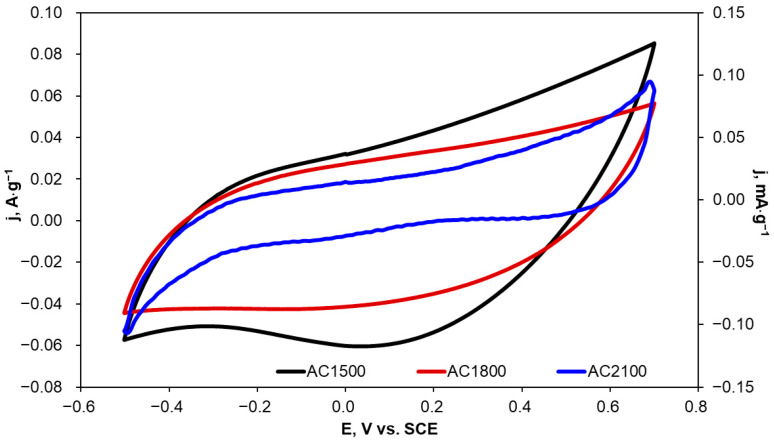
Activated carbons can be applied in various areas of our daily life depending on their properties. This study was conducted to investigate the effect of thermal treatment of activated carbon on its properties, considering its future use. The characteristics of activated carbon heat-treated at temperatures of 1500, 1800, and 2100 °C based on its future use are presented. The significant effect of the treatment temperature on morphological, adsorption, electrochemical, and corrosion properties was proved. Increasing the temperature above 1800 °C resulted in a significant decrease in the specific surface area (from 969 to 8 m·g) and material porosity-the formation of mesopores (20-100 nm diameter) was observed. Simultaneously, adsorption capability, double layer capacity, and electrochemically active surface area also decreased, which helped to explain the shape of cyclic voltammograms recorded in 2,4-dichlorophenoxyacetic acid and in supporting electrolytes. However, a significant increase in corrosion resistance was found for the carbon material treated at a temperature of 2100 °C (corrosion current decreased by 23 times). Comparison of morphological, adsorption, corrosion, and electrochemical characteristics of the tested activated carbon, its applicability as an electrode material in electrical energy storage devices, and materials for adsorptive removal of organic compounds from wastewater or as a sensor in electrochemical determination of organic compounds was discussed.
活性炭可根据其性质应用于我们日常生活的各个领域。本研究旨在考虑活性炭的未来用途,研究其热处理对性能的影响。介绍了基于未来用途在1500、1800和2100℃温度下热处理的活性炭的特性。证明了处理温度对形态、吸附、电化学和腐蚀性能有显著影响。温度升高到1800℃以上导致比表面积显著降低(从969降至8 m·g),材料孔隙率降低——观察到中孔(直径20 - 100 nm)的形成。同时,吸附能力、双层电容和电化学活性表面积也降低,这有助于解释在2,4 - 二氯苯氧乙酸和支持电解质中记录的循环伏安图的形状。然而,发现2100℃处理的碳材料的耐腐蚀性显著提高(腐蚀电流降低了23倍)。讨论了测试活性炭的形态、吸附、腐蚀和电化学特性比较,其作为电能存储装置电极材料的适用性,以及作为从废水中吸附去除有机化合物的材料或作为电化学测定有机化合物的传感器的适用性。