Department for Medical ICU, General and Teaching Hospital Celje, 3000 Celje, Slovenia.
Department for Medical Rehabilitation, General and Teaching Hospital Celje, 3000 Celje, Slovenia.
Medicina (Kaunas). 2024 Oct 21;60(10):1724. doi: 10.3390/medicina60101724.
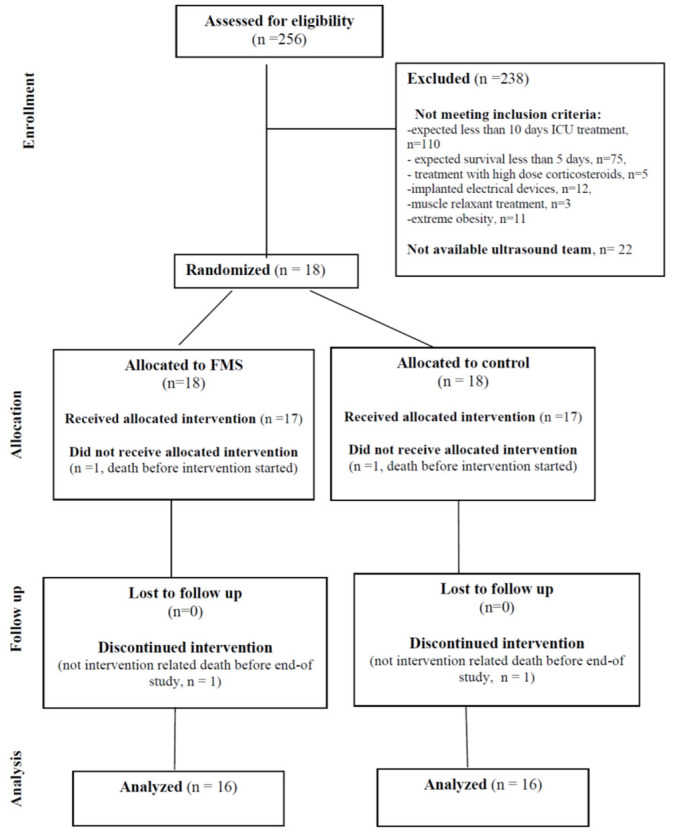
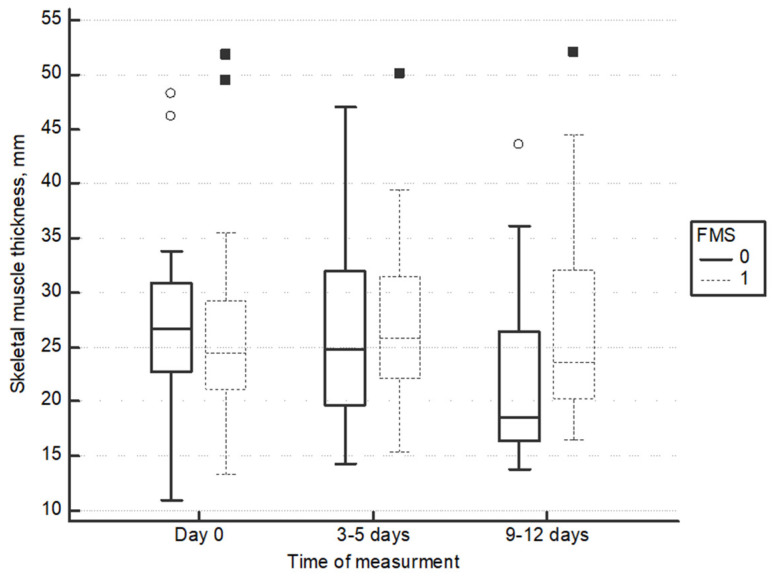
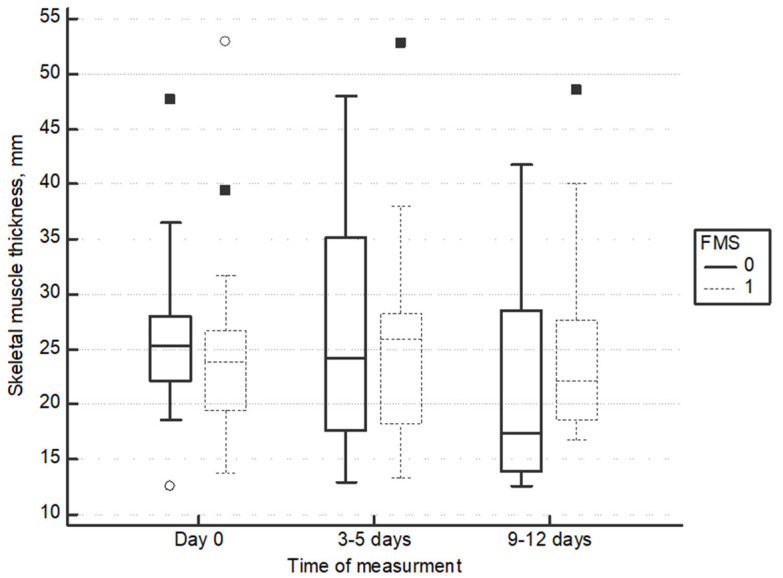
: Muscle loss is a known complication of ICU admission. The aim of the study was to investigate the effect of neuromuscular functional magnetic stimulation (FMS) on quadriceps muscle thickness in critically ill patients. : Among ICU patients one quadriceps was randomized to FMS (Tesla Stym, Iskra Medical, Ljubljana, Slovenia) stimulation and the other to control care. Quadriceps thickness was measured by ultrasound (US) in transversal and longitudinal planes at enrolment, Days 3-5, and Days 9-12. The trial stopped early following an interim analysis comparing muscle thickness differences between groups using repeated measures ANOVA. : Of 18 patients randomized, 2 died before completing the trial. The final analysis reported included 16 patients (female 38%, age 68 ± 10 years, SOFA 10.8 ± 2.7). Three mild skin thermal injuries were noted initially, which were later avoided with proper positioning of FMS probe. Primary outcome comparison showed that quadriceps thickness in transversal and longitudinal planes decreased in the non-stimulated legs and, but it did not change in FMS legs (-4.1 mm (95%CI: -9.4 to -0.6) vs. -0.7 mm (95%CI: -4.1 to -0.7) ( = 0.03) and -4.4 mm (95%CI: -8.9 to -1.1) vs. -1.5 mm (95%CI: -2.6 to -2.2) ( = 0.02), respectively) (ANOVA difference between groups = 0.036 and 0.01, respectively). In the critically ill, neuromuscular FMS is feasible and safe with precautions applied to avoid possible skin thermal injury. FMS decreases the loss of quadriceps muscle thickness.
肌肉减少是 ICU 入住的已知并发症。本研究旨在探讨神经肌肉功能磁刺激(FMS)对危重症患者股四头肌厚度的影响。
在 ICU 患者中,一侧股四头肌随机接受 FMS(Tesla Stym,Iskra Medical,卢布尔雅那,斯洛文尼亚)刺激,另一侧接受对照护理。在入组时、第 3-5 天和第 9-12 天,通过超声(US)在横切和纵切平面测量股四头肌厚度。在使用重复测量 ANOVA 比较组间肌肉厚度差异的中期分析后,试验提前停止。
在 18 名随机分组的患者中,有 2 名在完成试验前死亡。最终分析报告包括 16 名患者(女性 38%,年龄 68 ± 10 岁,SOFA 10.8 ± 2.7)。最初注意到 3 例轻度皮肤热损伤,后来通过正确放置 FMS 探头避免了这种损伤。主要结局比较显示,未刺激侧股四头肌厚度在横切和纵切平面均减少,而 FMS 侧股四头肌厚度不变(-4.1mm(95%CI:-9.4 至-0.6)比-0.7mm(95%CI:-4.1 至-0.7)( = 0.03)和-4.4mm(95%CI:-8.9 至-1.1)比-1.5mm(95%CI:-2.6 至-2.2)( = 0.02)(ANOVA 组间差异分别为 0.036 和 0.01)。在危重症患者中,神经肌肉 FMS 是可行和安全的,应用预防措施可避免可能的皮肤热损伤。FMS 可减少股四头肌厚度的丢失。