Srivastava Ankita, Renna Heather A, Johnson Maryann, Sheehan Katie, Ahmed Saba, Palaia Thomas, Pinkhasov Aaron, Gomolin Irving H, Wisniewski Thomas, De Leon Joshua, Reiss Allison B
Department Foundations of Medicine, NYU Grossman Long Island School of Medicine, Mineola, NY 11501, USA.
Department of Medicine, NYU Grossman Long Island School of Medicine, Mineola, NY 11501, USA.
Life (Basel). 2024 Sep 28;14(10):1241. doi: 10.3390/life14101241.
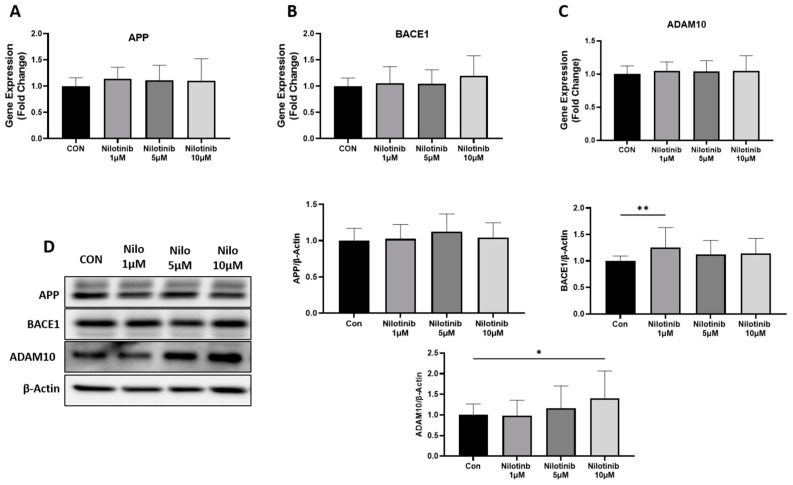
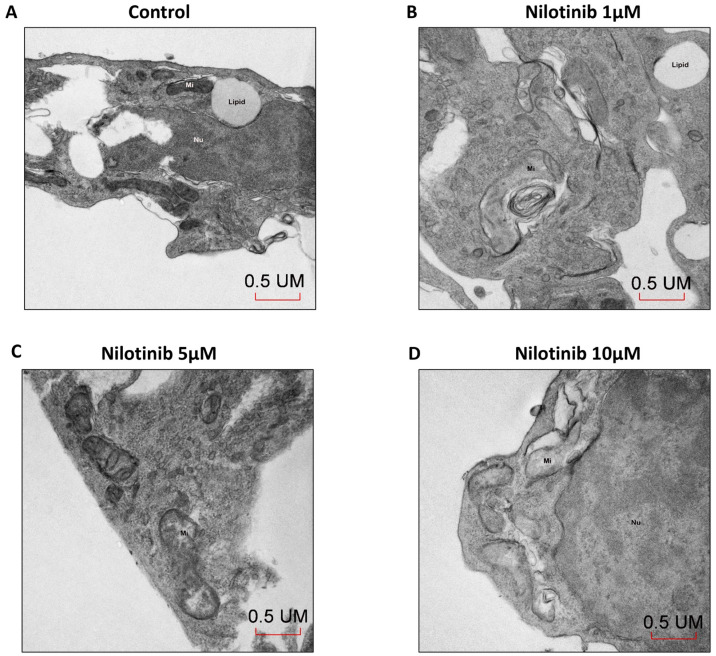
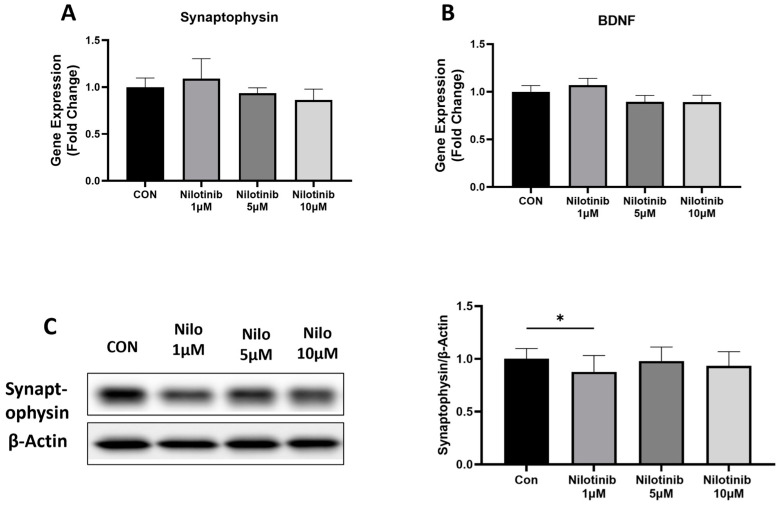
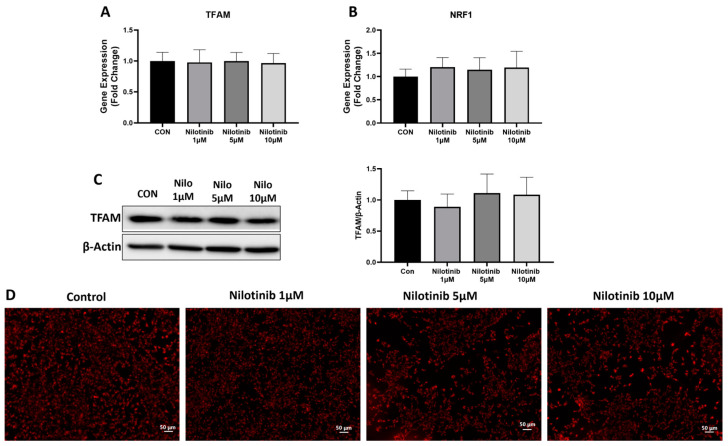
Nilotinib, a tyrosine kinase inhibitor that targets the Abelson tyrosine kinase (c-Abl) signaling pathway, is FDA-approved to treat chronic myeloid leukemia. Nilotinib has properties indicative of a possible utility in neuroprotection that have prompted exploration of repurposing the drug for the treatment of Alzheimer's disease (AD) and Parkinson's disease (PD). AD is a progressive age-related neurodegenerative disorder characterized by the deposition of extracellular amyloid-β plaques and intracellular neurofibrillary tangles. It is incurable and affects approximately 50 million patients worldwide. Nilotinib reduces c-Abl phosphorylation, amyloid-β levels, and dopaminergic neuron degeneration in preclinical AD models. This study explores the effects of nilotinib on amyloid processing and mitochondrial functioning in the SH-SY5Y human neuroblastoma cell line. SH-SY5Y cells were exposed to nilotinib (1, 5, and 10 µM). Real-time PCR and immunoblot analysis were performed to quantify the expression of genes pertaining to amyloid-β processing and neuronal health. Nilotinib did not significantly change APP, BACE1, or ADAM10 mRNA levels. However, BACE1 protein was significantly increased at 1 µM, and ADAM10 was increased at 10 µM nilotinib without affecting APP protein expression. Further, nilotinib treatment did not affect the expression of genes associated with neuronal health and mitochondrial functioning. Taken together, our findings do not support the efficacy of nilotinib treatment for neuroprotection.
尼罗替尼是一种靶向阿贝尔逊酪氨酸激酶(c-Abl)信号通路的酪氨酸激酶抑制剂,已获美国食品药品监督管理局(FDA)批准用于治疗慢性髓性白血病。尼罗替尼具有一些特性,表明其可能具有神经保护作用,这促使人们探索将该药物重新用于治疗阿尔茨海默病(AD)和帕金森病(PD)。AD是一种与年龄相关的进行性神经退行性疾病,其特征是细胞外淀粉样β蛋白斑块和细胞内神经原纤维缠结的沉积。该病无法治愈,全球约有5000万患者受其影响。在临床前AD模型中,尼罗替尼可降低c-Abl磷酸化、淀粉样β蛋白水平以及多巴胺能神经元变性。本研究探讨了尼罗替尼对SH-SY5Y人神经母细胞瘤细胞系中淀粉样蛋白加工和线粒体功能的影响。将SH-SY5Y细胞暴露于尼罗替尼(1、5和10 μM)。进行实时PCR和免疫印迹分析以量化与淀粉样β蛋白加工和神经元健康相关的基因表达。尼罗替尼并未显著改变APP、BACE1或ADAM10的mRNA水平。然而,在1 μM尼罗替尼处理下,BACE1蛋白显著增加,在10 μM尼罗替尼处理下ADAM10增加,而不影响APP蛋白表达。此外,尼罗替尼处理不影响与神经元健康和线粒体功能相关的基因表达。综上所述,我们的研究结果不支持尼罗替尼治疗具有神经保护作用的疗效。