Savic Gesa Doreen, Torsello Giovanni F, Frisch Anne, Wieners Gero, Fehrenbach Uli, Auer Timo Alexander, Lüdemann Willie Magnus, Gebauer Bernhard, Savic Lynn Jeanette
Department of Radiology, Campus Virchow-Klinikum, Charité-Universitätsmedizin Berlin, Freie Universität Berlin and Humboldt-Universität zu Berlin, Augustenburger Platz 1, 13353 Berlin, Germany.
Department of Diagnostic and Interventional Radiology, Universitätsklinikum Göttingen, 37075 Göttingen, Germany.
Life (Basel). 2024 Oct 5;14(10):1270. doi: 10.3390/life14101270.
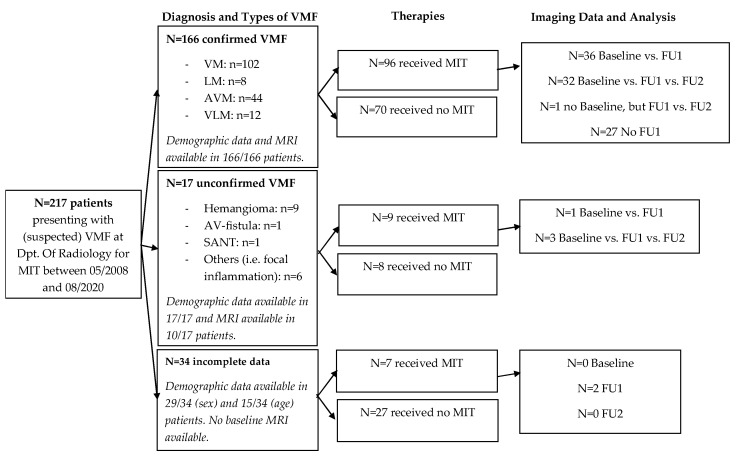
This retrospective study was aimed at characterizing vascular malformations (VMFs) presenting for minimally invasive image-guided therapies (MIT) at a tertiary-care center and evaluating treatment regimens and image-based outcomes using MRI. We analyzed demographic, disease-related, and radiologic features of VMFs presenting to interventional radiology between May 2008 and August 2020 using compendium vascular anomaly (Compva) criteria. MIT and specific agents were evaluated, and treatment effects were assessed through volumetry and mean signal intensity (MSI) on multiparametric longitudinal MRI. The statistics included the paired -test, ANOVA, and Fisher's exact test. The cohort included 217 patients (mean age 30 ± 18.4 years; 134 female). Venous malformations were most common (47%). VMFs were frequently located in the head-neck region (23.5%), legs (23.04%), and arms (13.8%). Among 112 treatments, sclerotherapy was performed most frequently (63.9%), followed by embolization (19.3%). MRI showed a significant reduction in T2 MSI for venous (1107.95 vs. 465.26; = 0.028) and decreased contrast media uptake for lymphatic malformations (557.33 vs. 285.33; = 0.029) after sclerotherapy, while the lesion volumes did not change significantly ( = 0.8). These findings propose MRI-derived MSI as a potential non-invasive biomarker for assessing the response of VMF to MIT. By leveraging MRI, this study addresses challenges in managing rare diseases like VMFs, while advocating for standardized approaches and prospective studies to better link imaging findings with clinical outcomes.
这项回顾性研究旨在对在一家三级医疗中心接受微创影像引导治疗(MIT)的血管畸形(VMF)进行特征描述,并使用磁共振成像(MRI)评估治疗方案和基于影像的治疗效果。我们采用综合血管异常(Compva)标准,分析了2008年5月至2020年8月期间介入放射科收治的VMF的人口统计学、疾病相关和放射学特征。对MIT及特定治疗药物进行了评估,并通过多参数纵向MRI上的体积测量和平均信号强度(MSI)评估治疗效果。统计分析包括配对t检验、方差分析和Fisher精确检验。该队列包括217例患者(平均年龄30±18.4岁;134例女性)。静脉畸形最为常见(47%)。VMF常位于头颈区域(23.5%)、腿部(23.04%)和手臂(13.8%)。在112例治疗中,硬化治疗最为常用(63.9%),其次是栓塞治疗(19.3%)。MRI显示,硬化治疗后,静脉畸形的T2加权MSI显著降低(1107.95对465.26;P = 0.028),淋巴管畸形的造影剂摄取减少(557.33对2E5.33;P = 0.029),而病变体积无显著变化(P = 0.8)。这些发现表明,MRI衍生的MSI可作为评估VMF对MIT反应的潜在非侵入性生物标志物。通过利用MRI,本研究解决了VMF等罕见病管理中的挑战,同时倡导采用标准化方法和前瞻性研究,以更好地将影像学结果与临床结局联系起来。