Goessinger Bea, Greisenegger Stefan, Kastl Stefan, Rosenhek Raphael, Serles Wolfgang, Hengstenberg Christian, Gabriel Harald, Schrutka Lore
Division of Cardiology, Department of Internal Medicine II, Medical University of Vienna, Vienna, Austria.
Department of Neurology, Medical University of Vienna, Vienna, Austria.
Int J Stroke. 2025 Apr;20(4):450-460. doi: 10.1177/17474930241298778. Epub 2024 Nov 20.
Patent foramen ovale (PFO) closure is recommended for secondary prevention of cryptogenic stroke. However, data on long-term results are limited. We aimed to evaluate safety and efficacy of transcatheter PFO closure and predict neurologic recurrence.
Data from patients undergoing PFO closure between 2010 and 2015 were collected to assess the combined endpoint of transient ischemic attack (TIA), stroke, or death from stroke at short- and long-term follow-up.
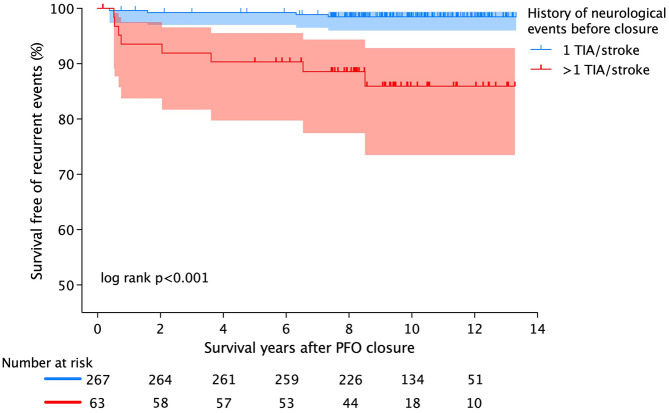
330 patients were included, mean age was 49 (±12) years, and 55.5% were male. Before PFO closure, 86% experienced a stroke and 19% multiple neurological events. Procedure-related complications occurred in 2.4% of patients. Over a median follow-up of 10 years, the combined endpoint occurred in 3.6%, with a recurrence rate of 0.38 per 100 patient-years. Freedom from the combined endpoint at 5 and 10 years was 97.5% and 96.2%, respectively. New-onset atrial fibrillation was detected in 3%. The Risk of Paradoxical Embolism (RoPE) score (adjHR: 0.68; = 0.032), the PFO-Associated Stroke Causal Likelihood (PASCAL) classification system (adjHR: 0.37; = 0.042), and a history of prior neurological events (adjHR: 9.94; < 0.001) were independent predictors of future recurrent neurologic events. Age, sex, and cardiovascular risk factors did not influence outcomes.
In this real-world cohort, transcatheter PFO closure was associated with low long-term recurrence of neurologic events, especially cryptogenic strokes. The RoPE score, the PASCAL score, and history of previous neurological events were predictive of recurrent events. This study supports the safety and efficacy of PFO closure for secondary prevention of cryptogenic strokes, and underscores the importance of patient selection.
卵圆孔未闭(PFO)封堵术被推荐用于隐源性卒中的二级预防。然而,关于长期结果的数据有限。我们旨在评估经导管PFO封堵术的安全性和有效性,并预测神经复发情况。
收集2010年至2015年间接受PFO封堵术患者的数据,以评估短期和长期随访时短暂性脑缺血发作(TIA)、卒中或卒中死亡的复合终点。
纳入330例患者,平均年龄为49(±12)岁,55.5%为男性。在PFO封堵术前,86%的患者发生过卒中,19%发生过多次神经事件。2.4%的患者发生了与手术相关的并发症。在中位随访10年期间,复合终点的发生率为3.6%,复发率为每100患者年0.38例。5年和10年时无复合终点的生存率分别为97.5%和96.2%。3%的患者检测到新发房颤。矛盾栓塞风险(RoPE)评分(调整后风险比:0.68;P = 0.032)、PFO相关卒中因果可能性(PASCAL)分类系统(调整后风险比:0.37;P = 0.042)以及既往神经事件史(调整后风险比:9.94;P < 0.001)是未来神经复发事件的独立预测因素。年龄、性别和心血管危险因素不影响预后。
在这个真实世界队列中,经导管PFO封堵术与神经事件尤其是隐源性卒中的低长期复发率相关。RoPE评分、PASCAL评分和既往神经事件史可预测复发事件。本研究支持PFO封堵术用于隐源性卒中二级预防的安全性和有效性,并强调了患者选择的重要性。